If you’ve ever felt like Nepal’s electric vehicle market lacked a sense of true luxury, you're not alone. Until now, most EV options on our roads have been either budget compacts or practical mid-range models. But this week, something entirely new has entered the scene, something bold, beautiful, and built for those who want more than just eco-friendliness in their ride.
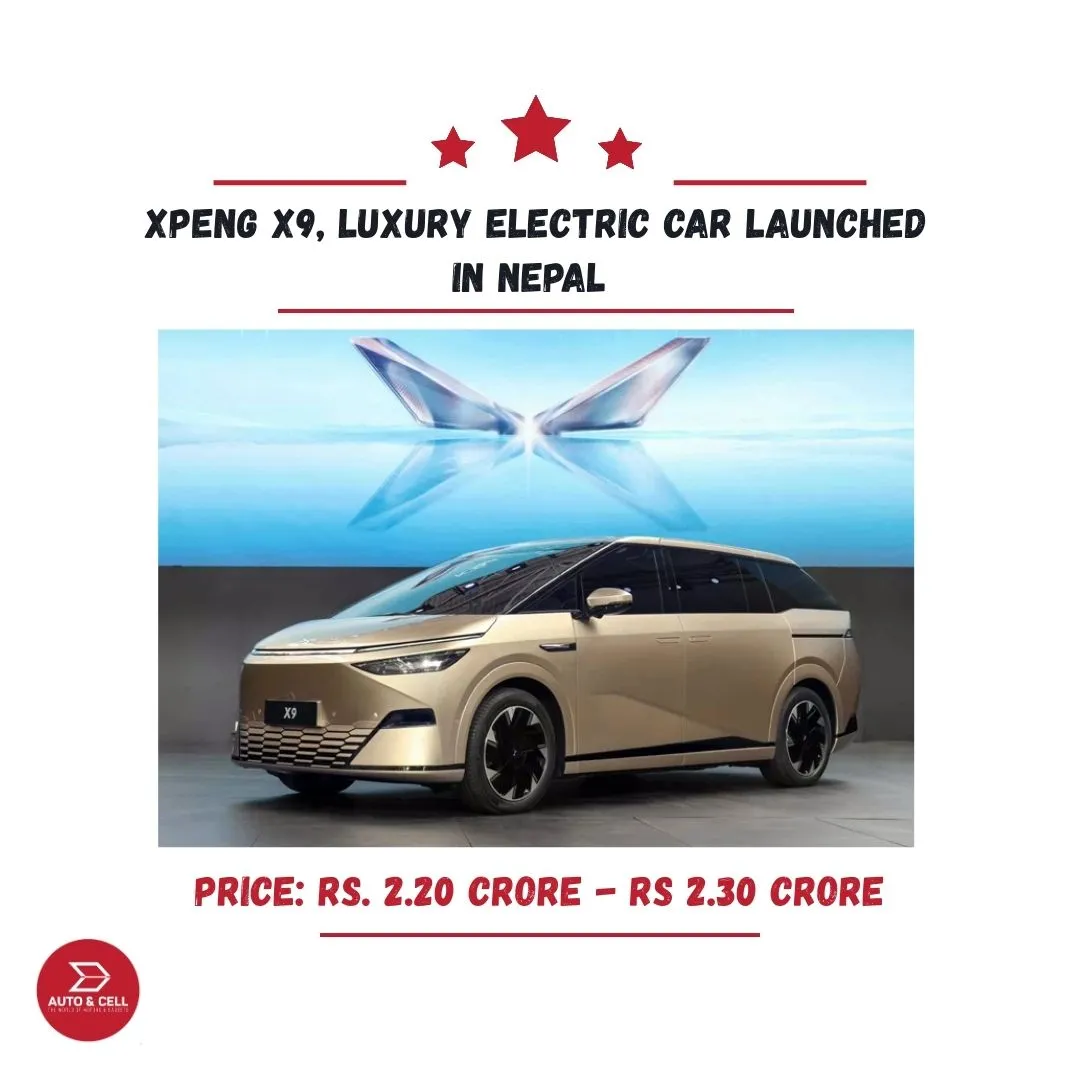
Meet the Xpeng X9, officially launched by CG Motors at the NADA Auto Show 2025. This all-electric MPV isn't just another addition to the EV lineup. It's a turning point, a declaration that Nepal is ready for the big leagues in electric mobility. With pricing that starts at Rs. 2.20 crore and stretches to Rs. 2.30 crore, the X9 is aimed squarely at buyers who value space, tech, performance, and yes, presence.
Design
Let’s start with its look, because the Xpeng X9 is impossible to ignore. It stretches over 5.2 meters in length, making it one of the largest passenger EVs you’ll find on the streets of Kathmandu. But it doesn’t feel like a bulky van. Instead, it wears a sleek, futuristic design that plays with aerodynamics and elegant proportions.
Its 0.236 drag coefficient is a technical way of saying it cuts through air more efficiently than most other MPVs, and it shows. Whether you’re gliding down city roads or cruising on highways, the vehicle feels smooth, stable, and planted.
Inside, it’s clearly built for seven, but not in a cramped, third-row way. With a 3,160 mm wheelbase, the X9 provides serious cabin space. And thanks to its flat EV platform, there’s more headroom, more legroom, and just more room, period. There’s even 755 liters of trunk space, and if you fold the back row, you’ll open up a cargo-hauling beast.
Performance
One of the biggest surprises of the Xpeng X9 is that it doesn’t drive like a van at all. It’s powered by a 235 kW front-wheel drive electric motor, delivering a strong 450 Nm of torque. That’s the kind of torque you’d expect from a performance sedan, not a family MPV.
Put your foot down, and you’ll feel it. The X9 goes from 0 to 100 km/h in just 7.7 seconds, which is a thrill for any driver and unheard of in this vehicle class. And with a top speed of 200 km/h, you’re never left behind, even on open highways.
Despite weighing in at 2,555 kg, it doesn’t feel sluggish. Instead, it offers a composed, almost silent driving experience, backed by instant torque and zero emissions.
Battery Range
Let’s talk range, because that’s where most luxury EVs lose their practicality. Not the X9. It comes with an 84.5 kWh lithium iron phosphate (LFP) battery, offering a WLTP-certified range of 500 km.
For most drivers in Nepal, that means charging just once a week, even if you’re commuting daily or taking the occasional weekend trip. The energy consumption rate of 16.2 kWh/100 km makes it highly efficient given its size.
This is important because while EV charging stations are growing in number, you still want that peace of mind when planning longer trips across the country.
Interior
Inside the X9, it’s less of a vehicle and more of a lounge on wheels. Everything has been carefully curated, from the material quality to the layout and the immersive digital setup.
You get dual displays, one for the central infotainment and another for the passenger side , giving both driver and front passenger full access to media, navigation, and vehicle settings. The UI feels fast, responsive, and modern, with easy integration for mobile devices and apps.
There’s ample storage throughout the cabin, premium seating materials, ambient lighting, and more. The attention to detail is what truly sets the X9 apart. It doesn’t just transport you , it cocoon you in comfort while doing it.
Next-Level Intelligence with XPILOT 2.5
Now here’s where the Xpeng X9 really starts feeling like the future. The vehicle is equipped with XPILOT 2.5, Xpeng’s advanced driver assistance system (ADAS), and it’s a class above anything currently available in Nepal.
At the core is NVIDIA DRIVE Orin, a computing platform that powers some of the world’s most advanced autonomous systems. The X9’s sensor suite includes cameras, ultrasonic sensors, millimeter-wave radar, and a high-precision positioning unit, all working together to deliver:
-
Adaptive Cruise Control
-
Lane Centering and Speed Assistance
-
Autonomous Emergency Braking
-
Driver State Monitoring
-
Traffic Sign Recognition
-
Intelligent High Beam Adjustments
It’s like having an extra set of eyes, ears, and a brain that helps prevent accidents and reduce driver fatigue. And on Nepali roads, where unpredictability is the norm, that’s not a luxury, it’s a necessity.
Quick Spec Recap
|
Category |
Details |
|
Powertrain |
235 kW (FWD) Electric Motor |
|
Torque |
450 Nm |
|
Acceleration (0–100 km/h) |
7.7 seconds |
|
Top Speed |
200 km/h |
|
Battery Capacity |
84.5 kWh LFP |
|
Range (WLTP) |
500 km |
|
Energy Consumption |
16.2 kWh/100 km |
|
Dimensions (L×W×H) |
5,293 × 1,988 × 1,785 mm |
|
Seating Capacity |
7 |
|
Trunk Space |
755 liters (expandable) |
|
ADAS System |
XPILOT 2.5 (NVIDIA DRIVE Orin) |
Conclusion
If you’re a large family who values safety, comfort, and tech, or a business leader looking for an executive people mover that’s sustainable and future-ready, the Xpeng X9 is worth serious consideration. It may carry a premium price tag, but it justifies every rupee with design, power, and intelligent features that are way ahead of the curve. This isn’t just Nepal catching up, it’s Nepal leading the way in premium electric mobility.
-original.webp)
-original.webp)
-original.webp)