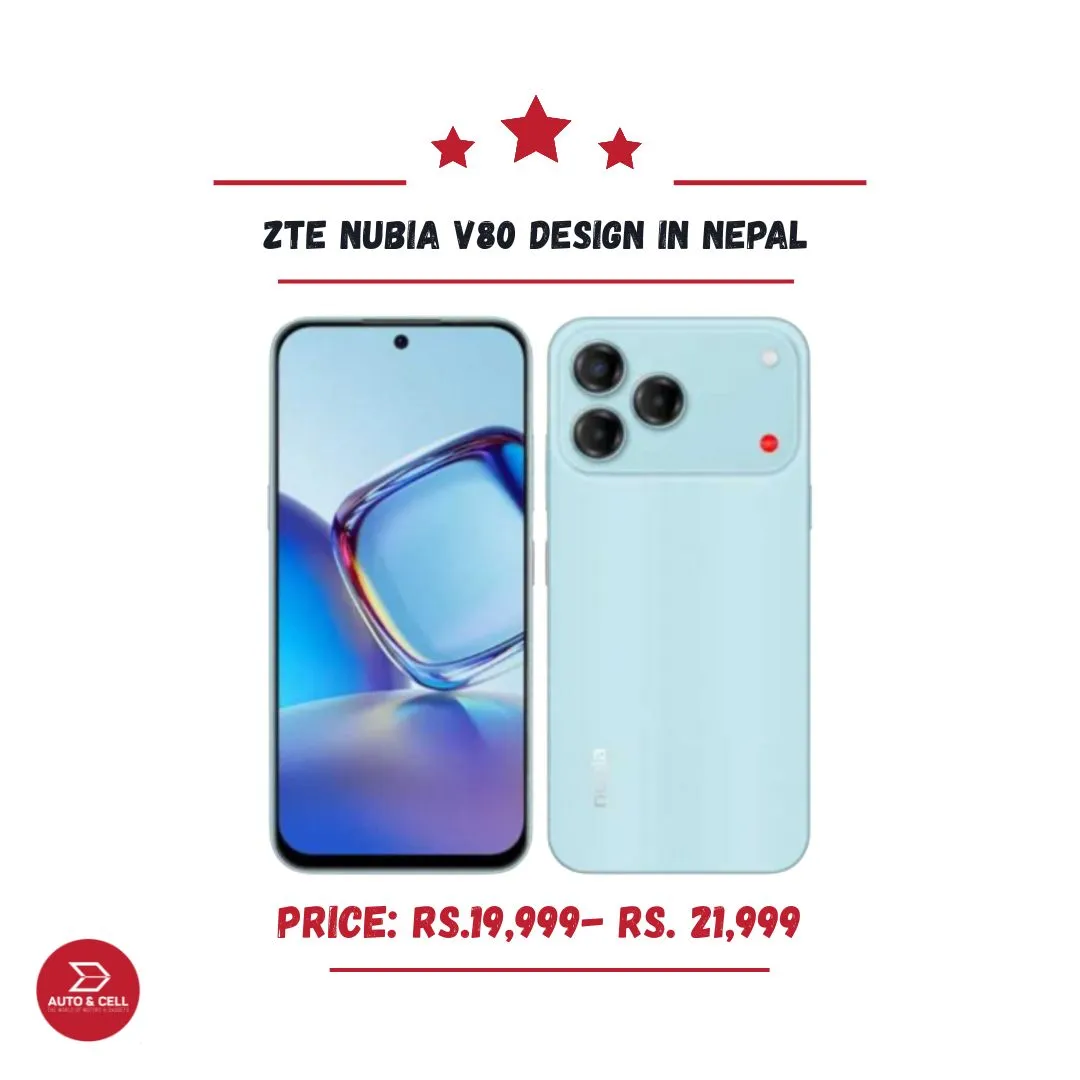
ZTE seems to be back on track in 2025, and this time, with sharper focus. After a lukewarm performance by the Nubia V70 Design, the company is making a stronger case with its new mid-range contender: the ZTE Nubia V80 Design. The phone has officially launched in Nepal with subtle but meaningful upgrades across the board, design, display, performance, and even software.
With this price, ZTE is clearly trying to hit the sweet spot in the under-25K smartphone segment, a space increasingly dominated by aggressive brands like Infinix, Motorola, and HMD. But can the V80 Design finally give ZTE the comeback story it needs in Nepal’s competitive mid-range market? Let’s explore.
Design
ZTE has never been shy about drawing design inspiration from the industry's premium flagships, and the Nubia V80 Design carries on this trend , perhaps more boldly than ever. The rear camera module is unmistakably “iPhone-esque” with its squircle bump and flash placement mimicking Apple’s iPhone 17 Pro.
However, make no mistake, this is still a budget device through and through. The plastic back and frame might lack the premium touch, but they help keep the phone lightweight at 191g while allowing ZTE to focus more on internal upgrades.
The phone also brings IP64 dust and water resistance, a rare sight in this segment, giving it a solid edge in terms of durability for everyday users in Nepal’s dusty or humid environments.
Display
ZTE equips the V80 Design with a 6.75-inch LCD panel boasting a 120Hz refresh rate. Though the resolution is not technically Full HD (900 x 1940 pixels), the panel is bright enough for most conditions, thanks to 1000 nits peak brightness (HBM).
For budget-conscious consumers, a high-refresh-rate screen makes a noticeable difference , smoother scrolling, better gaming, and more fluid UI animations. The punch-hole camera cutout keeps the look modern, housing a 13MP selfie shooter that should be sufficient for casual social media use and video calls.
Performance
Performance has often been a tricky balancing act for ZTE’s mid-range devices. With the V80 Design, we see a meaningful improvement. It’s powered by the UNISOC T7280 (12nm) processor, which, while not a chart-topper, is certainly a notch above what the V70 offered.
Paired with 8GB of RAM and storage options of 128GB or 256GB, the phone supports microSD expansion, something not every competitor retains these days. This makes the device a practical pick for users who rely on local media, offline videos, or bulk app installations.
Of course, the chipset still lags behind competitors like the Helio G200 in the Infinix Hot 60 Pro or the Snapdragon 695 in the HMD Crest, but for day-to-day usage, the T7280 should get the job done without many hiccups.
Camera
From a distance, the triple-camera setup might raise expectations, but the reality is far more grounded. The main 50MP shooter is the only real performer here, supported by a 2MP depth sensor that barely contributes. The third “lens” is just for design symmetry.
Marketing it as an “AI Camera” might make sense on paper, but in real-world use, this is still a single-camera experience. That said, for its price bracket, the 50MP sensor should offer reasonable image quality in good lighting.
On the front, the 13MP selfie camera is placed inside the punch-hole and seems decent for selfies and casual video chats. Don’t expect flagship-like sharpness or dynamic range, but it won’t disappoint the average user.
Battery & Charging
ZTE hasn’t changed much on the battery front. The Nubia V80 Design houses a 5,000mAh non-removable cell, the same capacity as the V70 Design. However, what stands out is the 22.5W wired fast charging, paired with bypass charging support , a feature that allows the phone to run directly on power during heavy usage (like gaming or video streaming) without heating up the battery.
This is a thoughtful touch. In long-term use, bypass charging can significantly extend battery lifespan and reduce thermal throttling during performance-heavy tasks.
Software
Here’s where ZTE genuinely redeems itself, software. Unlike last year’s V70 Design, which arrived with an outdated version of Android, the V80 Design debuts with Android 16 out of the box, overlaid with MyOS 16.
This puts the phone on par with 2025’s software expectations and ensures compatibility with the latest security updates and apps. It’s also a clear signal that ZTE is listening to feedback and is serious about reclaiming user trust.
Price in Nepal
-
8/128GB: Rs. 19,999
-
8/256GB: Rs. 21,999
ZTE is also offering a 0% EMI option, making the V80 Design an attractive buy for young professionals and students who might not want to spend all at once.
However, the Rs. 3,000 price bump from the V70 Design puts it in a tricky spot. At this price range, options like the Infinix Hot 60 Pro (1.5K AMOLED, Helio G200) or Moto G35 (ultra-wide camera, clean Android experience) start to look more compelling, especially for users who value performance or camera versatility.
Conclusion
The ZTE Nubia V80 Design is a well-calibrated update. It addresses many of the criticisms faced by its predecessor: improved performance, fresher design, better software, and smart battery features. The inclusion of IP64, bypass charging, and Android 16 are all rare and commendable additions at this price.
Yet, ZTE still walks a thin line. In a hyper-competitive mid-range market in Nepal, every rupee matters. While the V80 Design ticks several boxes, it needs to convince buyers that it’s more than just a stylish phone with average internals.
For those seeking a dependable 4G device under 22K with modern design and decent specs, this might just be the surprise hit of the season. But for performance junkies or camera-centric users, alternatives are still more appealing.
If ZTE continues this upward trajectory, and maybe throws in a 5G chip next year, the Nubia line might just become relevant again in Nepal’s tech landscape.
-original.webp)
-original.webp)

-original.webp)