-original.webp)
When Tata Motors pulled the covers off the Harrier EV in mid-2024, it was clear this wasn’t just another electric conversion added to the portfolio. This was a statement. A signal that Tata’s EV journey had moved beyond affordability and experimentation, and into the territory of confidence, scale, and maturity. Indian buyers responded quickly. With over 5,000 units sold in a relatively short span, the Harrier EV has proven that there is real appetite for a premium, Indian-built electric SUV that does not feel like a compromise.
Naturally, that success has sparked interest beyond India, especially in Nepal, where Tata already enjoys strong brand trust through Sipradi Trading. Yet, despite the buzz, the Nepal launch remains unconfirmed. Tata has been careful with its words, prioritizing other products for now. Still, if trends, market logic, and regional strategy are anything to go by, 2026 feels like a realistic and optimistic window.
Until then, the Harrier EV stands as an important reference point. Not just for what it is, but for what it represents for Tata’s electric ambitions in South Asia.
Expected Price in Nepal and Launch
As of now, Tata has not confirmed pricing or launch timelines for Nepal. Based on Indian pricing, which starts at INR 21.49 lakhs, and factoring in taxes and duties, the Tata Harrier EV price in Nepal is expected to hover around Rs. 70 lakhs. This figure remains speculative and will ultimately depend on variant selection and Sipradi Trading’s strategy.
What is clearer is that the Harrier EV is not an immediate priority for Tata Nepal. With several ICE launches lined up, the electric flagship may have to wait. Still, a 2026 launch feels more likely than not.
There is also reason for cautious optimism and tempered expectations. Historically, Nepal-bound EVs often arrive with reduced motor outputs or limited variant choices. The AWD version, in particular, may not make the cut. Nothing is confirmed yet, but past patterns suggest buyers should be prepared for a slightly toned-down offering.
Also read the Price of Suzuki Victoris in Nepal
Design
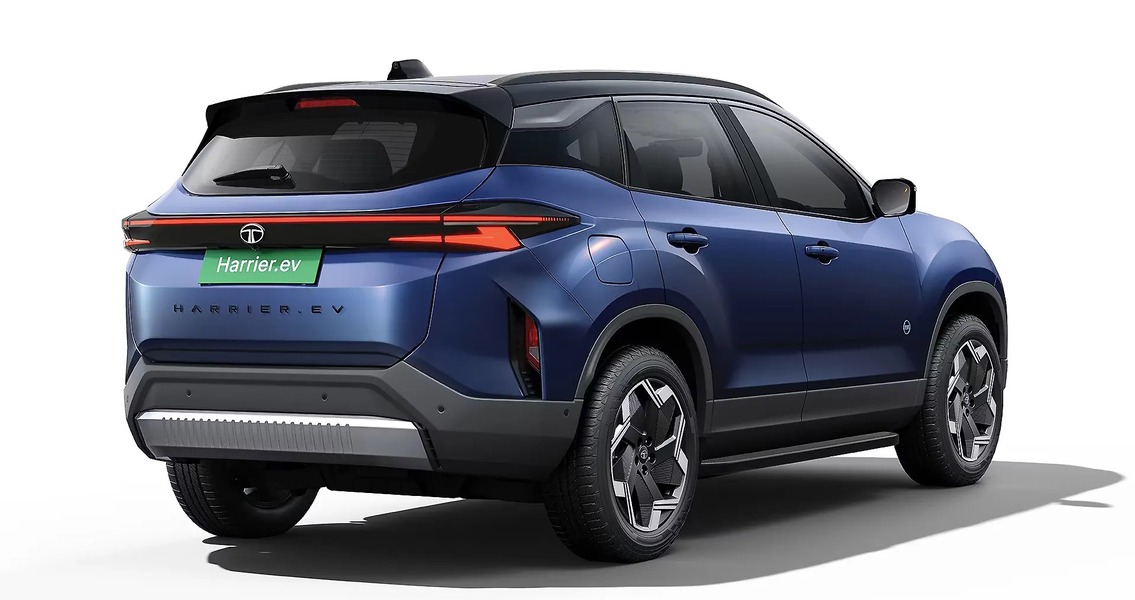
One of the Harrier EV’s biggest advantages is familiarity. Tata did not reinvent the Harrier’s identity, and that decision works in its favor. The upright stance, muscular proportions, and commanding road presence remain intact. What changes is the detailing, and those changes are deliberate.
At the front, the traditional grille gives way to a clean, blanked-off surface that immediately signals its electric nature. Full-width LED DRLs stretch across the nose, while vertically stacked LED bi-projector headlights sit lower on the bumper. Vertical chrome slats and a satin silver skid plate add a sense of toughness, ensuring the Harrier EV still looks every bit like an SUV, not a softened crossover.
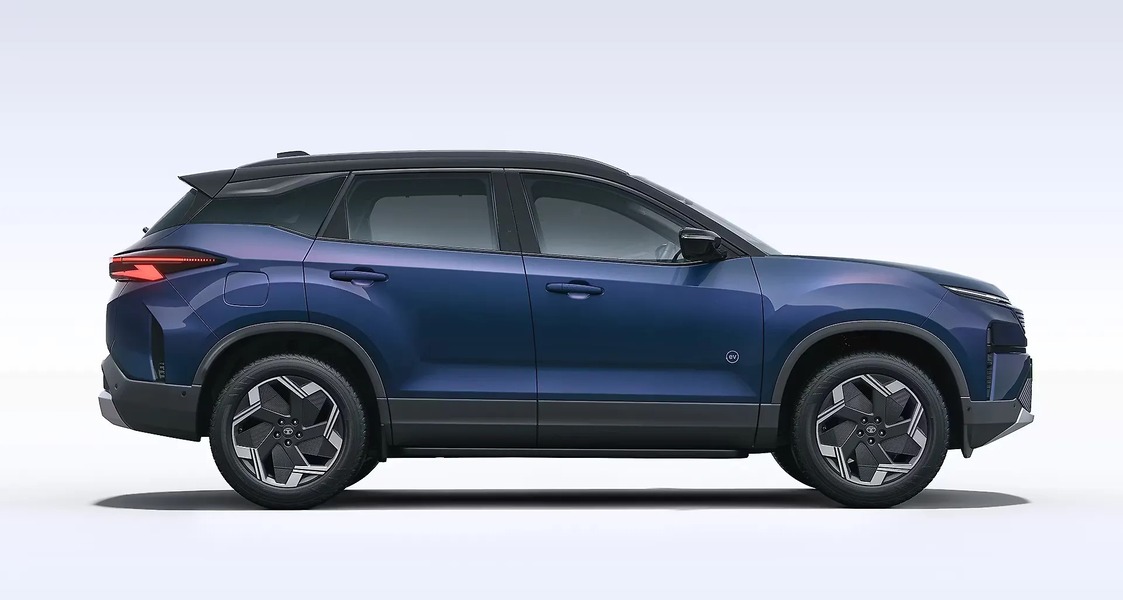
From the side, the 19-inch turbine-style alloy wheels deserve special mention. They are not just visually striking but also designed with aerodynamics in mind. The ground clearance remains a healthy 205 mm, reinforcing its SUV credentials, while the wheelbase stays unchanged at 2741 mm, matching the ICE Harrier.
At the rear, the design feels modern and cohesive. A full-width LED light bar connects sharp tail lamps, while chunky cladding and a thick skid plate complete the look. The powered tailgate adds convenience, though the boot capacity, at 502 liters, is more decent than class-leading.
Color options such as Nainital Nocturne and Empowered Oxide further enhance the Harrier EV’s premium appeal, giving buyers a mix of elegance and boldness.
Interior
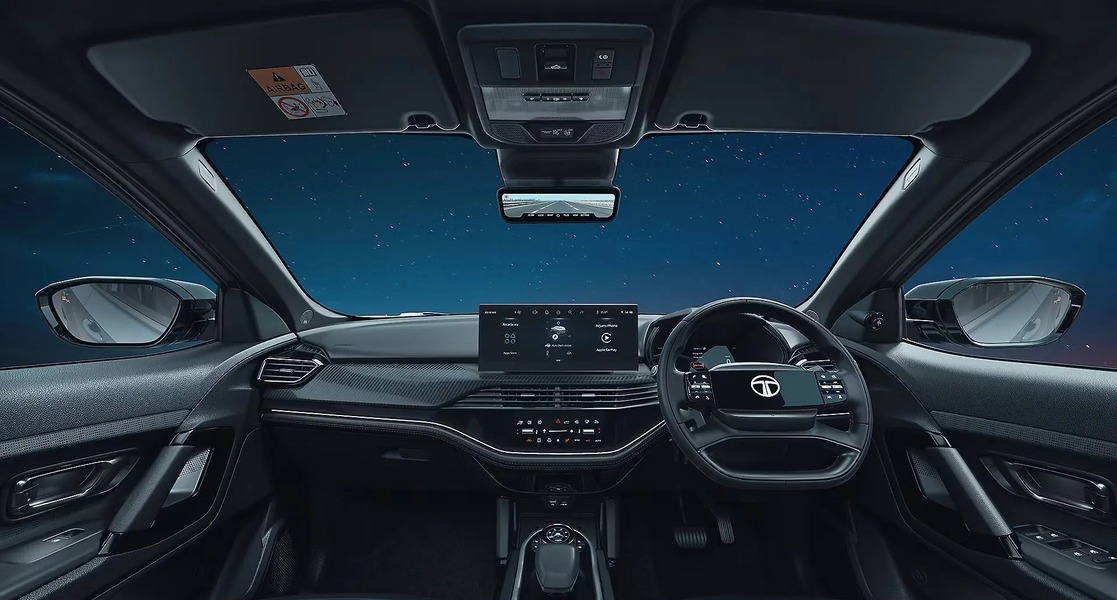
Step inside the Harrier EV, and it becomes evident that Tata wants this cabin to feel like a generational leap. The layout closely mirrors the ICE Harrier, but the execution feels more refined and technology-driven.
The dual-tone leatherette upholstery immediately sets an upmarket tone. Space is generous, both in the front and rear, and Tata has gone all-in on comfort features. Front seats are powered, ventilated, and heated, while rear passengers benefit from a dedicated Boss Mode, reinforcing the Harrier EV’s positioning as a comfortable long-distance cruiser.
The dashboard is dominated by a massive 14.5-inch Samsung-sourced QLED touchscreen, paired with a 10.25-inch digital instrument cluster. The display quality is genuinely impressive, offering sharp visuals and a modern interface that finally puts Tata on par with global competitors. That said, the heavy reliance on touch controls has drawn some criticism, with early users reporting occasional software glitches and accidental inputs.
Feature highlights include a panoramic sunroof, dual-zone climate control, wireless phone charging, fast-charging USB ports, a cooled glovebox, a digital IRVM, and a powerful 10-speaker JBL sound system. Overall, this is easily one of the most tech-laden cabins Tata has ever produced.
Performance and Powertrain
The Harrier EV is built on Tata’s acti.ev platform, and this is where the SUV genuinely impresses. The platform has already proven itself in smaller models like the Punch EV and Nexon K3.ev, but the Harrier EV tests it at a much larger and more demanding scale. The results are convincing.
Buyers can choose between two battery packs: 65 kWh and 75 kWh. The 65 kWh version is offered exclusively with a rear-wheel-drive setup, producing 238 PS and 315 Nm of torque. Under the C75 test cycle, it delivers a real-world-oriented range of around 420 to 445 km.
The 75 kWh variant expands the options. In RWD form, it retains the same motor output but stretches the C75 range to around 480 to 505 km. MIDC figures go as high as 627 km, though real-world expectations should remain grounded.
The real headline, however, is the AWD variant. This is the first all-wheel-drive electric SUV from an Indian manufacturer. With a dual-motor setup producing a combined 317 PS and 504 Nm, the Harrier EV AWD accelerates from 0 to 100 km/h in just 6.3 seconds. It also introduces six terrain modes, including Rock Crawl and Sand, along with adjustable regenerative braking and even a dedicated Drift mode.
Charging is equally competitive. Using a 7.2 kW AC charger, the 65 kWh battery takes about 10 hours to fully charge, while the 75 kWh pack needs around 11.5 hours. DC fast charging allows both variants to charge from 20% to 80% in roughly 25 minutes, with the larger battery supporting up to 125 kW.
Tata Harrier EV Specifications
Category | Details |
Electric Motor Setup | Single 175 kW PMS motor for Rear-Wheel Drive; Dual-motor configuration with 175 kW rear and 115 kW front motor for All-Wheel Drive |
Drivetrain Options | Rear-Wheel Drive (RWD) and All-Wheel Drive (AWD) |
Maximum Power Output | 238 PS for RWD variants; up to 317 PS for AWD variant |
Peak Torque | 315 Nm (RWD); 504 Nm (AWD) |
Battery Technology | Lithium Iron Phosphate (LFP) |
Battery Capacity Choices | 65 kWh (RWD only); 75 kWh (RWD and AWD) |
Claimed Driving Range | 65 kWh RWD: approx. 420–445 km (C75), up to 538 km (MIDC); 75 kWh RWD: around 480–505 km (C75), up to 627 km (MIDC); 75 kWh AWD: roughly 460–490 km (C75), up to 622 km (MIDC) |
AC Charging (7.2 kW) | Around 10 hours for full charge (65 kWh); approx. 11 hours 30 minutes (75 kWh) |
DC Fast Charging | 20–100% in about 25 minutes; supports up to 100 kW (65 kWh) and up to 120–125 kW (75 kWh) |
Transmission Type | Single-speed automatic |
Vehicle Dimensions (L×W×H) | 4607 mm × 2132 mm × 1740 mm |
Wheelbase | 2741 mm |
Ground Clearance | Approx. 205 mm |
Suspension Setup | McPherson strut at the front; multi-link rear with frequency-dependent dampers |
Tyre Specification | 245/55 R19 tubeless tyres |
Seating Capacity | Five occupants |
Luggage Space | 502-liter rear boot with an additional 67-liter front trunk |
Kerb Weight | Approximately 2235 kg to 2335 kg depending on variant |
Safety & Driver Assistance | 5-Star B-NCAP rating, six airbags, ADAS suite, electronic stability control, hill assist, and 360-degree camera with transparent view |
Exterior Color Options | Nainital Nocturne, Pure Grey, Pristine White, Empowered Oxide |
Ride, Handling, and Practicality
Suspension duties are handled by a McPherson strut setup at the front and a multi-link arrangement at the rear, complemented by frequency-dependent dampers. This configuration balances comfort and control well, making the Harrier EV suitable for both highway cruising and rougher terrain.
Despite its size and weight, which ranges between 2235 kg and 2335 kg, the Harrier EV remains composed on the road. The steering feels stable at speed, and the low center of gravity from the battery pack helps manage body roll.
Practicality is further enhanced by a 67-liter frunk, adding useful storage space that many rivals still lack.
Safety and Technology
Safety has clearly been a priority. The Harrier EV carries a 5-star B-NCAP rating and comes equipped with six airbags, electronic stability control, hill assist, and a comprehensive ADAS suite. A 360-degree camera with transparent mode improves visibility in tight spaces, while features like Summon Mode and Auto Park Assist push the Harrier EV firmly into modern EV territory.
Additional capabilities such as Vehicle-to-Load and Vehicle-to-Vehicle charging further expand its usefulness, especially in markets where power reliability can be inconsistent.
Rivals: A Brewing Indian EV Rivalry
When it does arrive, the Harrier EV will most directly challenge the Mahindra XEV 9e. While Mahindra deserves credit for developing its EV from the ground up, the Harrier EV holds an edge in performance, thanks to its AWD system and terrain-focused capabilities.
Tata’s larger, sharper infotainment display and features like transparent camera mode and digital IRVM also give it a technological advantage. That said, the XEV 9e’s futuristic design and driver-focused layout ensure this rivalry will be closely contested.
Conclusion
The Tata Harrier EV feels like the product Tata has been building toward for years. It blends familiarity with innovation, strength with sophistication, and performance with practicality. Its strong sales in India suggest Tata has struck the right balance.
For Nepal, the waiting continues. Whether the Harrier EV arrives slightly late or perfectly timed remains to be seen. But if Tata manages to bring it with minimal compromises, it has the potential to redefine expectations in the midsize electric SUV segment.
The only real question is this: will Tata seize the moment, or will the market move on before the Harrier EV gets its chance?