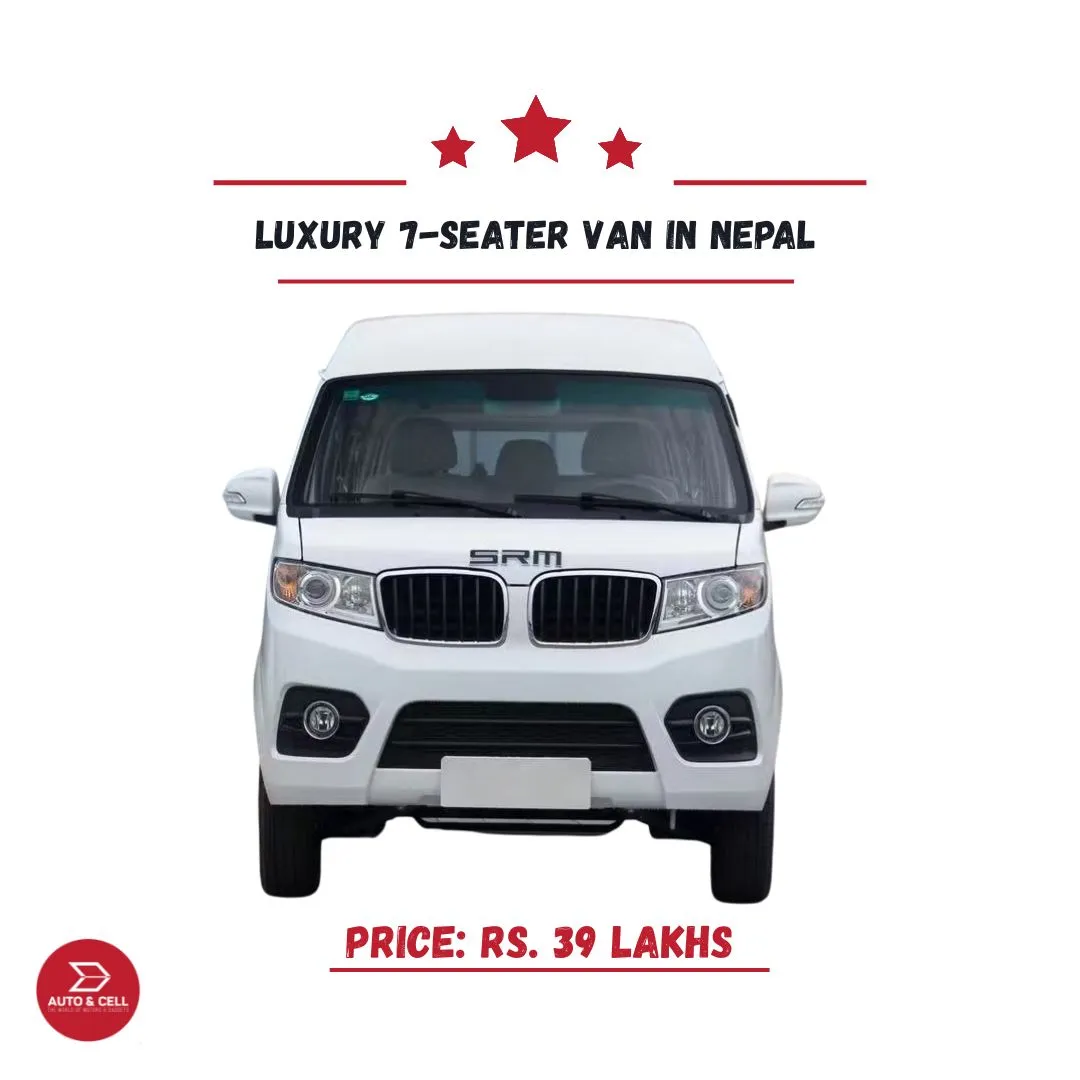
Nepal's electric vehicle market has spent years asking one question nobody could quite answer: where is the electric van for families and tourism operators who want something better than a school microbus but cannot justify spending a crore on an imported SUV? The SRM X30L 7-Seater Luxury Van answers that question. Starting at Rs. 39 lakhs, it delivers premium leather seats, Hill Assist Control, three driving modes, and a 300 km range, in a fully electric package that costs less to run in a week than a diesel van does in a day.
Distributed in Nepal by Pooja Construction Nepal Pvt. Ltd. under VG Motors, the authorized importer and exclusive distributor for SRM and Joylong vehicles, the 7-Seater was formally unveiled at Soaltee Hotel, Kathmandu, in late 2025. The launch made a deliberate statement: this van belongs in the same conversation as premium MPVs, not beside budget microbuses.
Price in Nepal
The SRM X30L 7-Seater Luxury Van is priced between Rs. 39,00,000 and Rs. 42,00,000 in Nepal, depending on variant and configuration. VG Motors' financing options, available without collateral requirements, bring this within reach of individual buyers, tourism operators, and small fleet managers who cannot front the full amount.
Pooja Construction / VG Motors backs the vehicle with 75-plus charging stations across Nepal, 20-plus service touch points nationwide covering all seven provinces, and spare parts priced at approximately 80 percent below competing EV brands. The customer support line runs 24 hours a day, seven days a week.
Design
The SRM X30L 7-Seater is built on the same 4,495 x 1,680 x 1,990 mm body as its 11-seater platform sibling, compact enough for Kathmandu's tighter routes, but tall enough to stand out. The 2,925 mm wheelbase is the key figure here. It is what allows the van to offer genuinely spacious seating for seven passengers without the claustrophobic cabin that plagues shorter-wheelbase MPVs in this price bracket. VG Motors claims 40 percent more interior space compared to conventional alternatives, and with only seven seats spread across that footprint, the per-passenger room is immediately noticeable.
Ground clearance is 180 mm, adequate for Nepal's urban and semi-urban routes. The minimum turning radius of 5.5 metres keeps the van maneuverable through tight spots, hotel driveways, narrow hillside lanes, and busy city intersections included. Alloy wheels wearing 175/70 R14 tyres complete an exterior profile that reads as premium without being ostentatious.
The interior is where the 7-Seater breaks from what buyers expect at this price. Premium leather seats, a digital instrument cluster, a front camera, a rear camera, and a full infotainment system are not features you find bundled together under Rs. 42 lakhs in the Nepali market. A rear boot space and ample cabin room give the van genuine practicality for airport pickups, family road trips, and hotel shuttle operations where luggage is part of the equation.
Performance
The SRM X30L 7-Seater runs a 50 kW electric motor producing 220 Nm of torque through a rear-wheel drive layout. Top speed is 100 km/h, and the van's gradability rating of 25 percent makes it confident on sustained inclines, a minimum requirement for any vehicle taking Nepal's hill routes seriously.
What separates this van from most electric vehicles at this price point is Hill Assist Control. It holds the vehicle stationary on a slope during the transition from brake to accelerator, preventing rollback on steep starts. Anyone who has driven a manual diesel van up a Kathmandu hill will understand exactly why this matters in practice.
The three driving modes, Drive, Eco, and Sports, add genuine flexibility. Eco mode extends range on lighter urban routes. Sports mode sharpens throttle response when the road demands it. Drive sits between the two for everyday use. This kind of driver-selectable tuning is typically found on vehicles costing twice the price, and its presence here signals that the SRM 7-Seater is genuinely attempting to compete on features rather than simply on cost.
Steering is handled by an Electronic Power Steering (EPS) system with a 5.5-metre turning radius. The front suspension uses a Macpherson strut setup for refined handling, while the rear runs a six-leaf spring arrangement tuned for load stability across seven passengers and their luggage. Braking is front disc, rear drum, a reliable and serviceable combination for Nepal's mixed road conditions.
Battery and Charging
The 7-Seater draws power from a 41.86 kWh Lithium Iron Phosphate (LFP) battery manufactured by CATL, the same globally trusted battery brand found in vehicles from premium European and Chinese manufacturers. LFP chemistry is thermally stable, long-cycling, and purpose-suited for the daily charging demands of a family or fleet vehicle.
NEDC-rated range is 300 km on a full charge. Using AC charging, the battery reaches full capacity in 6 hours, a clean overnight charge that costs around Rs. 336 for a 200 km operating day at Rs. 12 per unit. DC fast charging brings the battery from 20 to 80 percent in just 45 minutes, using the GB/T standard. With over 75 GB/T charging stations already deployed across Nepal by VG Motors and Pooja Construction, the infrastructure to support daily use is already in place, not coming soon, already there.
Gross vehicle weight is 2,500 kg, kerb weight sits at 1,500 kg, and the van carries a 1,000 kg payload capacity. The EV's battery is floor-mounted, lowering the centre of gravity and improving stability, a physics advantage that a tall van on winding mountain roads genuinely benefits from.
Key Features
Safety
Anti-lock Braking System (ABS): Prevents wheel lock under hard braking on wet or uneven surfaces
Dual Airbags: Driver and front passenger protection in the event of a frontal collision
Hill Assist Control: Prevents rollback on slopes during brake-to-accelerator transitions, critical for Nepal's hilly terrain
Child Safety Lock: Rear door controls lockout to prevent children from opening doors while the vehicle is in motion
Headlamp Range Adjustment: Allows the driver to angle headlights based on load, preventing oncoming driver dazzle on loaded runs
Technology & Comfort
3 Driving Modes (Drive, Eco, Sports): Selectable modes that adjust throttle response and power delivery for different conditions
Digital Instrument Cluster: Clean, clear readout of speed, range, charge status, and mode
Infotainment System: In-cabin entertainment and connectivity for passengers on longer routes
Front Camera and Rear Camera: Full front-and-rear visibility aids for tight maneuvering
Premium Leather Seats: Comfort finish across all seven positions
Technical Specifications
Parameter | Specification |
Seating Capacity | 7 Passengers |
Motor Type | Electric |
Max Power | 50 kW |
Max Torque | 220 Nm |
Drive | Rear-Wheel Drive |
Gradability | 25% |
Max Speed | 100 km/h |
Battery Type | Lithium Iron Phosphate (CATL) |
Battery Capacity | 41.86 kWh |
Range (NEDC) | 300 km |
AC Charging Time | 6 hours (0-100%) |
DC Fast Charging | 45 min (20-80%) |
Charging Standard | GB/T |
Dimensions (L x W x H) | 4,495 x 1,680 x 1,990 mm |
Wheelbase | 2,925 mm |
Ground Clearance | 180 mm |
Min. Turning Radius | 5.5 m |
GVW | 2,500 kg |
Kerb Weight | 1,500 kg |
Payload | 1,000 kg |
Tyre Size | 175/70 R14 |
Wheels | Alloy |
Front Suspension | Mcpherson Strut |
Rear Suspension | 6 Leaf Springs |
Brakes | Front Disc / Rear Drum |
Steering | Electronic Power Steering (EPS) |
Driving Modes | Drive / Eco / Sports |
Conclusion
The SRM X30L 7-Seater does what few electric vehicles at this price manage to do, it feels premium without asking buyers to compromise on practicality or affordability. With a CATL battery, Hill Assist Control, three driving modes, and running costs that leave diesel far behind, it is one of the most complete electric vans available in Nepal today. For families and fleet operators ready to make the switch, the numbers make the decision easy.