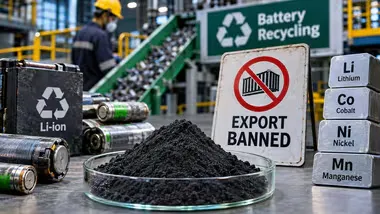
India has stopped letting a specific kind of battery waste leave the country.
On 10 November, the Directorate General of Foreign Trade issued Notification No. 49/2026-27, changing the export policy for lithium-ion battery black mass under ITC(HS) Code 85491400 from Free to Prohibited, with immediate effect and until further orders.
That sounds like a technical customs change. It is actually a country deciding that a waste product is now a strategic resource, and India is not the first to reach that conclusion.
What black mass is
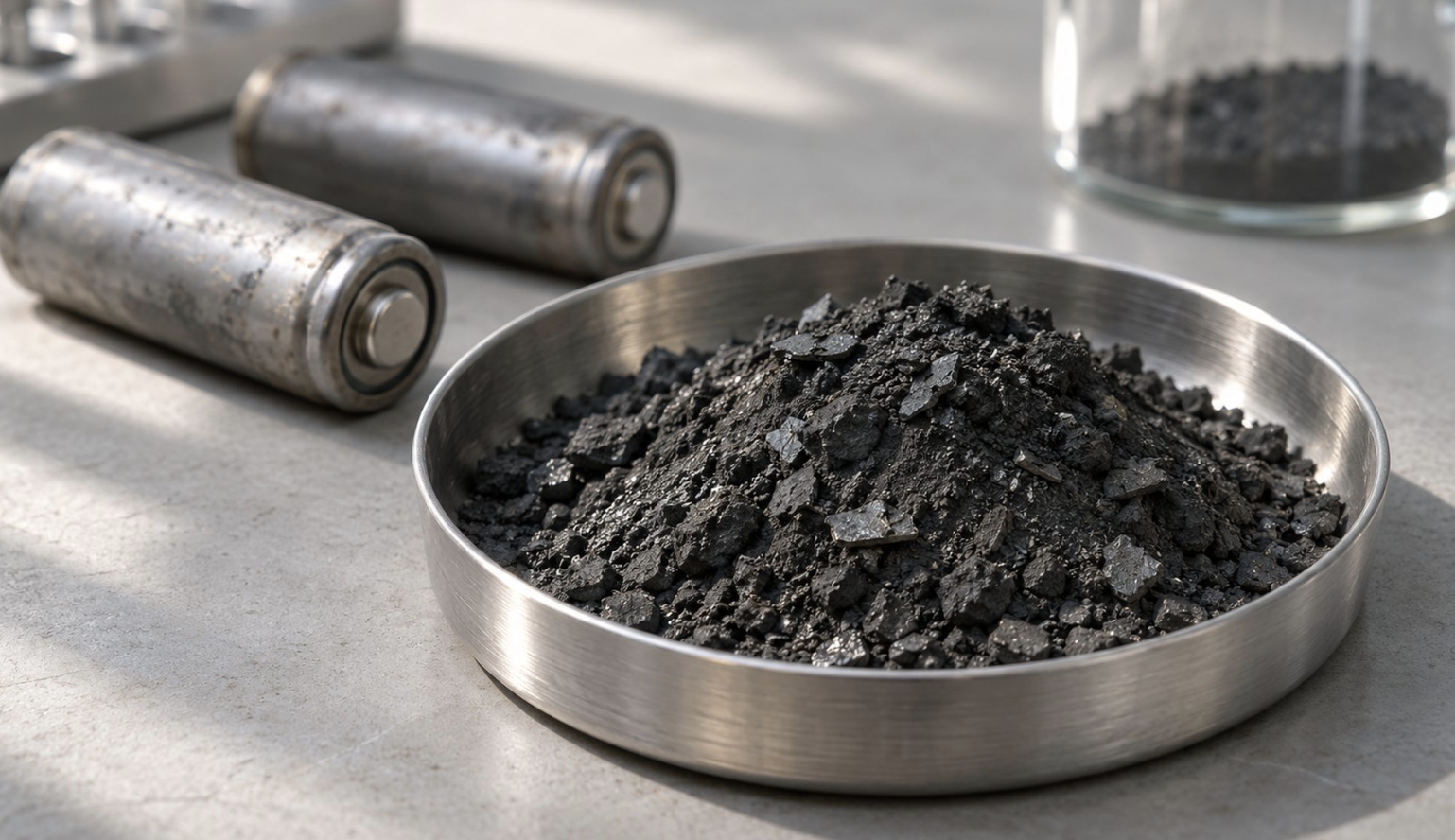
Black mass is the dark, powder-like material left after shredding end-of-life lithium-ion batteries and battery manufacturing waste.
It contains lithium, cobalt, nickel and manganese. Those four minerals are what make electric vehicle batteries, grid storage systems and most modern electronics possible, and India currently imports a substantial share of them.
The material is not directly usable. It has to be refined through hydrometallurgy before it becomes battery-grade salts. That refining step is where the value sits, and it is the capability India wants to build at home rather than export the raw feedstock and buy the finished product back.
The notification covers unsorted scrap and shredded scrap of primary cells and batteries not containing lead, cadmium or mercury, including black mass from lithium-ion batteries.
Why now
The government's own reasoning is more specific than the headline suggests, and it is worth quoting accurately.
India says its battery recycling and critical mineral refining capacity has expanded considerably, but remains underutilised because there is not enough feedstock to run it. Recyclers were being starved of material while that material was being shipped abroad.
The export ban is designed to fix exactly that. Keep the black mass in India, feed the plants that already exist, and improve capacity utilisation.
It also complements the government's INR 1,500 crore Incentive Scheme for Critical Mineral Recycling. Building recycling facilities with public money only works if those facilities have something to recycle.
There is a second piece that clarifies the strategy. India had already removed the basic import duty on lithium battery scrap. So the country is simultaneously making it easier to bring battery waste in and impossible to send processed black mass out.
India does not just want to recycle its own batteries. It wants to become the place where the region's batteries get recycled.
What the notification does
Changes export status from Free to Prohibited under ITC(HS) Code 85491400
Covers unsorted and shredded battery scrap, including lithium-ion black mass
Issued as Notification No. 49/2026-27, dated 10 November 2026
Effective immediately, with no fixed expiry date
Subject to transitional provisions under Foreign Trade Policy 2023
Affects exporters, battery waste processors and recycling businesses
Complements the INR 1,500 crore Incentive Scheme for Critical Mineral Recycling
This is a global pattern
India is late to this rather than early, and that context matters.
The European Union's black mass export ban has already taken effect. The United States has built barriers around lithium batteries and black mass through the Inflation Reduction Act and its own standards regime.
So the three largest battery markets outside China have now all moved to keep battery waste inside their borders within roughly the same period.
What that signals is a shift in how governments think about recycled material. Black mass used to be handled as waste, sold to whoever would take it. It is now being treated the way countries treat mineral deposits, which is to say as something you do not let leave.
For anyone watching the EV supply chain, this is the same resource competition that drove China's dominance in battery production, playing out at the recycling end instead of the mining end.
The enforcement question
The ban is simple to write and harder to police.
Black mass is a powder. It can plausibly be declared as a range of other industrial materials, and the difference between a prohibited shipment and a permitted one may come down to laboratory analysis rather than visual inspection.
Effective enforcement will depend on customs checks catching misclassification under other product categories. Until that is demonstrably working, the practical effect of the ban is uncertain.
What this means for Nepal
More than it might appear, and in two directions.
Nepal's EV fleet has grown quickly. Thousands of electric vehicles have come in through Korala and other crossings, and the country now has a substantial and growing stock of lithium-ion batteries on its roads.
Those batteries have a finite life. The earliest EVs imported here are already several years old, and within the next decade Nepal will face a volume of end-of-life battery packs it currently has no capacity to process. There is no meaningful lithium-ion recycling industry here.
That creates a straightforward question. Where does Nepal's battery waste go?
India is the obvious answer geographically, and India has made itself a more willing recipient by scrapping the import duty on battery scrap. A country building recycling capacity and short of feedstock has every reason to welcome material from across the border.
The less comfortable framing is this. If Nepal exports its battery waste as raw scrap and India refines it into battery-grade material, the value stays in India. Nepal takes the environmental burden of the vehicles and none of the economic upside of what is inside them.
That is a policy question Nepal has not yet had to answer, and this notification is a reminder that the clock is running.
Conclusion
A customs notification about powdered battery waste is not an obvious headline. What sits behind it is more significant.
India has looked at a material it was exporting freely, recognised it as a source of minerals it currently buys from abroad, and shut the door. The EU did the same. The US did the same. Within a few years, the global market for battery waste has been largely closed off by the countries generating the most of it.
For a market like Nepal, which imports vehicles, imports batteries and has no recycling industry, that trend is worth watching closely. The vehicles arriving now will become waste eventually, and the countries that know what that waste is worth have already started acting accordingly.
For more on EV policy, imports and the auto market in Nepal, Autoncell covers them as they land.