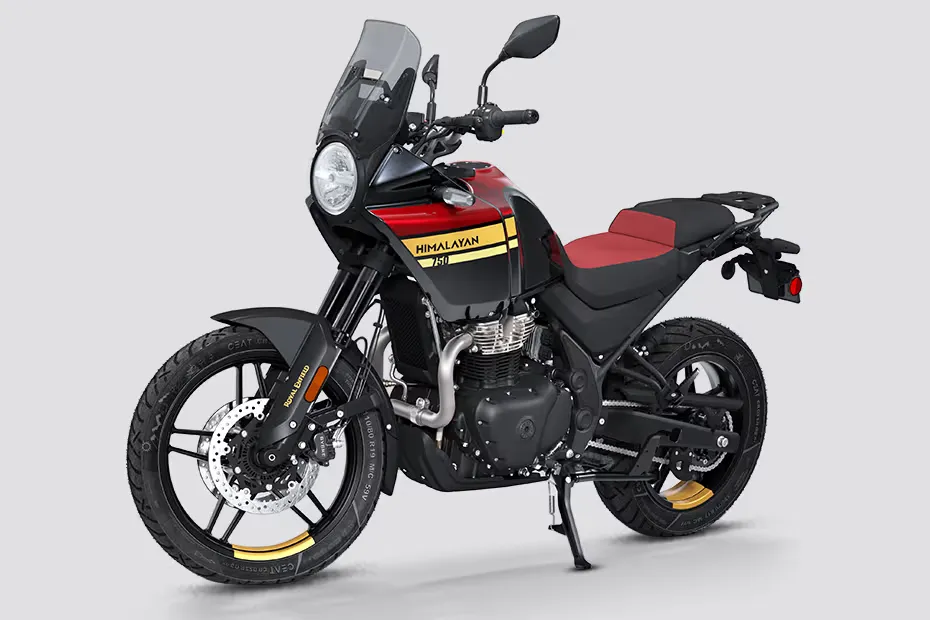
Royal Enfield has put a twin-cylinder engine in a Himalayan for the first time, and it is the largest motorcycle the company has ever built.
That matters more than the displacement suggests. The Himalayan was always the simple single you bought because it was cheap, light and would survive anything. The 750 is a different machine with different ambitions, carrying the most powerful engine Royal Enfield currently makes.
It was unveiled on 3 November 2026 at EICMA in Milan, at Fiera Milano Rho on the first press day, alongside the Continental GT 750 and the Flying Flea S6 Scrambler. Bookings are already open across European markets.
You can also Watch the full video on our YouTube channel, covering the engine, specs, features and what it means for Nepal.
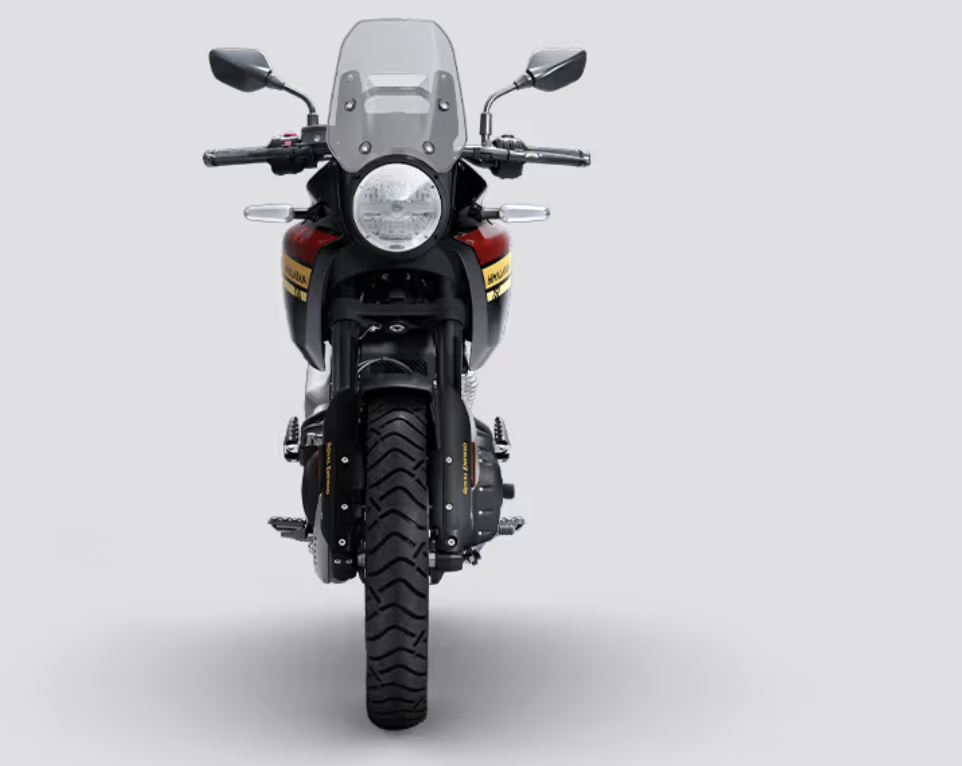
Engine
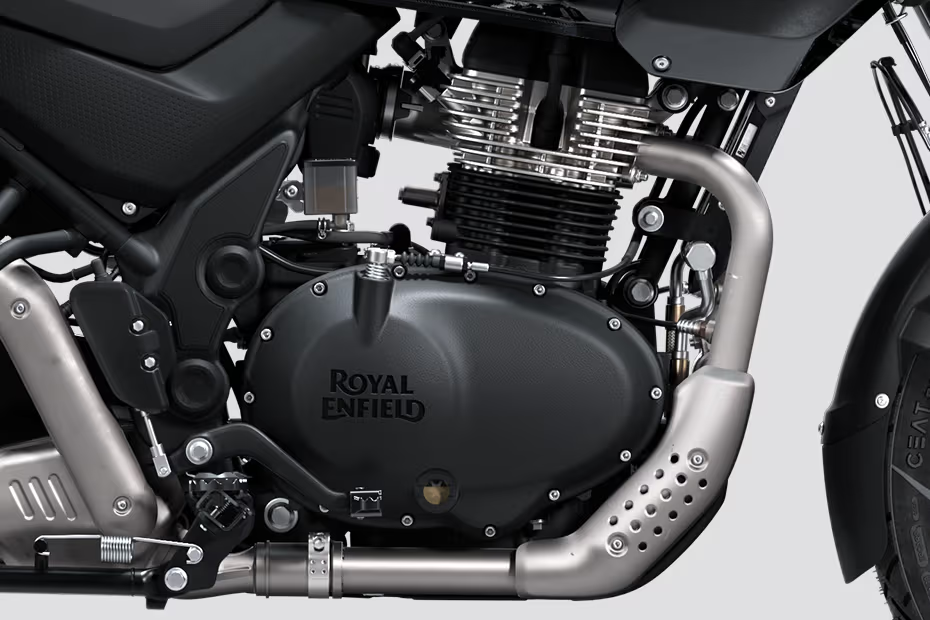
The new 743cc air and oil-cooled SOHC parallel twin produces 55 PS, or 54.25 bhp, at 7,000 rpm, with 63 Nm at 5,000 rpm, driving through a six-speed gearbox.
The figure that actually matters sits underneath those. Royal Enfield says 90 percent of peak torque is available from just 3,500 rpm.
For an adventure bike that is the specification that counts. Peak power at 7,000 rpm is academic when you are picking your way up a loose climb. Having nearly all the torque from 3,500 rpm is what makes a motorcycle manageable on a trail and relaxed on a highway.
There is a second engineering detail worth noting. Royal Enfield claims the 743cc unit weighs about the same as the existing 650cc engine, despite the extra displacement. The engine builds on the 650 architecture with a longer stroke, higher valve lift, plated cylinder bores, shorter cooling fins and magnesium covers.
Royal Enfield has stayed with air and oil cooling rather than moving to liquid, which keeps the engine simpler and lighter at the cost of ultimate output.
Chassis and suspension
The Himalayan 750 uses an all-new box-section spine frame with the engine acting as a stressed member.
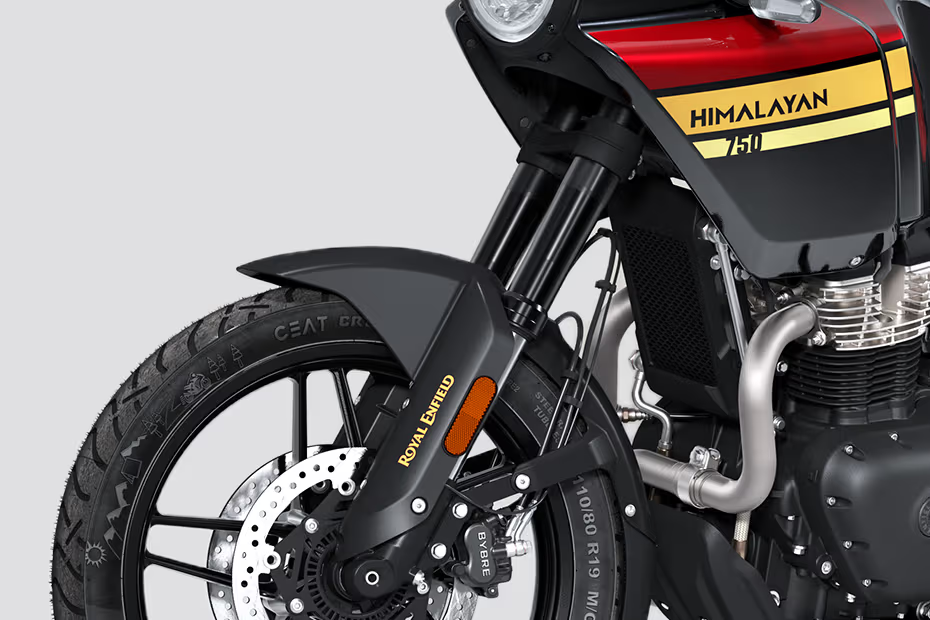
Suspension is 43mm Showa adjustable upside-down forks with 190mm of travel, paired with a Showa Mono Tube IFB monoshock at the rear offering rebound damping, remote preload adjustment and 175mm of wheel travel.
Remote preload adjustment deserves a mention. On a bike that will carry luggage and a pillion, being able to adjust without tools is the difference between doing it and not bothering.
Wheels are 19-inch front and 17-inch rear, available in alloy or spoked form, with tubeless tyres and tyre pressure monitoring standard.
Braking comes from twin 280mm front discs and a 255mm rear. The Himalayan 450 runs a single front disc, and on a 224kg motorcycle the extra stopping power is necessary rather than luxurious.
Dimensions and touring kit
Seat height is 815mm with separate rider and pillion seats. Low Ride, Touring Rider and Touring Passenger seats will be offered as accessories.
Ground clearance is 205mm, kerb weight 224kg and the fuel tank holds 17.8 litres. Payload capacity is rated at 195kg.
The windshield adjusts across five positions with 60mm of range, a detail that only matters to people who ride long distances and matters considerably to them.
At 224kg this is a substantial machine, noticeably heavier than the Himalayan 450. That weight will be felt in slow technical riding, though the low-rev torque delivery should offset some of it.
Electronics
This is the most comprehensive electronics package Royal Enfield has fitted to any motorcycle.
A six-axis inertial measurement unit enables cornering ABS and lean-sensitive traction control, with five riding modes: Road, Road Sport, Rain, Trail and Custom.
The display is a 4-inch circular TFT with Bluetooth connectivity, full map navigation, and phone and music controls. Cruise control is standard, along with an immobiliser, self-cancelling indicators and two USB-C charging ports.
Lighting comes from a new 7-inch headlamp with revised reflectors and an aluminium housing designed to improve heat dissipation.
Royal Enfield Himalayan 750 features
First twin-cylinder Himalayan and Royal Enfield's largest production motorcycle
743cc air and oil-cooled parallel twin, the brand's most powerful engine
90 percent of peak torque available from 3,500 rpm
Engine weight comparable to the existing 650cc unit
Six-speed gearbox
Box-section spine frame with engine as stressed member
43mm Showa adjustable USD forks, 190mm travel
Showa Mono Tube IFB monoshock with remote preload, 175mm travel
Twin 280mm front discs and 255mm rear
Six-axis IMU with cornering ABS and lean-sensitive traction control
Five riding modes: Road, Road Sport, Rain, Trail, Custom
4-inch circular TFT with navigation and Bluetooth
Cruise control and immobiliser
Tubeless tyres with TPMS
Five-position adjustable windshield with 60mm range
Self-cancelling indicators and two USB-C ports
Specifications
Specification | Detail |
Engine | 743cc, air and oil-cooled, SOHC parallel twin |
Max Power | 55 PS (54.25 bhp) at 7,000 rpm |
Peak Torque | 63 Nm at 5,000 rpm |
Torque Delivery | 90 percent of peak from 3,500 rpm |
Gearbox | 6-speed |
Frame | Box-section spine, engine as stressed member |
Front Suspension | 43mm Showa adjustable USD forks, 190mm travel |
Rear Suspension | Showa Mono Tube IFB monoshock, remote preload, 175mm travel |
Front Brakes | Twin 280mm discs |
Rear Brake | 255mm disc |
Wheels | 19-inch front, 17-inch rear, alloy or spoked |
Tyres | Tubeless with TPMS |
Seat Height | 815 mm |
Ground Clearance | 205 mm |
Kerb Weight | 224 kg |
Payload | 195 kg |
Fuel Tank | 17.8 litres |
Display | 4-inch circular TFT with navigation |
Rider Aids | Six-axis IMU, cornering ABS, lean-sensitive traction control, five riding modes |
What Royal Enfield said
B. Govindarajan, Managing Director of Eicher Motors and CEO of Royal Enfield, framed the launch around the model's history, saying the Himalayan 750 brings together a decade of learning and takes the Himalayan legacy further, offering greater capability and performance while retaining what he called the untamed spirit of exploration.
Royal Enfield has also been explicit on one point that was unclear before EICMA. The Himalayan 750 does not replace the Himalayan 450. Both will sit in the range.
That is the right call. The 450 is the accessible, lighter adventure bike that built the nameplate's reputation. The 750 is aimed at riders who had outgrown it and were looking at Hondas and Kawasakis instead.
One note for European buyers. The version shown is not A2 licence compliant.
The rest of the EICMA stand
The Himalayan 750 was not the only reveal.
Royal Enfield also unveiled the Continental GT 750, a sportier take on its café racer, shown in three colours: Red Line, TT Blue and Master Clean. Alongside it sat the Flying Flea S6 Scrambler, part of the company's electric mobility brand.
Three significant unveilings at one show is the busiest Royal Enfield has been at EICMA in years, and it reflects a company with momentum. Royal Enfield recorded its highest-ever monthly sales in September 2026 at 133,958 motorcycles globally, with exports up 17 percent.
Variants, pricing and availability
Royal Enfield will offer the Himalayan 750 in three variants, differentiated by colour schemes, wheel configurations and standard accessories.
Pricing has not been announced in any market. Bookings are open across Europe, with the Indian debut expected at Royal Enfield's Motoverse event in late November 2026.
Where it competes
Once launched, the Himalayan 750 lands against the Honda NX500 and Kawasaki Versys 650, with the BMW F 900 GS and Suzuki V-Strom 800 in range depending on where the price settles.
That is a mature, crowded segment, and Royal Enfield is entering it with air and oil cooling against liquid-cooled rivals. The counter-argument is the one the company has used successfully for years: simpler engineering, lower running costs and a torque curve built for real riding rather than dyno charts.
Whether that holds against a Versys 650 comes down entirely to price.
Will it reach Nepal?
Nothing has been announced. Royal Enfield has not confirmed Nepal availability or pricing for the Himalayan 750, and we are not estimating a figure.
Royal Enfield has a strong position here through Alpha Automotive, which recently expanded the Hunter 350 range with a new variant and two colours. But the Nepali Royal Enfield market runs overwhelmingly on 350cc machines, and a 750 would sit at a price point the brand has not tested here in any volume.
The same uncertainty applies as with Honda's CB500, which launched in India with no Nepal date confirmed. Indian production shortens the logistics considerably, and the Motoverse launch later this month will tell us far more than EICMA did.
Worth noting too that the Himalayan 440 is currently booked out for roughly six months in India. Royal Enfield has demand it cannot meet before adding another model to the queue.
Conclusion
The Himalayan 750 is Royal Enfield building something it has not built before.
A twin-cylinder engine, Showa suspension at both ends, a six-axis IMU, cornering ABS, five riding modes and navigation on a TFT screen would have been unimaginable on a Himalayan when the original 411 arrived nearly ten years ago. Govindarajan's framing about a decade of learning is accurate rather than promotional.
The open questions are the ones no spec sheet answers. At 224kg this is heavy for genuine off-road work. Air and oil cooling may limit how hard it can be pushed on long fast stretches. And nobody knows what it costs.
What is clear is the intent. Royal Enfield spent years being the sensible, affordable choice in adventure touring. With the Himalayan 750 it is asking to be judged on the same terms as Honda and Kawasaki.
For more on new launches and prices in Nepal, Autoncell covers them as they land.