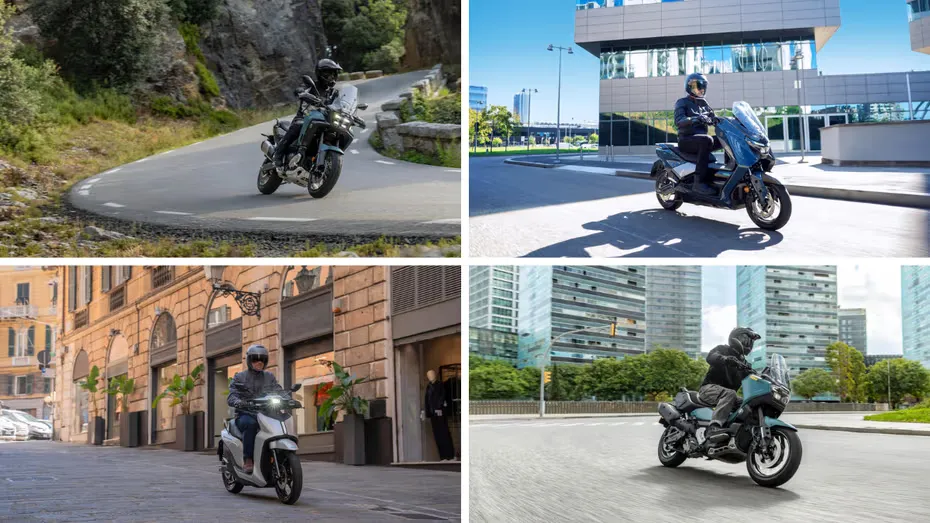
Yamaha has taken the 690cc CP2 engine from the Tenere 700, the MT-07 and the R7, and put it in a scooter.
That is the headline from Yamaha's EICMA stand, where the company unveiled five new scooters spanning electric city commuters and full adventure machines. The RW700 is the one that will get attention, and not only because of the engine. It is also the first Yamaha scooter with a genuine gearbox.
Here is what Yamaha showed and what it actually means.
The RW700 and RW700 Explore
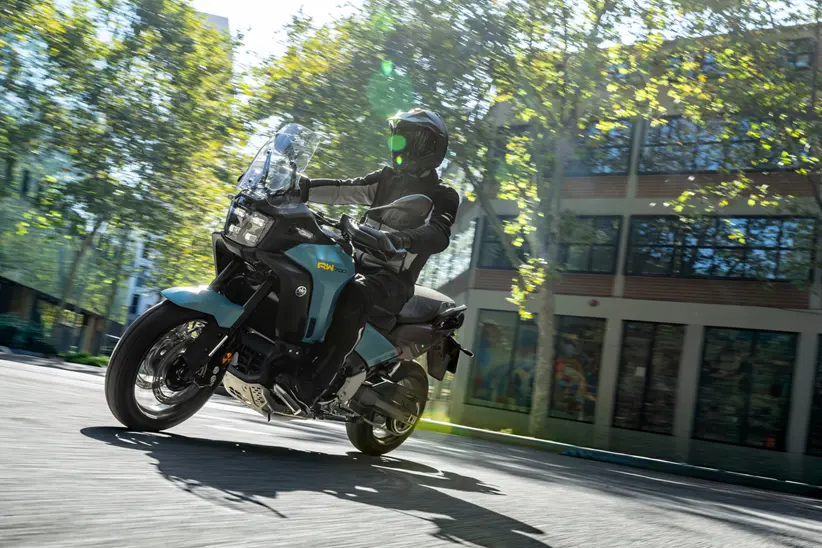
Both versions use the 689cc CP2 parallel twin, the same liquid-cooled four-valve unit found across Yamaha's middleweight range.
What makes it unusual is the transmission. Rather than a CVT, the RW700 runs Yamaha's Y-AMT automated manual gearbox, operated in either automatic or manual mode through handlebar controls. No clutch lever, but real gears, which no Yamaha scooter has had before.
The chassis is a steel backbone frame with 41mm upside-down forks offering 160mm of travel and a monoshock with 155mm, both adjustable. Ground clearance is 170mm and seat height 810mm, with a wet weight of 221kg.
Those suspension numbers are not scooter numbers. They sit closer to a mid-capacity adventure motorcycle, which is clearly the point. This is Yamaha's answer to the Honda X-ADV.
The Explore version adds adjustable front suspension, heated grips, a heated seat, a centre stand and backlit switches.
Yamaha has not released power figures for either.
The RW350
The smaller adventure scooter is arguably the more complete product, because Yamaha has disclosed everything about it.
It runs an all-new 327cc liquid-cooled single-cylinder SOHC four-valve engine producing 29.2 PS at 7,000 rpm and 31.5 Nm at 5,750 rpm, driving through a CVT. A four-axis balancer handles vibration, and Yamaha quotes 3.5 litres per 100km, which works out to roughly 28.5 km/l.
The engineering detail worth noting is Yamaha's new Dynamic Ride system. The engine is fixed to the frame with only the CVT transmission moving, rather than the whole engine-transmission unit swinging with the rear wheel. That is how you make a scooter handle like a motorcycle, and it is a meaningful piece of design rather than marketing.
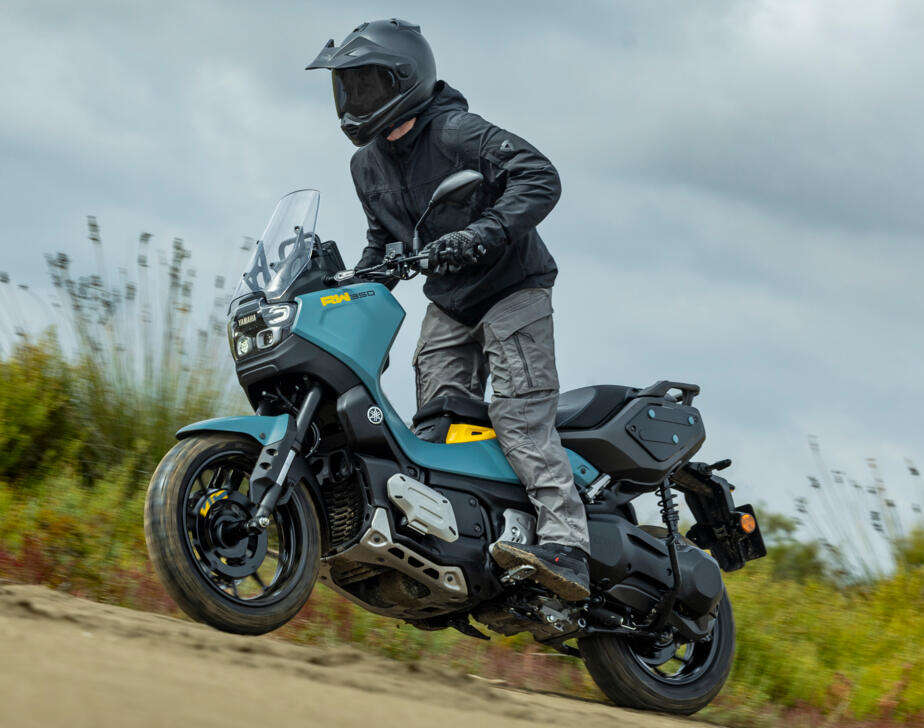
Suspension is a 37mm upside-down fork with 140mm of travel and twin rear shocks with 105mm. Ground clearance is 185mm, seat height 810mm and kerb weight 192kg, with a 13-litre tank.
Wheels are 16-inch front with a 120-section tyre and 14-inch rear with a 150-section, shod with knobbly rubber. Braking is a 282mm front disc and 245mm rear with ABS.
Ergonomics are built around standing up. There are wide footpegs with heel guards, plus foldable footboards that let you stretch your legs forward on longer runs.
Equipment covers three YRC ride modes in Street, Explore and Eco, ride-by-wire throttle, cruise control, a smart key with auto-cancelling indicators, emergency stop signalling, large under-seat storage and a 5-inch TFT with Yamaha MyRide and Garmin-based navigation.
The electric pair
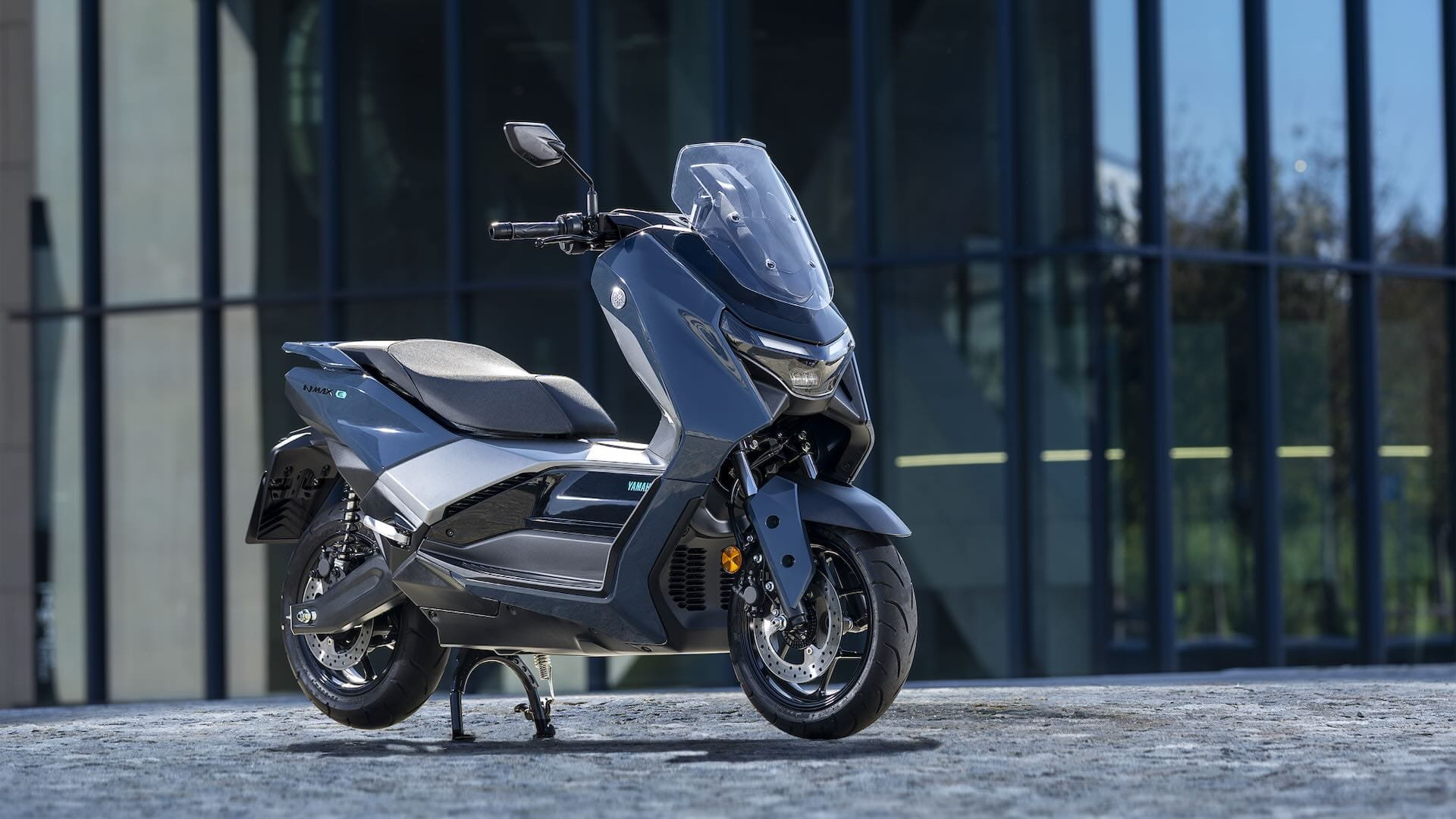
The Xenter E and NMax E share a 7.5 kW motor paired to a 3.5 kWh battery producing 33.3 Nm, both offering performance equivalent to a 125cc scooter and suitable for an A1 licence.
The Xenter E claims 108 km on the WMTC cycle and marks Yamaha's return to the high-wheel segment, riding on 16-inch wheels at both ends with a lightweight underbone frame, a flat footboard and a 790mm seat height.
The NMax E manages 104 km, uses a more familiar design closer to the petrol NMax, and rides on 13-inch wheels with a 770mm seat height and 121kg dry weight.
Both get a 5-inch TFT display, three ride modes, traction control, a reverse function and a smart key. Full charging takes a claimed 5.5 hours.
Yamaha has confirmed both go on sale in spring 2027.
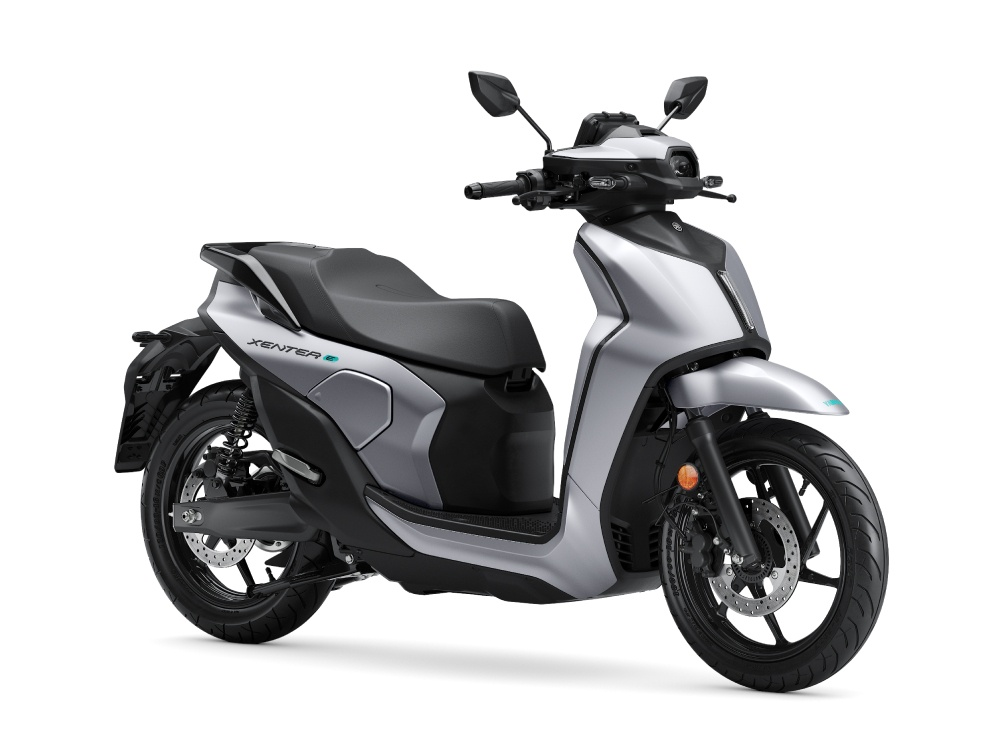
Yamaha's EICMA 2026 scooter lineup
RW700: 689cc CP2 engine, Y-AMT gearbox, 221kg
RW700 Explore: adds adjustable forks, heated grips and seat, centre stand, backlit switches
RW350: 327cc single, 29.2 PS, 31.5 Nm, Dynamic Ride system
Xenter E: 7.5 kW electric, 108 km range, 16-inch wheels
NMax E: 7.5 kW electric, 104 km range, 13-inch wheels
Both electric models on sale spring 2027
Five-inch TFT displays across the range
First Yamaha scooter with a genuine gearbox
Specifications
Specification | RW700 | RW350 |
Engine | 689cc CP2 parallel twin | 327cc liquid-cooled single, SOHC |
Power | Not disclosed | 29.2 PS at 7,000 rpm |
Torque | Not disclosed | 31.5 Nm at 5,750 rpm |
Transmission | Y-AMT automated manual | CVT |
Front Suspension | 41mm USD fork, 160mm travel | 37mm USD fork, 140mm travel |
Rear Suspension | Monoshock, 155mm travel | Twin shocks, 105mm travel |
Ground Clearance | 170 mm | 185 mm |
Seat Height | 810 mm | 810 mm |
Weight | 221 kg wet | 192 kg kerb |
Fuel Tank | Not disclosed | 13 litres |
Wheels | Not disclosed | 16-inch front, 14-inch rear |
Brakes | Not disclosed | 282mm front, 245mm rear, ABS |
Specification | Xenter E | NMax E |
Motor | 7.5 kW | 7.5 kW |
Battery | 3.5 kWh | 3.5 kWh |
Torque | 33.3 Nm | 33.3 Nm |
Range (WMTC) | 108 km | 104 km |
Charging | 5.5 hours to full | 5.5 hours to full |
Wheels | 16-inch front and rear | 13-inch |
Seat Height | 790 mm | 770 mm |
Weight | Not disclosed | 121 kg dry |
Display | 5-inch TFT | 5-inch TFT |
On Sale | Spring 2027 | Spring 2027 |
Why adventure scooters
The RW family exists because of a gap that has been obvious for years.
Plenty of riders want the convenience of a scooter, with a step-through frame, storage and no clutch, but find conventional scooters useless the moment the road deteriorates. Small wheels, minimal travel and low clearance make them city-only machines.
Honda proved there was a market with the X-ADV. Yamaha has now built two answers, one at 327cc and one with a proper middleweight motorcycle engine, and given both real suspension travel and ground clearance.
Whether that market is large enough to sustain three models is Yamaha's problem. For riders, it is a format worth taking seriously.
Will any of these reach Nepal?
Almost certainly not in the near term, and Yamaha has announced nothing.
MAW Rides handles Yamaha distribution in Nepal, and the lineup here runs on commuter scooters and accessible motorcycles. The most premium recent arrival was the XSR 155 at Rs 5.39 lakh, which gives a sense of where the ceiling currently sits.
An RW700 with a 689cc engine would land in a different price bracket entirely, in a segment Nepal does not really have. The RW350 is marginally more plausible, though a 327cc adventure scooter would still be an unusual proposition here, where the TVS Ntorq 150 at Rs 3,69,900 sits near the top of what scooter buyers spend.
The electric models face a different obstacle. A 3.5 kWh battery with 5.5-hour charging is fine for a European commuter and less convincing where power supply is uneven.
Conclusion
The RW700 is the kind of thing manufacturers build when they stop worrying about categories.
A 689cc parallel twin from an adventure motorcycle, a proper automated gearbox, 160mm of front suspension travel and 170mm of ground clearance, all wrapped in a scooter body. On paper it should not work. Honda has proved it does.
The RW350 may end up being the more significant of the two. The Dynamic Ride system, fixing the engine to the frame so only the transmission moves, addresses the fundamental reason scooters handle badly, and 185mm of ground clearance makes it genuinely usable beyond tarmac.
For Nepal, none of this is arriving soon. But the thinking behind it, which is that a scooter does not have to be a city-only machine, applies here better than almost anywhere.
For more on new launches and prices in Nepal, Autoncell covers them as they land.