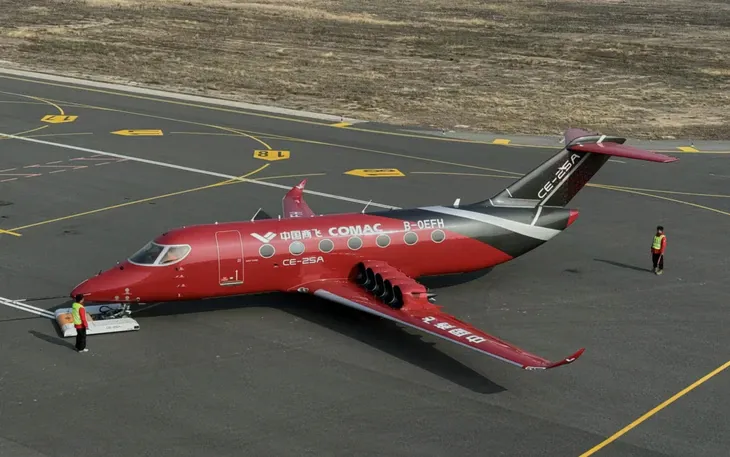
COMAC's CE-25A took off from Binzhou Dagao Airport in Shandong on Saturday with two pilots and a flight-test engineer aboard. It stayed up for 16 minutes and 38 seconds and covered 60.4 kilometres.
That is the first crewed flight of a 10-tonne battery-electric commercial aircraft, and it is a genuine milestone.
It is also 60.4 kilometres, against a claimed design range of 400. The gap between those two numbers is the whole story of electric aviation right now, and it is worth being clear about before getting to the significance.
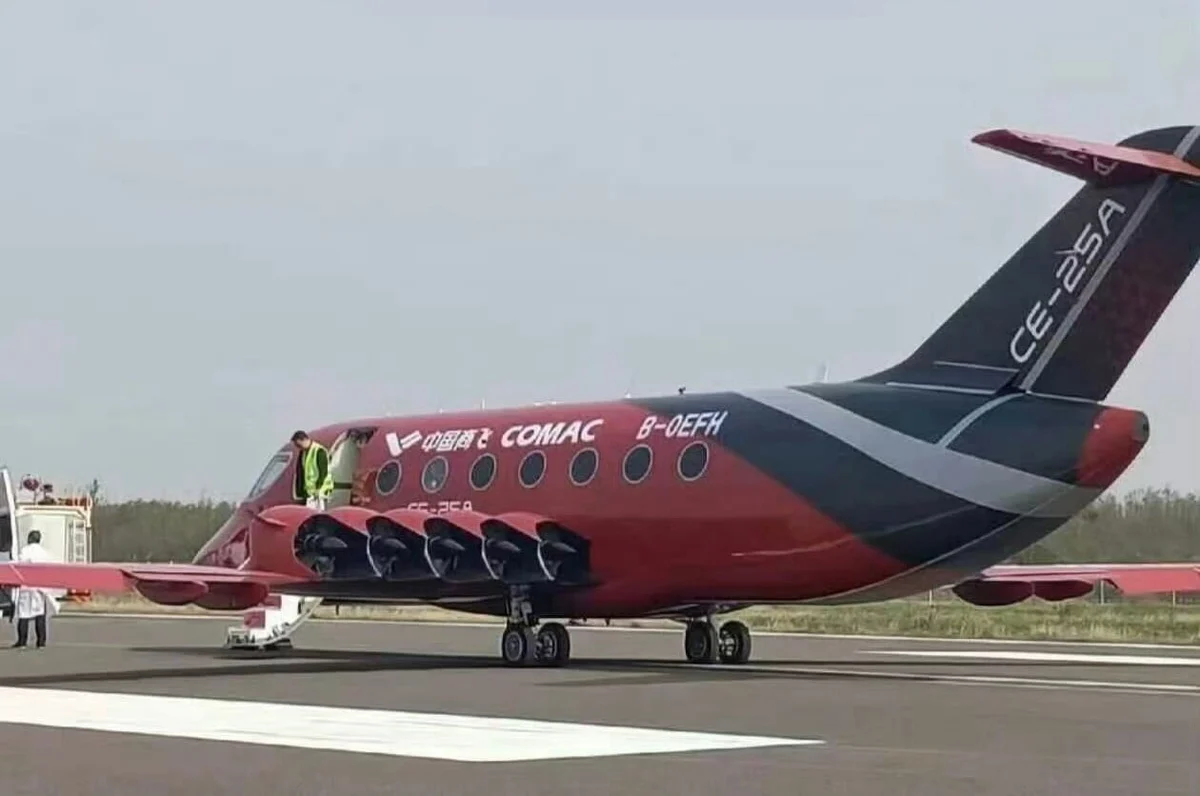
The CE-25A is a T-tail commuter aircraft with 10 electric ducted fans built into the wings, five per side, rather than conventional propellers.
COMAC lists a cruise speed of 300 km/h and a range of 400 km, with some reports citing a planned 400 to 500 km. Maximum takeoff weight is 10 tonnes with capacity for 19 passengers.
Ducted fans rather than open propellers is an unusual choice. They are typically quieter and can be more efficient at certain speeds, but add weight and complexity. On an aircraft where every kilogram comes out of the battery allowance, that is a deliberate trade.
It had already been flying
The crewed flight was not the aircraft's first.
The CE-25A made its first uncrewed autonomous flight on 2 February 2026 and completed 19 uncrewed test flights before anyone climbed aboard.
That sequence tells you something about how COMAC has approached this. Nine months of autonomous validation before putting people in the aircraft is a conservative programme, and it is probably the right way to develop something with this much novel propulsion technology.
China's aviation regulator has now begun reviewing the type certificate application, which starts the airworthiness certification process.
Who built it
This is where your source understates the position slightly.
The CE-25A was developed jointly by COMAC, battery manufacturer CATL and Shanghai Jiao Tong University. The three established a joint venture in July 2023 with registered capital of USD 83 million specifically to develop electric aircraft technology.
So CATL is not a potential supplier. It is a development partner.
What remains undisclosed is which battery actually powers the aircraft. CATL introduced its condensed battery technology around the same time as the joint venture, claiming energy density up to 500 Wh/kg at cell level and saying it was testing the technology against aviation standards.
That 500 Wh/kg figure matters. It has long been treated as roughly the threshold where commercial electric aviation becomes practical rather than theoretical. Current automotive-grade cells sit well below it.
Whether the CE-25A is using condensed cells, or something more conventional, COMAC has not said.
What we know about the CE-25A
19 passenger seats, 10-tonne maximum takeoff weight
10 electric ducted fans, five per wing
T-tail configuration
Claimed cruise speed of 300 km/h
Claimed range of 400 km, with 400 to 500 km cited as the design target
First uncrewed flight 2 February 2026, followed by 19 autonomous test flights
First crewed flight 14 November 2026, lasting 16 minutes 38 seconds over 60.4 km
Developed by COMAC, CATL and Shanghai Jiao Tong University
Type certificate application now under regulatory review
Battery technology not disclosed
How it compares
COMAC is not alone in this, and the field is instructive.
Heart Aerospace, based in the US, flew its X1 demonstrator for 27 minutes in Plattsburgh, New York, in August 2026. At roughly 11.34 tonnes with a 106-foot wingspan, the company described it as the largest battery-electric aircraft to have flown. It is the closest comparison to the CE-25A in size.
Heart's history is also a useful caution. The company originally developed a 19-seat aircraft called the ES-19 before shifting to the 30-seat ES-30 in 2022. The newer design uses reserve turbogenerators to extend range, which is an admission that pure battery power could not deliver useful range at that scale. BAE Systems is working on its battery technology, and Heart is targeting commercial operations by 2031.
Eviation's nine-seat Alice flew in September 2022. The company laid off most of its staff in early 2025.
That pattern, where a pure-electric design either gains a generator or runs out of money, is the backdrop against which the CE-25A should be read.
What a 16-minute flight proves
Being precise here matters.
It proves the aircraft flies with people aboard, that the distributed propulsion system works under crewed conditions, and that all systems functioned normally. For a novel configuration, that is not trivial.
What it does not prove is range, payload capability, or economics. A 60.4 km flight is less than a sixth of the claimed range, and certainly without 19 passengers aboard.
COMAC has not announced a commercial service date, and the certification review beginning does not mean the aircraft is close to carrying paying passengers. Type certification for a novel propulsion system typically takes years.
The honest summary is that this is an early but real step, not a product.
Why Nepal should be watching
This is where it gets genuinely interesting, because the CE-25A's specification maps onto Nepal almost uncannily.
Nepal's domestic aviation runs substantially on 19-seat turboprops. Twin Otters and Dornier 228s flying short hops are the backbone of the network, serving exactly the commuter class the CE-25A is designed for.
The route distances fit too. Kathmandu to Pokhara is around 125 km. Kathmandu to Lukla is roughly 135 km. Kathmandu to Biratnagar is about 240 km. Even Kathmandu to Nepalgunj sits near the 400 km mark. A 400 km electric aircraft would cover most of the domestic network.
And Nepal generates electricity from hydropower, which means the energy would be domestic and clean rather than imported jet fuel. For a country spending heavily on fuel imports, that is not a small consideration.
Now the problems, and they are serious.
Altitude is the big one. Lukla sits at 2,860 metres. Thin air reduces lift and forces engines to work considerably harder, which on a battery aircraft means drawing more power from a fixed energy store. Electric aircraft lose range at altitude in ways that compound rather than offset.
Cold is the second. Battery performance degrades in low temperatures, and Nepal's mountain airstrips are cold most of the year.
Third, Nepal's mountain runways are short, unpaved in places, and demand excellent climb performance. An aircraft with 400 km of range in ideal conditions may have considerably less margin on those routes.
None of this makes electric aviation impossible here. It does mean Nepal would be among the harder markets rather than the easier ones, and that the Terai routes would be viable long before anything in the mountains.
The wider context
The CE-25A sits within a pattern that has become familiar.
China has built dominance in batteries, in electric vehicles and increasingly in the supply chain that feeds both. CATL is central to all of it, and Chinese manufacturers now account for the majority of the global EV market.
Applying that battery capability to aviation is the logical next move, and having a state aircraft manufacturer, the world's largest battery maker and a leading engineering university working on it together is a structural advantage Western startups do not have.
COMAC also has credibility it lacked a decade ago. The C919 narrowbody entered commercial service with China Eastern in 2023, which means the company has taken an aircraft through certification and into airline operation.
Conclusion
A 19-seat electric aircraft flying 60 km with three people aboard is not an airline service. It is a demonstrator doing what demonstrators do.
But the direction is clear, and the institutional backing behind it is more serious than anything the Western electric aviation sector has assembled. Heart Aerospace has already compromised on pure electric power. Eviation has largely stopped. COMAC is proceeding with a battery manufacturer as a development partner and a regulator already reviewing certification.
The decisive factor will be energy density. At 500 Wh/kg, short-haul electric aviation starts to work. Below that it does not, regardless of how clever the airframe is.
For Nepal, this is worth tracking without expecting anything soon. The route structure fits beautifully. The terrain does not. Both of those will still be true in a decade, and whichever aircraft eventually works here will have to solve the altitude problem that nobody is currently designing for.
For more on EV and mobility technology, visit Autoncell.