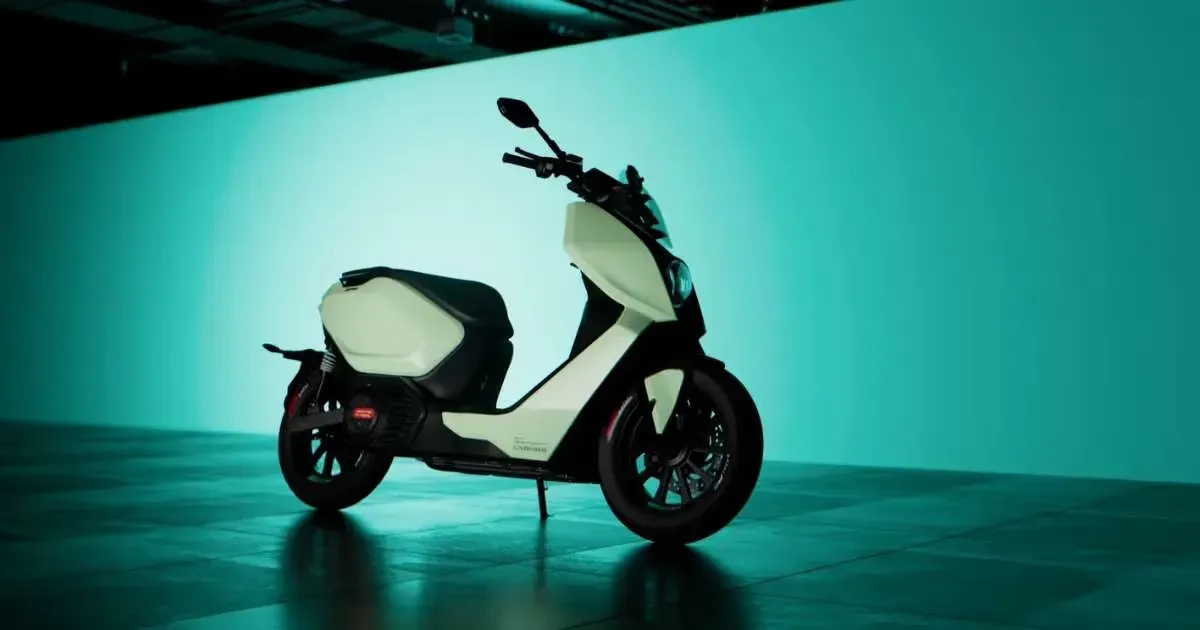
Forget the imported badges for a second. The most interesting two-wheeler at NADA this year was designed and built here.
Sipradi Yatri launched the Made-in-Nepal P2 electric scooter at the NADA Auto Show 2026 with a specification list that embarrasses several pricier imports. Three battery sizes, a bolt-on range extender, a 7-inch connected display with wireless CarPlay, and 315 Nm of torque at the wheel on the top variant. Pricing followed on September 17, starting at Rs 3,29,900. Here is what Yatri has actually built, and what it really costs.
Prefer to watch rather than read? The full breakdown is here
Design
The P2 wears a clean maxi-scooter stance that looks like the premium product it is trying to be. The wheelbase is a compact 1,390 mm with 175 mm of ground clearance, which Sipradi says helps stability at speed and on broken surfaces while freeing up legroom.
A 775 mm seat height and 320 mm floor height keep it accessible to a wide range of riders, and at 140 kg it stays manageable without feeling hollow. There is 30 litres of LED-lit boot space, plus a 45W device charger mounted at the front. It rides on 14-inch alloys, and the lighting does much of the visual work, with a Class-D projector LED headlamp, a floating position lamp and a regeneration-responsive tail lamp.
Six colours are offered across every power pack: Mustang Desert, Everest Snow, Sauraha Mist, Annapurna Storm, Chure Thunder and Kalapatthar Midnight.
Performance
At the centre sits a mid-drive PMSM motor, which is worth noting on its own. Rather than the hub motor almost every scooter in this market uses, Yatri went with a motorcycle-style mid-mounted unit and chain drive, a decision aimed squarely at Nepal's gradients.
The top variant peaks at 10 kW and delivers 315 Nm of torque at the wheel with a claimed top speed of 90 km/h. Output scales down the range, running 6 kW on the 3.0 kWh pack and 8 kW on the 3.7 kWh.
Controller hardware shifts too. The entry version uses a 340A controller while both larger packs step up to 450A. All three carry a 1,350W onboard charger as standard.
Battery and Range
Three battery sizes are on offer: 3.0 kWh, 3.7 kWh and 5.2 kWh, with claimed city ranges of 90 km, 112 km and 157 km respectively.
The clever part is the range extender. Both the 3.7 kWh and 5.2 kWh versions accept a 1.8 kWh add-on battery, lifting claimed range to 162 km and 207 km. It connects directly into the P2's battery architecture and adds roughly 50 km. Practical thinking: you pay for the extra capacity only if your riding actually needs it.
The packs use LG lithium-ion cells with built-in thermal runaway protection, an IP67 ingress rating and a dual-architecture protocol that switches between operating configurations. The battery management system behind the real-time energy meter and smart display is certified by the Automotive Research Association of India.
On charging, read the fine print. The headline figure is 80 percent in 41 minutes, but that applies on Yatri's own 3.3 kW DC fast chargers, which Sipradi Yatri plans to install at 30 to 35 locations nationwide. Yatri claims this is the first scooter in its segment with DC fast charging. On the 1,350W onboard AC charger, expect roughly 2 hours 5 minutes for the smaller packs and around 2 hours 30 minutes for the 5.2 kWh. A 2,000W rapid charger is optional on the top variant.
Warranty scales with the pack. The 3.0 kWh gets five years or 50,000 km, the 3.7 kWh gets six years or 60,000 km with an eight-year, 80,000 km extension available, and battery coverage runs up to eight years or 80,000 km.
Chassis and Brakes
The foundation is a high-strength automotive-steel dual-cradle trellis frame paired with an aluminium swingarm. Suspension is a 90 mm-travel telescopic front fork with dual progressive spring-damper rear shocks, running 110/80-14 tubeless tyres on 14-inch alloys.
Braking deserves its own mention. Dual discs with CBS, a 240 mm ventilated front rotor with a three-piston calliper and a 220 mm ventilated rear rotor with a single-piston calliper. A three-piston front calliper on a scooter is unusual, and it says something about how seriously Yatri took this.
Development backs that up. The P2 completed more than 7,000 km of road testing across Nepal before launch, on routes through Kathmandu, Nuwakot, Jiri, Hetauda, Mulkot, Katari, Bharatpur and Waling.
Also watch the Yadea GS70
Technology
This is the P2's strongest hand, though what you get depends on which connectivity tier you are on.
The hardware centrepiece is a fully programmable 7-inch TFT LED cluster with 4G connectivity. Standard Connectivity delivers live vehicle location, live trip data, real-time state of charge, energy consumption and ride statistics to your phone. Advanced Connectivity adds wireless Apple CarPlay and Android Auto, a live charger finder on the touchscreen, and the full companion app with keyless proximity start, with the Anti-Theft Package bundled in.
Ride Intelligence telemetry covers trip data, state of charge, energy consumption, regen data, and heading, roll and pitch. The companion app extends to location tracking, charger availability, trip optimisation, charging notifications, ride and charging logs, and service booking and history.
On the riding side there is terrain-adapting cruise control, multiple drive modes, a reverse mode, three levels of regenerative braking, hill-hold, and three AC charging modes in Optimized, Eco and Quick. Yatri also fitted an outdoor speaker with configurable sound profiles, which is either a gimmick or a delight depending on your temperament.
Yatri P2 Features
7-inch programmable TFT LED cluster with 4G connectivity
Wireless Apple CarPlay and Android Auto on Advanced Connectivity
ARAI-certified battery management system
Real-time nearby DC charging station info
Ride Intelligence telemetry covering trip, SOC, energy and regen data
Companion app with keyless start, location tracking and service history
Terrain-adapting cruise control and multiple drive modes
Reverse mode and three-level regenerative braking
Hill-hold function
AC charging modes: Optimized, Eco, Quick
45W front device charger and 30-litre LED-lit boot
Outdoor speaker with configurable sound profiles
Integrated tyre pressure monitoring on Advanced Connectivity
Safety and Security
Fall detection cuts power automatically and shares location, backed by the floating position lamp, Class-D projector LED headlamp and regeneration-responsive tail lamp.
Security matters just as much in this market. The anti-theft system provides movement alerts, location tracking and a remote immobiliser, which is a genuine selling point given how common scooter theft is here.
Specifications at a Glance
Specification | Detail |
Motor | Mid-drive PMSM with chain drive, 6 / 8 / 10 kW by variant |
Torque | Up to 315 Nm at the wheel (5.2 kWh variant) |
Top Speed | 90 km/h (5.2 kWh variant) |
Controller | 340A (3.0 kWh), 450A (3.7 and 5.2 kWh) |
Battery Options | 3.0 / 3.7 / 5.2 kWh, LG cells, IP67 |
Range (3.0 kWh) | 90 km |
Range (3.7 kWh) | 112 km, 162 km with extender |
Range (5.2 kWh) | 157 km, 207 km with extender |
Range Extender | 1.8 kWh add-on, roughly 50 km |
Onboard Charger | 1,350W, 2,000W rapid charger optional |
DC Fast Charging | 80 percent in 41 minutes on Yatri's 3.3 kW DC network |
Battery Warranty | Up to 8 years / 80,000 km |
Frame | Steel dual-cradle trellis with aluminium swingarm |
Front Suspension | 90 mm telescopic fork |
Brakes | Dual disc with CBS, 240 mm front, 220 mm rear |
Wheels | 14-inch alloys, 110/80-14 tubeless |
Wheelbase | 1,390 mm |
Ground Clearance | 175 mm |
Seat Height | 775 mm |
Boot Space | 30 litres, LED-lit |
Kerb Weight | 140 kg |
Display | 7-inch TFT, 4G, CarPlay and Android Auto |
Colours | Mustang Desert, Everest Snow, Sauraha Mist, Annapurna Storm, Chure Thunder, Kalapatthar Midnight |
Price in Nepal
Starting prices are as follows:
Variant | Motor | Power Pack | Starting Price |
P2 3.0 kWh | 6 kW | 3.0 kWh | Rs 3,29,900 |
P2 3.7 kWh | 8 kW | 3.7 kWh | Rs 3,99,900 |
P2 5.2 kWh | 10 kW | 5.2 kWh | Rs 4,99,900 |
Those are entry figures, and the gap between them and a configured scooter is substantial.
The 3.0 kWh has no connectivity as standard. Standard Connectivity costs Rs 19,200, and Advanced Connectivity and TPMS are not available on this pack at all. Add every listed option and it reaches Rs 3,87,690.
The 3.7 kWh includes Standard Connectivity, with Advanced Connectivity available for Rs 25,000. Fully equipped it comes to Rs 4,72,230, or Rs 5,62,830 with the Rs 90,600 range extender.
The 5.2 kWh gets Advanced Connectivity as standard. With options but without the rapid charger and extender it sits at Rs 5,29,740, and fully loaded it reaches Rs 6,49,340.
Configuration | Price |
3.0 kWh base | Rs 3,29,900 |
3.0 kWh fully equipped | Rs 3,87,690 |
3.7 kWh base | Rs 3,99,900 |
3.7 kWh fully equipped | Rs 4,72,230 |
3.7 kWh with range extender | Rs 5,62,830 |
5.2 kWh base | Rs 4,99,900 |
5.2 kWh with options, no charger or extender | Rs 5,29,740 |
5.2 kWh fully equipped | Rs 6,49,340 |
Individual options: Standard Connectivity Rs 19,200, Advanced Connectivity Rs 25,000, 1.8 kWh range extender Rs 90,600, 2,000W rapid charger Rs 29,000, cruise control Rs 5,000, regen tail light Rs 2,500, anti-theft pack Rs 5,000, extended warranty Rs 9,990, Dash Pack Rs 5,650, Michelin tyres Rs 16,000, wider premium mirrors Rs 3,480, premium grips Rs 960 and TPMS Rs 3,750.
Availability
Customers who booked at NADA will receive the 3.7 kWh and 5.2 kWh variants between mid-October and November. The entry 3.0 kWh follows in December, at which point all three variants go on general sale.
Conclusion
The P2 is not just another electric scooter with a local badge on it. The mid-drive motor is a deliberate engineering choice rather than a cost-saving one, the braking hardware is better than the segment expects, and the connected tech would pass as flagship kit on an imported machine.
The pricing is where buyers need to pay attention. Rs 3,29,900 gets the headlines, but that version arrives without connectivity, on the smallest pack and the weakest motor. The 3.7 kWh is arguably the sweet spot, since it includes Standard Connectivity, carries a longer warranty and is the cheapest way into the range extender. From there the spread runs to Rs 6,49,340, a gap of more than Rs 3 lakh between the cheapest and most expensive P2.
For more on Nepal's fast-evolving two-wheeler market, Autoncell tracks every new launch as it lands.