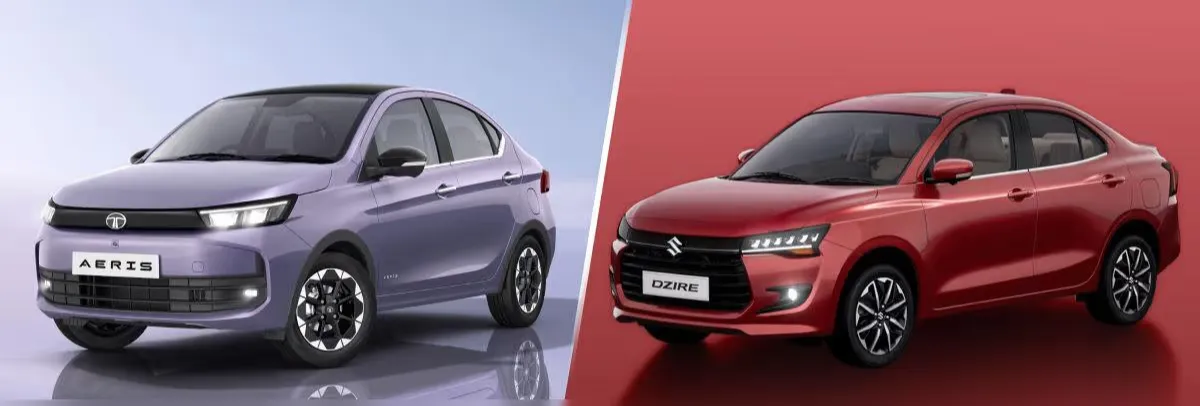
Park these two side by side and pull out a measuring tape. Same length, right down to the millimetre. Same wheelbase. Sub-4 metre rules do that to cars.
Then open the boot on the Aeris and you find 37 litres more space. Check the Dzire's claimed mileage and it returns over 30 percent better fuel economy on petrol. Look at the price and Tata undercuts Maruti by roughly a lakh to get in the door.
So they are the same size and almost nothing else. Tata has just launched the Aeris in India to take on the car that has owned this segment for years, and the two make completely different arguments for your money. Here is how they stack up, and who each one is actually for.
Price
The Aeris opens at INR 5.29 lakh and runs to INR 9.74 lakh for the top variant, spread across five trims.
The Dzire starts higher at INR 6.30 lakh and tops out slightly lower at INR 9.54 lakh, across four variants.
So Tata undercuts Maruti by roughly INR 1 lakh at the entry point while asking INR 20,000 more at the top. The Aeris is cheaper to get into, marginally more expensive to max out, and gives you one more trim to choose from.
Model | Price Range | Variants |
Tata Aeris | INR 5.29 lakh to INR 9.74 lakh | 5 |
Maruti Dzire | INR 6.30 lakh to INR 9.54 lakh | 4 |
Design
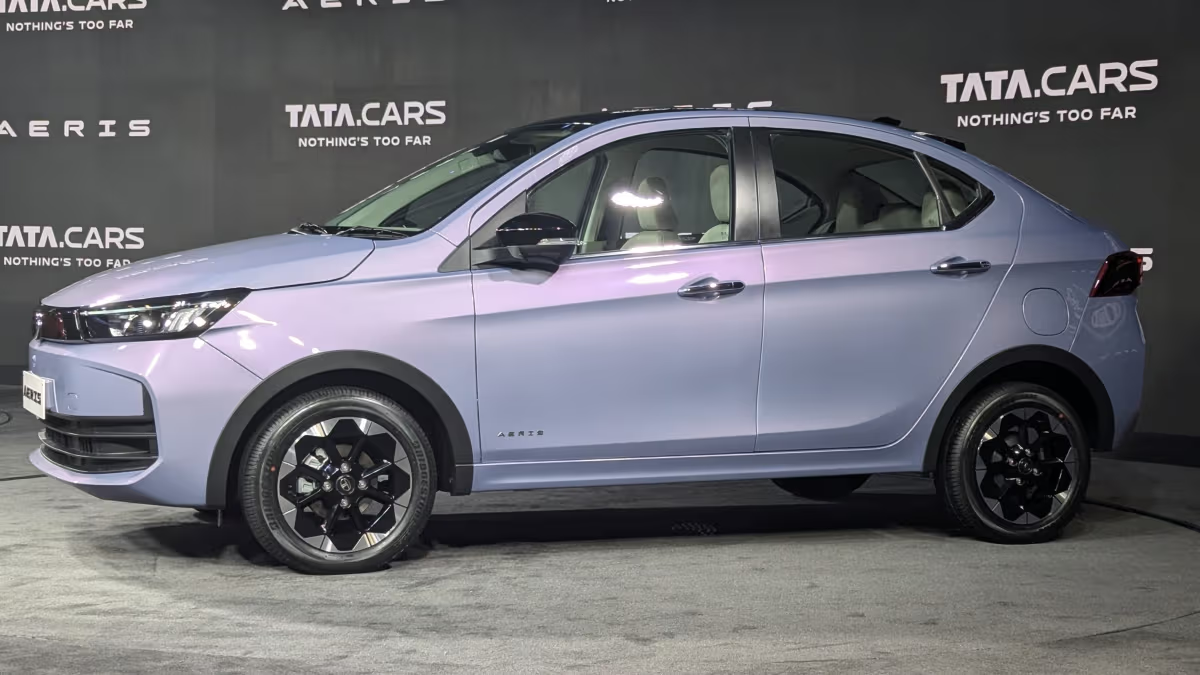
The Aeris goes for full LED lighting and contemporary styling, with a boot section that carries echoes of the Tigor's full-width stop lamp treatment. It is the more modern-looking of the two.
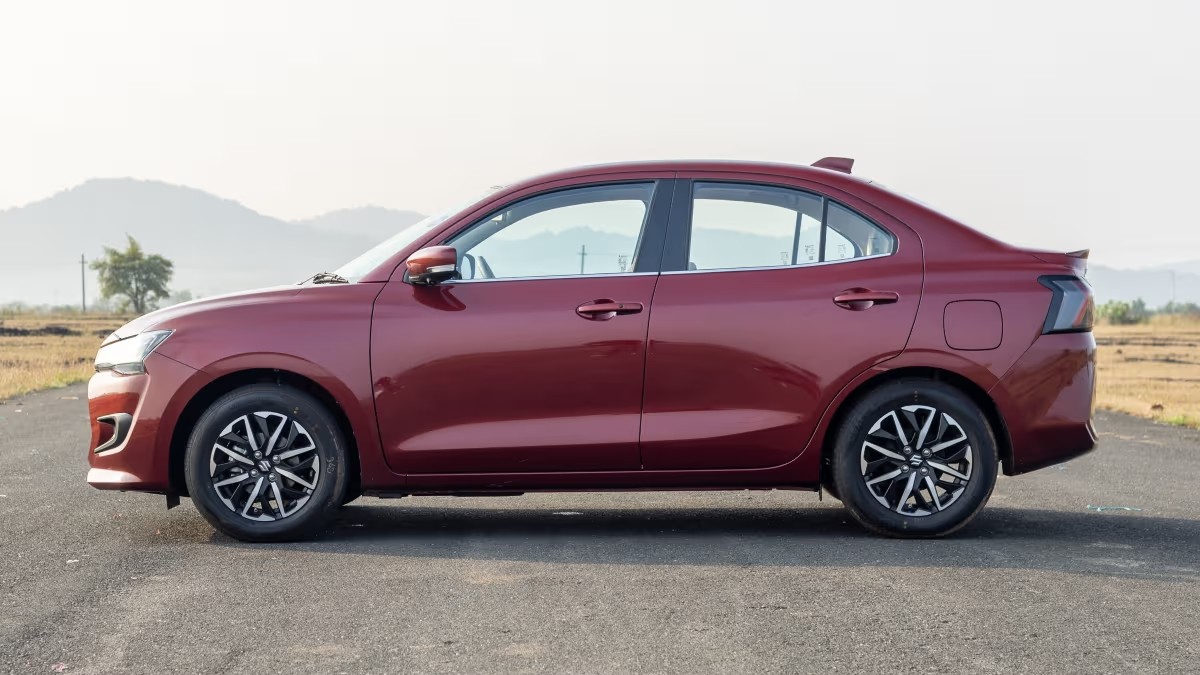
The Dzire plays things straighter. More conventional in shape, but it holds a premium feel with LED headlamps, dual-tone alloy wheels and fog lamps.
There is a positioning difference worth noting too. Tata is selling the Aeris to private buyers only, keeping it clear of taxi and fleet operators. The Dzire serves both, which is a large part of why it sells in the numbers it does and also why some private buyers hesitate over resale perception.
Dimensions
Both cars measure 3,995mm long on a 2,450mm wheelbase, which is identical. That is sub-4 metre regulation doing its job.
Everything else diverges. The Dzire is wider at 1,735mm against the Aeris at 1,684mm, a difference of 51mm that will show in shoulder room across the rear bench. The Aeris is marginally taller at 1,532mm versus 1,525mm, and sits higher with 170mm of ground clearance against 163mm.
The boot is where the Aeris pulls clear. The petrol version offers 419 litres against the Dzire's 382 litres, a gap of 37 litres that is noticeable the first time you load for a family trip.
Dimension | Tata Aeris | Maruti Dzire |
Length | 3,995 mm | 3,995 mm |
Wheelbase | 2,450 mm | 2,450 mm |
Width | 1,684 mm | 1,735 mm |
Height | 1,532 mm | 1,525 mm |
Ground Clearance | 170 mm | 163 mm |
Boot Space | 419 litres (petrol) | 382 litres |
Features
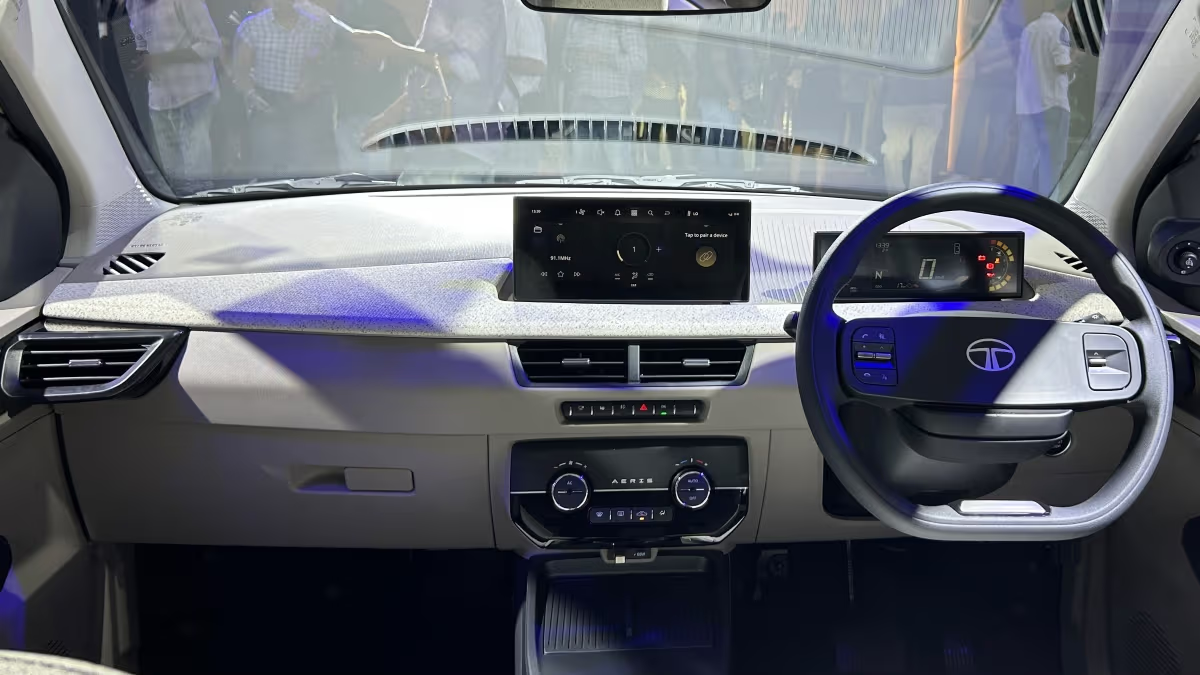
This is the Aeris's strongest ground.
Tata offers a 10.25-inch touchscreen, a 5-inch digital driver display, ventilated front seats, a built-in dashcam, rain-sensing wipers, a digital instrument cluster and a blind-view monitor.
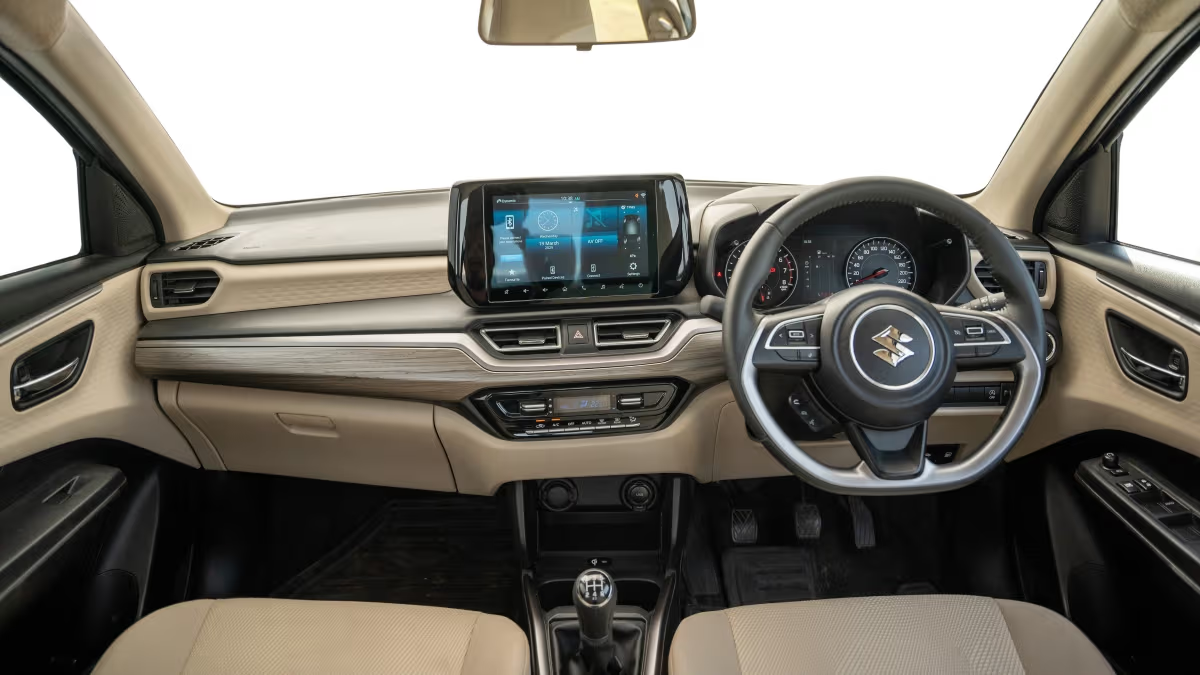
The Dzire counters with a layered dashboard built around a 9-inch touchscreen, six airbags, wireless charging, climate control, rear AC vents, tyre pressure monitoring, a 360-degree camera and cruise control.
Both lists are strong, but they emphasise different things. Tata has gone for the features people notice immediately, ventilated seats and a big screen. Maruti has covered more of the practical ground, with rear vents, TPMS and cruise control.
Feature | Tata Aeris | Maruti Dzire |
Touchscreen | 10.25-inch | 9-inch |
Driver Display | 5-inch digital | Digital cluster |
Ventilated Front Seats | Yes | Not listed |
Built-in Dashcam | Yes | Not listed |
Blind-View Monitor | Yes | Not listed |
Rain-Sensing Wipers | Yes | Not listed |
360-Degree Camera | Not listed | Yes |
Wireless Charging | Not listed | Yes |
Rear AC Vents | Not listed | Yes |
Cruise Control | Not listed | Yes |
TPMS | Not listed | Yes |
Airbags | Not listed | Six |
Engine and Performance
Both run 1.2-litre petrol engines, and both offer CNG with a five-speed manual or AMT.
The Aeris makes 85 bhp and 113 Nm on petrol, dropping to 74 bhp and 97 Nm on CNG.
The Dzire uses Maruti's newer Z-series three-cylinder unit, producing 80 bhp and 112 Nm on petrol and 69 bhp and 102 Nm on CNG.
So the Aeris has a modest power advantage in both fuel modes. Five bhp is not going to change how the car feels day to day, but it is the Tata that is technically stronger.
Specification | Tata Aeris | Maruti Dzire |
Engine | 1.2-litre petrol | 1.2-litre Z-series, 3-cylinder |
Petrol Output | 85 bhp, 113 Nm | 80 bhp, 112 Nm |
CNG Output | 74 bhp, 97 Nm | 69 bhp, 102 Nm |
Transmission | 5-speed manual, AMT | 5-speed manual, AMT |
Mileage
Here is where the comparison stops being close.
The Aeris claims around 19 kmpl on petrol and roughly 24 km per kg on CNG.
The Dzire claims 25.15 kmpl on petrol and up to 35.63 km per kg on CNG.
That is not a gap, it is a chasm. The Dzire is claiming over 30 percent better fuel economy on petrol and nearly 50 percent better on CNG.
For a private buyer covering modest distances, this may not override the Aeris's advantages. For anyone doing serious mileage, it changes the entire ownership calculation. Over five years of heavy use, that difference will dwarf the INR 1 lakh Tata saves you at purchase.
Fuel | Tata Aeris | Maruti Dzire |
Petrol | Around 19 kmpl | 25.15 kmpl |
CNG | Around 24 km/kg | 35.63 km/kg |
Which one suits whom
The Aeris makes sense if you want the more modern car. Bigger screen, ventilated seats, a dashcam built in, more boot space, better ground clearance and a lower entry price. It is also private-buyer only, so you are not sharing your car's image with every taxi rank in the city.
The Dzire makes sense if running cost is what you actually care about. The fuel economy advantage is substantial enough to outweigh most of the Aeris's feature wins over a long ownership period, and Maruti's service network and resale record are not easily matched.
There is also the width difference. If you regularly carry three adults in the back, the Dzire's extra 51mm is worth more than any screen size.
What this means for Nepal
The Dzire has been available in Nepal for some time and is a familiar sight on local roads.
The Aeris has only just launched in India and has no confirmed Nepal launch, pricing or timeline. We are not estimating a local figure here.
That said, Indian production usually shortens the path to a Nepali launch considerably, and Tata already has a strong presence here. If it does arrive, Nepali buyers get a genuine choice in a segment that has been fairly settled for years.
For more on new launches, prices and the auto market in Nepal, Autoncell covers them as they land.