-original.webp)
After years of near silence, Skoda has finally broken through the noise in Nepal’s automotive market. And it has done so with intent.
The Skoda Kylaq is now officially launched in Nepal, marking what feels less like a routine product introduction and more like a strategic reset. For a brand that once enjoyed a strong reputation among enthusiasts and premium SUV buyers, the prolonged absence of fresh launches had quietly pushed Skoda into the background. Meanwhile, Chinese EV brands surged ahead, and established names like Hyundai, Kia, and Tata tightened their hold on the compact SUV space.
Now, under MAW Group, Skoda is attempting a recalibration. The Kylaq is positioned as a more accessible Skoda,compact, petrol-powered, and priced to reconnect with a market that has become far more competitive and price-sensitive.
But does it merely fill a gap, or does it truly reassert Skoda’s identity in Nepal? Let’s take a closer look.
Skoda Kylaq Price in Nepal
The Skoda Kylaq price in Nepal starts at Rs. 45,90,000 and goes all the way up to Rs. 70,90,000. In total, Skoda is offering 15 variants, split across manual and automatic transmissions.
The base Classic MT opens the lineup at Rs. 45.90 Lakhs, while the fully loaded Prestige+ AT tops out at Rs. 70.90 Lakhs. One of Skoda’s biggest talking points is the relatively accessible automatic transmission. The first automatic variant begins at Rs. 52.90 Lakhs, which is a calculated move in a market where automatics are increasingly in demand.
From a pricing perspective, the entry-level variants feel competitive. However, once you step into the fully equipped Prestige trims in the 65,70 lakh range, the Kylaq moves into territory where buyers will inevitably compare it against larger or more feature-packed alternatives.
Variant-wise Price List (2026)
Classic MT, Rs. 45,90,000
Classic+ MT, Rs. 49,90,000
Classic+ AT, Rs. 52,90,000
Signature MT (NSR), Rs. 49,90,000 / Rs. 54,90,000
Signature AT (NSR), Rs. 52,90,000
Signature MT, Rs. 55,90,000
Signature AT, Rs. 60,90,000
Signature+ AT (NSR) , Rs. 59,90,000
Signature+ MT, Rs. 59,90,000
Signature+ AT, Rs. 64,90,000
Prestige MT, Rs. 64,90,000
Prestige AT, Rs. 69,90,000
Prestige+ MT, Rs. 65,90,000
Prestige+ AT, Rs. 70,90,000
NSR denotes variants without a sunroof.
Also read about The Price of Suzuki victoris in Nepal
Design and Exterior
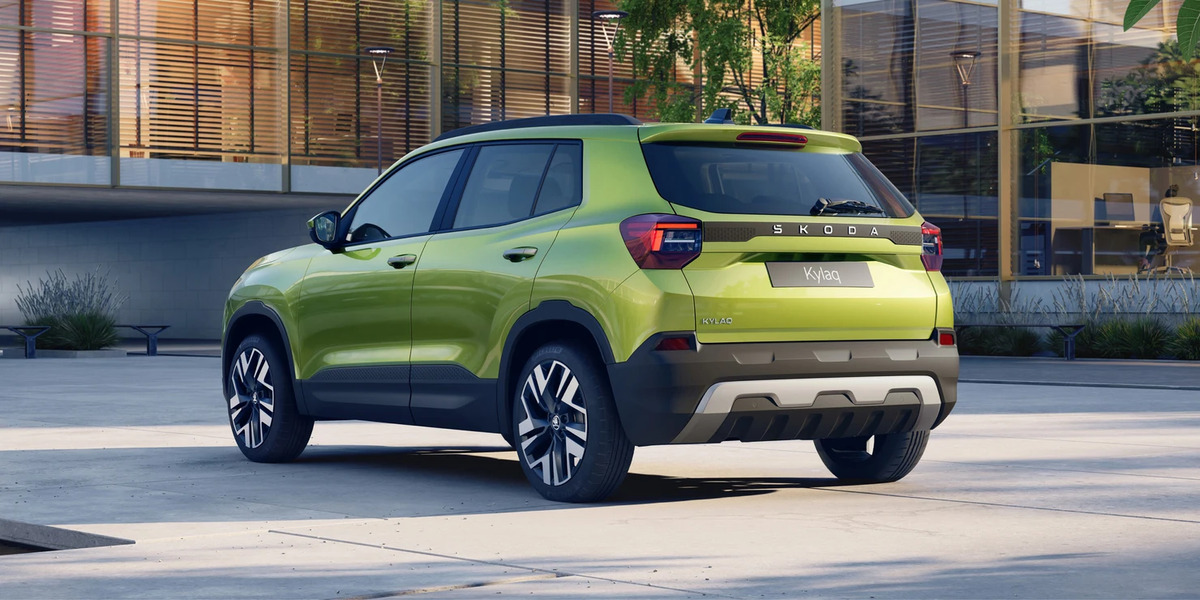
Skoda calls the Kylaq’s design philosophy “Modern Solid.” While that term may sound abstract, what the Kylaq actually delivers is visual restraint.
Built on the MQB-A0-IN platform, the Kylaq measures 3995 mm in length, deliberately staying under the 4-meter mark. This is not accidental. In India, sub-4-meter SUVs benefit from lower taxation, which allows Skoda to price the vehicle more competitively. That strategic engineering decision now benefits Nepali buyers as well.
At the front, the familiar Skoda butterfly grille anchors the fascia. Slim LED DRLs sit above the projector headlamps, creating a layered lighting signature. The bonnet is clean and flat, and the lower bumper gets textured cladding that visually hints at underbody protection.
The side profile is tidy and proportionate. With 189 mm of ground clearance and either 16-inch or 17-inch alloy wheels depending on the trim, the Kylaq stands confidently. Roof rails add functional appeal. However, the silhouette plays it safe,it is balanced rather than dramatic.
At the rear, Skoda avoids the now-trendy full-width light bar. Instead, a black cladding strip with “Skoda” lettering keeps things simple and cohesive. The short rear overhang reinforces its compact proportions.
Available colors include Lava Blue, Olive Gold, Deep Black, Brilliant Silver, Candy White, and Carbon Steel.
Interior
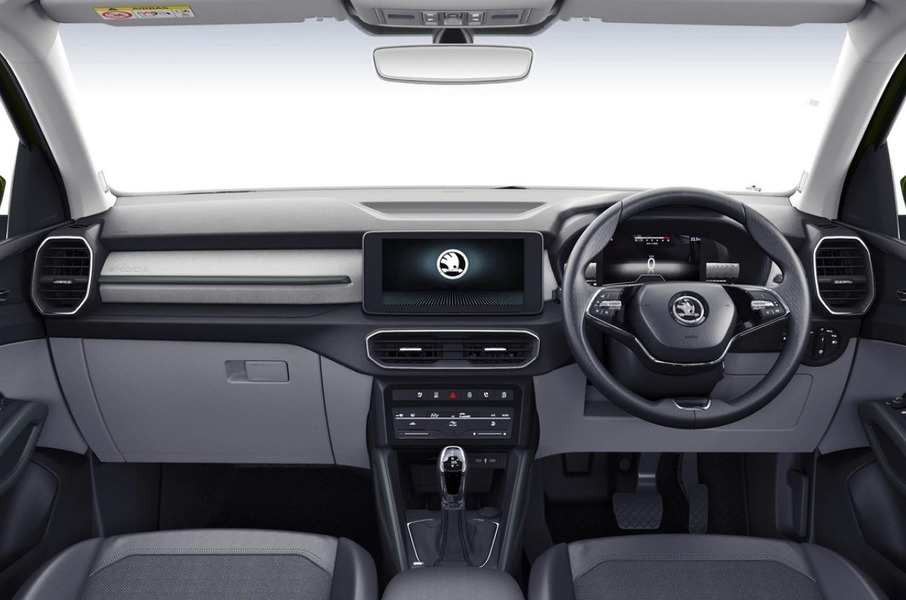
Step inside the Kylaq and you are greeted by a cabin that prioritizes function over flamboyance.
The material quality feels solid and well-assembled. It may not scream “luxury,” but it certainly feels durable and thoughtfully put together. The driving position is low-set, giving it a slightly more car-like feel rather than a tall SUV stance.
Top-tier Prestige+ variants get ventilated front seats and 6-way electric adjustment, while lower trims rely on manual seats without ventilation. The steering wheel offers tilt and telescopic adjustment, and automatic variants include paddle shifters, which is a welcome touch for enthusiasts.
The infotainment experience differs significantly by variant. Lower trims get a 9-inch Lenovo infotainment screen, while higher variants feature a larger and smoother 10-inch system. The instrument cluster ranges from a 3.5-inch TFT unit in base trims to an 8-inch digital cluster in upper variants.
Rear seat space is better than it initially appears. Passengers up to 6 feet tall can sit comfortably, and rear AC vents ensure acceptable comfort levels. Boot space stands at 360 liters, expandable to 1265 liters with the 60:40 split seats folded.
One lingering issue, however, is the air-conditioning performance. While functional, Skoda cabins have historically struggled with aggressive cooling in hotter climates, and early impressions suggest the Kylaq may not completely resolve that concern.
Engine and Performance
If there is one area where the Kylaq confidently carries Skoda’s DNA, it is in driving dynamics.
Under the hood lies the familiar 1.0-litre TSI turbo-petrol engine producing 115 PS between 5000,5500 rpm and 178 Nm of torque from 1750,4000 rpm. On paper, these numbers match the Kushaq. On the road, however, the Kylaq feels more refined.
Noise and vibration levels appear better managed. Whether this is due to improved tuning or simply the Kylaq’s lighter, more compact body, the engine feels smoother and more cohesive here.
Turbo lag is present but well-controlled. The mid-range punch remains the highlight, making overtakes confident and highway cruising effortless. Skoda offers both a 6-speed manual and a 6-speed Tiptronic automatic. The automatic, in particular, suits Nepal’s urban traffic conditions and hilly terrain well, especially with the added manual control via paddle shifters.
Skoda claims mileage figures of 19.68 kmpl for the automatic and 19.05 kmpl for the manual. In real-world mixed driving conditions, expect closer to 12.5 kmpl, depending on driving style.
With a top speed of 188 km/h and a 45-liter fuel tank, the Kylaq balances performance and touring capability effectively.
Ride, Handling, and Practicality
The Kylaq uses a MacPherson Strut front suspension and Twist Beam rear setup. The tuning leans toward comfort, absorbing most road imperfections reasonably well.
Ground clearance of 189 mm is reassuring for Nepali road conditions, whether it is uneven urban streets or rural stretches. The kerb weight ranges from 1213 kg to 1255 kg, depending on transmission.
In everyday usability terms, the Kylaq feels sized just right,compact enough for tight city lanes yet stable enough for highway runs.
Specification at Glance
Category | Specification |
Engine | 1.0L 3-Cylinder Turbocharged TSI Petrol |
Displacement | 999 cc |
Maximum Power | 115 PS @ 5000–5500 rpm |
Maximum Torque | 178 Nm @ 1750–4000 rpm |
Transmission Options | 6-Speed Manual / 6-Speed Tiptronic Automatic |
Drive Type | Front-Wheel Drive (FWD) |
Top Speed | 188 km/h |
Claimed Mileage | 19.05 kmpl (MT) / 19.68 kmpl (AT) |
Fuel Tank Capacity | 45 Litres |
Length | 3995 mm |
Width | 1783 mm |
Height | 1619 mm |
Wheelbase | 2566 mm |
Ground Clearance | 189 mm |
Kerb Weight | 1213 – 1255 kg |
Suspension Setup | MacPherson Strut (Front) / Twist Beam (Rear) |
Boot Space | 360 Litres (Expandable to 1265 Litres) |
Safety Highlights | 6 Airbags, ESC, TCS, TPMS, Hill Assist |
Features and Safety
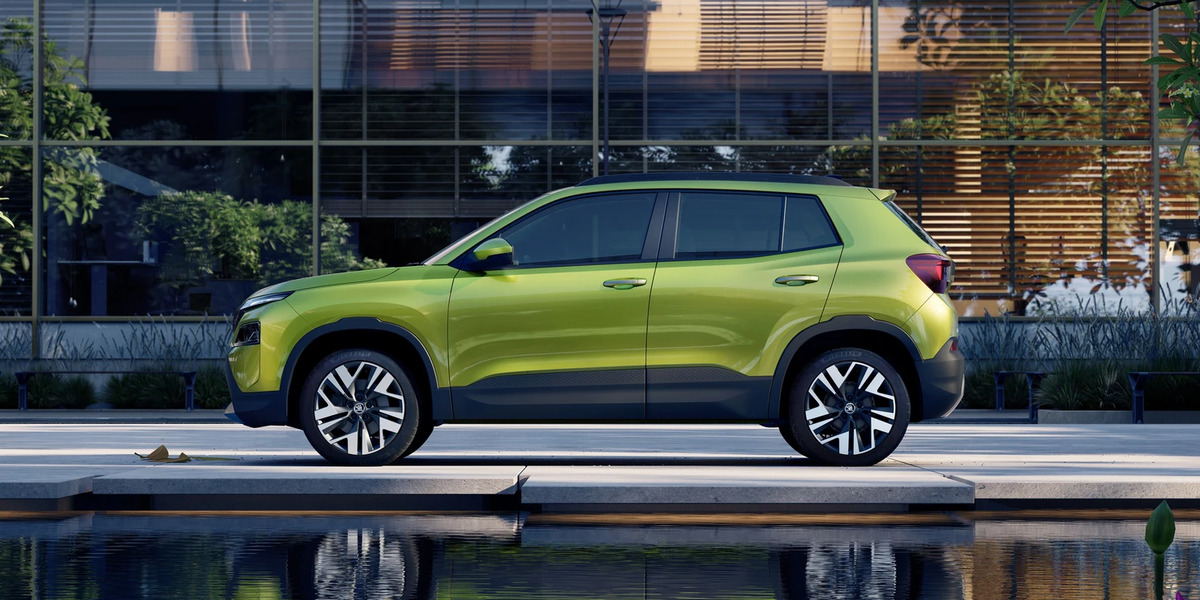
In its fully loaded Prestige variants, the Kylaq comes well equipped with features such as:
Crystalline LED projector headlamps
LED fog lamps with cornering function
Sunroof
Leatherette upholstery
Wireless phone charging
10-inch infotainment system
8-inch digital instrument cluster
Ventilated seats
6-speaker sound system
On the safety front, it boasts a 5-Star Bharat NCAP rating, along with six airbags, ESC, TCS, TPMS, Hill Hold Assist, rear parking sensors, and a rear-view camera.
Lower trims, however, are noticeably less equipped, so buyers will need to carefully evaluate their priorities.
Rivals and Market Position
The compact SUV segment in Nepal is fiercely contested. The Tata Nexon brings rugged character and strong safety credentials. The Kia Sonet leans heavily into styling and features.
The Kylaq positions itself differently. It does not try to out-style the Sonet or out-visualize the Nexon. Instead, it leans on balanced design, European driving dynamics, and mechanical refinement.
However, pricing at the top end puts it above key rivals. This makes the mid-level variants under Rs. 60 Lakhs particularly compelling, especially for buyers who value driving feel and structural safety over flashy electronics.
In a market increasingly shifting toward EVs, launching a petrol SUV may seem bold. But there remains a loyal base of buyers who trust internal combustion engines, particularly turbo-petrol units with proven reliability and predictable servicing. On that front, MAW Vriddhi has confirmed that the Kylaq requires servicing once every 12,000 km or once a year, which should offer some reassurance.
Conclusion
The Skoda Kylaq is not revolutionary. It is not disruptive. And it does not redefine the segment.
But what it does represent is something equally important,a serious, calculated return.
For buyers seeking a compact petrol SUV under Rs. 50 Lakhs with strong safety credentials, solid driving dynamics, and European engineering sensibilities, the Kylaq deserves serious consideration. If your priority is the top-spec variant loaded with features, then the price may require deeper reflection.
In many ways, the Kylaq feels like Skoda reminding Nepal that it still understands how to build a driver-focused SUV. The question now is whether the market, reshaped by EVs and aggressive competition, is ready to respond.
The comeback has begun. The rest depends on how convincingly the Kylaq can deliver where it matters most,on Nepali roads.
For more auto and tech news visit Autoncell
-original.webp)
-original.webp)
-original.webp)