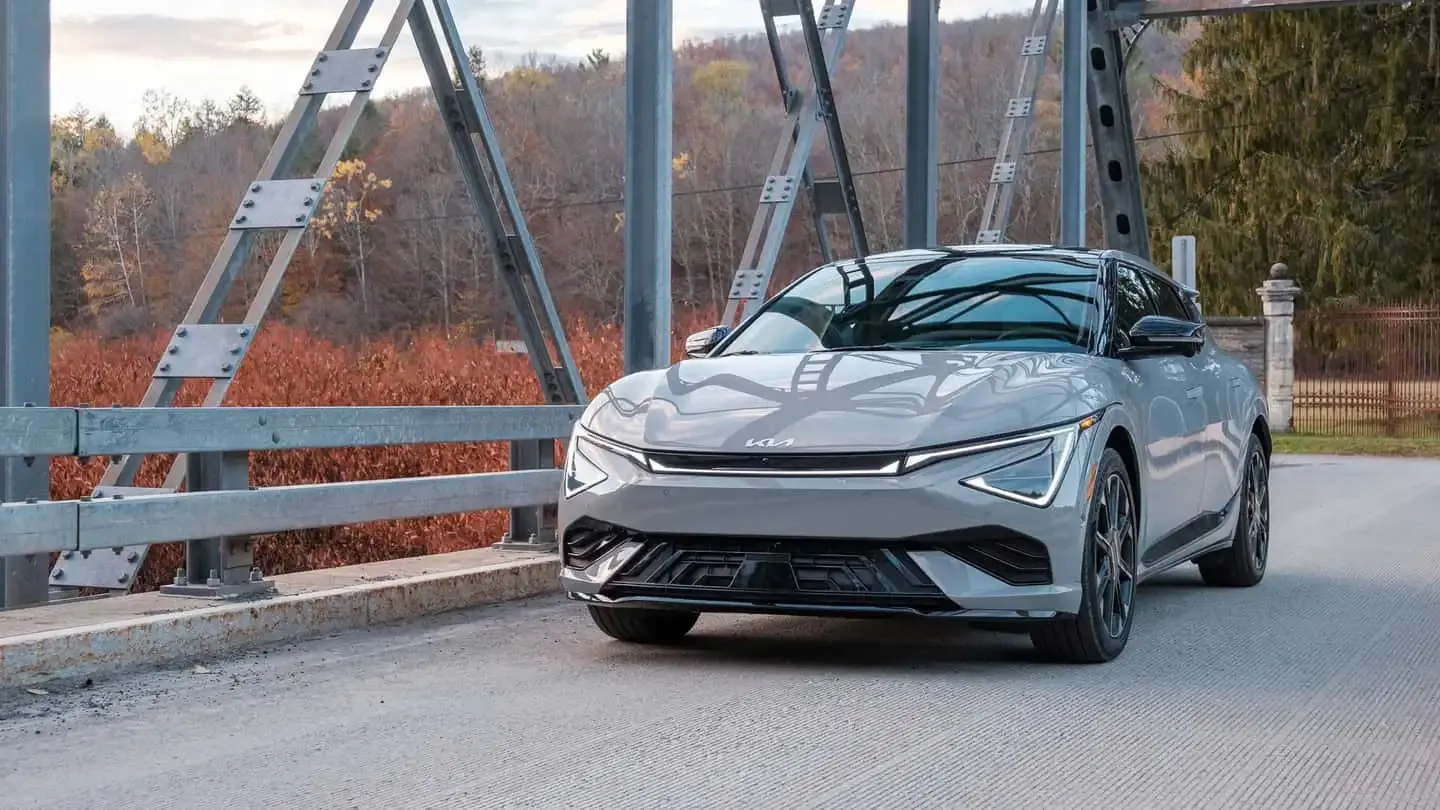
Not long ago, Kia looked like one of the smartest legacy automakers in the electric vehicle race. The EV6 wasn’t just good, it was a statement. When it launched in 2021, it felt like Kia had skipped a generation. Ultra-fast charging, striking design, serious performance credentials, it was the kind of car that made Tesla loyalists glance sideways. Then came the EV9, a bold three-row electric SUV that nearly clinched breakthrough honors across the industry. For a moment, it seemed Kia had cracked the code.
Fast forward two years, and the narrative has shifted dramatically.
Despite posting an overall January sales record, Kia’s EV portfolio is sliding, hard. The EV9, once hailed as the future of family transport, sold just 674 units last month, down 45% year-over-year. The EV6’s situation is even more concerning. Sales fell from 1,542 units in January 2025 to just 540 last month , a 65% collapse. And this isn’t a blip. In 2025, EV6 volumes were already down 40%, while EV9 sales dropped 31%.
The question isn’t whether something changed. It’s what changed, and whether Kia can reverse it.
The Market Reality
Before pointing fingers internally, context matters. The broader U.S. EV market is contracting. The expiration of the $7,500 federal clean vehicle tax credit at the end of September dramatically reshaped pricing psychology. Overnight, U.S.-built EV6 and EV9 models effectively became $7,500 more expensive. Lease structures that once felt like no-brainers lost their financial appeal.
Kia responded aggressively, offering up to $10,000 in manufacturer incentives for a limited period. But incentives are defensive tools. They stimulate movement; they don’t generate organic demand.
Compounding the issue, tariffs have squeezed margins across Kia’s core business. That reduces the company’s financial flexibility, particularly when it comes to supporting EV sales with subsidies, marketing spend, or aggressive pricing strategies.
In isolation, that would explain a dip. But it doesn’t explain why Kia’s EV decline is so much sharper than its closest sibling competitor.
The Ioniq 5 Problem
The Hyundai Ioniq 5 is, mechanically speaking, the EV6’s twin. They share architecture, battery technology, charging systems, and much of their engineering DNA. Yet the sales gap between them is striking.
In January, Hyundai sold 2,126 Ioniq 5 units, compared to just 540 EV6s. That’s a modest 6% decline for Hyundai versus Kia’s 65% plunge. And this is from a far larger base. In 2025, Hyundai moved 47,039 Ioniq 5s. Kia sold just 12,933 EV6s.
Even in 2023, the first full “normal” sales year for both, Hyundai outsold Kia nearly two-to-one: 33,918 Ioniq 5s versus 18,879 EV6s. This isn’t a recent divergence. It’s structural.
From a product perspective, many enthusiasts actually prefer the EV6’s sleeker proportions. But mass-market buyers often don’t shop like enthusiasts. The EV6’s low, raked-back profile reads more like a sporty hatchback than a traditional SUV. The Ioniq 5, by contrast, unmistakably looks like a crossover, upright, boxy, and practical.
That visual clarity matters. There are functional differences as well. The Ioniq 5 feels roomier. Its ergonomics are more intuitive, particularly with its separate media and climate controls. The EV6’s dual-function control interface, while clever, has frustrated some users. In a market where buyers are still learning EVs, simplicity wins.
Then there’s the snowball effect. Once a vehicle gains traction, visibility breeds familiarity, and familiarity breeds sales. The Ioniq 5 is now a common sight in EV-heavy metro areas. It dominates online discussions and YouTube reviews. The EV6, despite updates including a North American Charging Standard (NACS) port and improved software and range, has largely slipped from the conversation.
Marketing matters. Visibility matters. Momentum matters.
Manufacturing Strategy
Kia executives argue the issue is more operational than demand-driven. The EV6 and EV9 are built in West Point, Georgia, alongside high-volume, high-margin models like the Telluride, Sorento, and Sportage. That plant has flexibility. Production can shift between models depending on demand. And demand for hybrids and gasoline SUVs is booming.
From a pure business standpoint, prioritizing Telluride and Sportage output makes sense. Both posted record sales. Factories are capital-intensive assets. They must run at high utilization to justify investment.
Hyundai, however, operates differently. Its EV-focused Metaplant in Georgia primarily builds the Ioniq 5 and Ioniq 9. With fewer product lines to juggle, Hyundai is incentivized to maximize EV production to keep that facility running efficiently.
In other words, Hyundai needs to build EVs. Kia can choose not to. That strategic flexibility may be protecting short-term profitability, but it’s also starving EV6 and EV9 of supply at a time when brand momentum is fragile.
EV9 Internal Competition
When the EV9 launched, it was groundbreaking. A mainstream three-row electric SUV with bold design and strong charging performance, it carved out a new space in the market. It nearly secured major industry awards and was widely praised as proof that legacy automakers could out-innovate startups.
But innovation has a short half-life. Hyundai introduced the Ioniq 9 just a year later. Sales haven’t yet run a full annual cycle, but early numbers show it is already closing the gap, 580 units in January compared to the EV9’s 674.
This isn’t external competition. It’s internal cannibalization. If plant capacity is indeed constrained, Hyundai’s dedicated EV production could allow the Ioniq 9 to overtake the EV9 this year. That would place Kia, once the group’s EV flagbearer, in the uncomfortable position of chasing its corporate sibling.
Design
The EV6’s design is bold, sculpted, and futuristic. It appeals to drivers who want their EV to look advanced. But in broader market terms, it may be too avant-garde.
The Ioniq 5’s retro-modern aesthetic feels approachable. Its boxier stance signals space and practicality immediately. For family buyers, especially those transitioning from traditional SUVs , that familiarity reduces friction.
The EV9, by contrast, remains visually commanding. But as Hyundai’s Ioniq 9 enters the scene with a similar mission and potentially greater production focus, Kia’s first-mover advantage erodes.
Design in today’s EV market isn’t just about aesthetics. It’s about signaling purpose clearly. And in that subtle communication battle, Hyundai may have struck a more resonant chord.
Performance and Charging
Technically, Kia’s EVs remain strong. The EV6 continues to offer excellent performance, rapid DC fast-charging capability, and competitive range figures. Its E-GMP platform architecture remains one of the most advanced among legacy automakers. The addition of a North American Charging Standard port strengthens long-term charging compatibility and alleviates range anxiety concerns.
The EV9 similarly delivers strong real-world usability, impressive charging speeds, and family-friendly packaging. This isn’t a technology failure. The hardware is solid. The fundamentals remain intact.
The slump isn’t happening because the products became bad. It’s happening because market conditions, internal prioritization, branding momentum, and corporate strategy are intersecting at the wrong moment.
Profit vs Positioning
Kia’s record-setting overall sales suggest the company is not in crisis. On the contrary, prioritizing gas and hybrid SUVs in a cooling EV market is financially prudent. Investors likely approve.
But brands are built on long-term perception, not just quarterly numbers. The EV6 was once a symbol of Kia’s transformation from value-focused automaker to innovation leader. The EV9 reinforced that narrative. If those vehicles fade into the background while Hyundai dominates headlines and highways, Kia risks becoming the secondary EV brand within its own corporate family.
And perception is hard to rebuild once lost.
Conclusion: Can Kia Reignite the Spark?
Kia isn’t failing. It’s recalibrating. But recalibration carries risk. The EV market remains volatile, shaped by incentives, tariffs, consumer uncertainty, and infrastructure evolution. In such an environment, conservative production strategy makes sense. Yet leadership in the EV space requires more than good products. It demands relentless visibility, confident marketing, and strategic prioritization.
Kia proved it could build world-class electric vehicles. The EV6 and EV9 were not experiments , they were declarations of intent.
Now, as sales soften and Hyundai surges ahead, the question isn’t whether Kia can compete. It’s whether it’s willing to fight for EV dominance again. Because in the electric era, momentum is everything. And right now, momentum is slipping.
-original.webp)
-original.webp)