-original.webp)
After years of incremental tweaks and quiet refinements, the Bajaj Dominar 400 has finally received the update many riders in Nepal had been waiting for. Not a cosmetic shuffle. Not a token feature addition. But a meaningful upgrade that modernises the motorcycle without disturbing its core identity.
Hansraj Hulaschand & Co., the authorized distributor of Bajaj motorcycles in Nepal, has officially opened bookings for the upgraded Dominar 400. Deliveries are scheduled to begin from February 13, 2026, and interestingly, Bajaj Nepal will now only offer this updated version going forward. The older model has effectively been retired.
The Dominar 400 has always occupied a unique space in Nepal’s motorcycle market. It is Bajaj’s most powerful, heaviest, and most premium offering. It has built a reputation as a dependable highway mile-muncher rather than a city showpiece. With this latest update, Bajaj has not changed the Dominar’s personality, it has simply made it smarter.
So, has Bajaj finally given the Dominar the modern touch it needed? Let’s break it down in detail.
Price and Availability in Nepal
The updated Bajaj Dominar 400 is priced at Rs. 6,34,900 in Nepal.
Bookings are currently open across Bajaj showrooms nationwide. As a pre-booking incentive, Bajaj Nepal is offering a free MT helmet. Deliveries will commence from February 13, 2026.
With only a Rs. 10,000 price increase despite the addition of Ride-by-Wire, Traction Control, riding modes, and a fully digital connected console, the Dominar 400 continues to present itself as strong value within its category.
Design
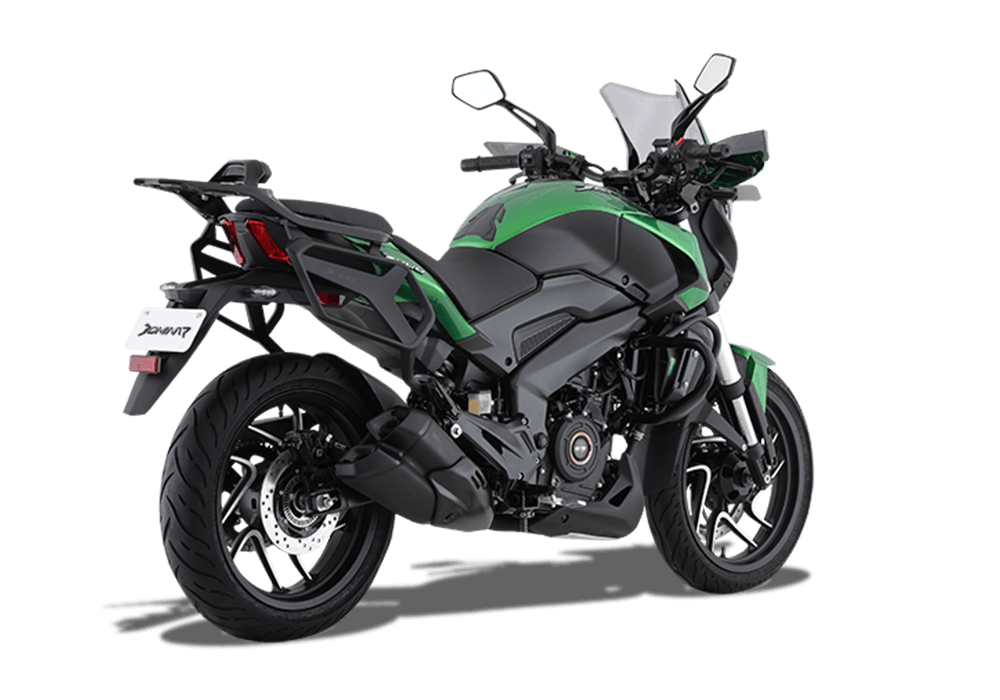
The Dominar 400 continues to wear its power-cruiser identity with confidence. Bajaj has wisely avoided unnecessary visual drama. Instead, the motorcycle retains its muscular proportions and planted stance, attributes that have always defined it.
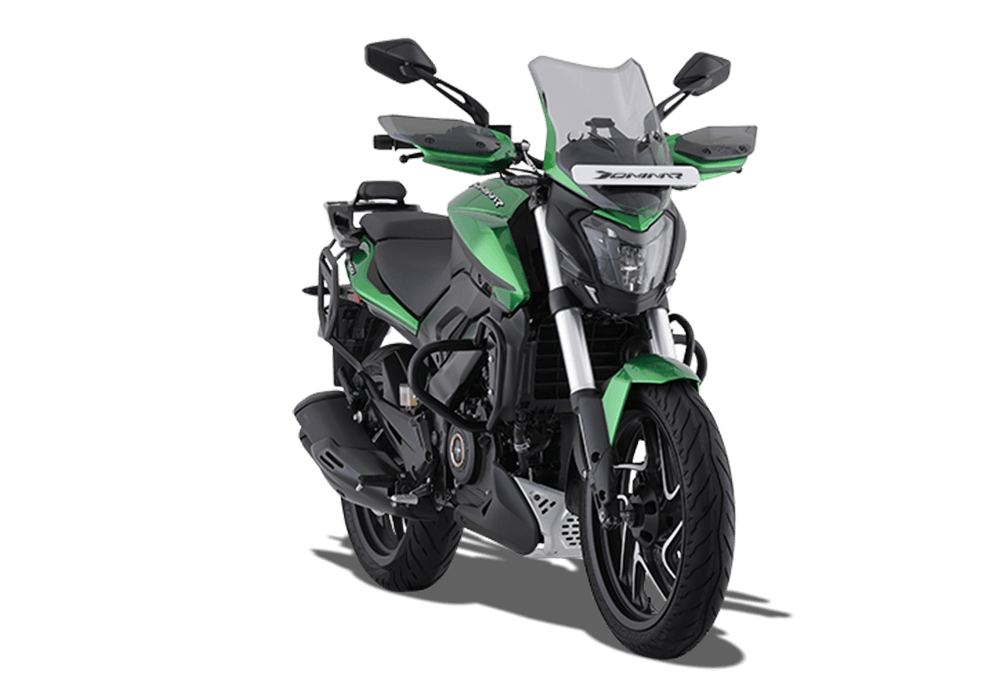
Up front, the signature Mosaic LED headlamp remains untouched, maintaining its wide and assertive road presence. The factory-fitted tall visor enhances its touring credentials, while the chunky 43mm USD forks reinforce the bike’s heavyweight character. The overall silhouette is mature and deliberate, not flashy.
From the side profile, the Dominar’s sculpted 13-litre fuel tank dominates the visual narrative. Sharp creases and strong shoulder lines give it depth, while the long wheelbase and thick swingarm communicate stability. The upswept dual-port exhaust adds a subtle sportiness without compromising its touring DNA.
The rear section remains compact but functional. A neatly integrated LED taillamp sits under the tail cowl, accompanied by practical additions like the Back Stopper and carrier rack , both factory-fitted. This is an important distinction. Bajaj is not selling touring capability as an optional extra; it is building it into the motorcycle.
The Dominar 400 is available in Aurora Green and Charcoal Black, both reinforcing its premium positioning.
The biggest visual and functional change, however, is the new color LCD instrument console. Borrowed from the Pulsar NS400Z, this dot-matrix display finally brings the Dominar into the modern era of connected motorcycles.
Performance
At its heart, the Dominar 400 continues with the proven 373.3cc, single-cylinder, liquid-cooled, DOHC, fuel-injected engine, KTM-derived and well-tested in this market.
It produces 40 PS at 8800 rpm and 35 Nm of torque at 6500 rpm, paired with a 6-speed gearbox featuring an assist and slipper clutch. On paper, nothing has changed. On the road, however, things feel noticeably more refined.
The major transformation lies in the electronics.
The outdated cable-operated throttle has now been replaced by a Ride-by-Wire system. This is not a superficial upgrade. Ride-by-Wire fundamentally alters how throttle inputs are interpreted and delivered. It enables precision, adaptability, and integration with other electronic aids.
With this, Bajaj has introduced four riding modes: Rain, Road, Sport, and Off-Road. Each mode recalibrates throttle response and ABS intervention levels to suit varying road conditions.
Rain mode softens throttle response and increases safety intervention.
Road mode offers balanced everyday performance.
Sport mode sharpens throttle delivery for more aggressive riding.
Off-Road mode reduces ABS interference to allow better control on loose surfaces.
Complementing this is Traction Control, another long-awaited addition. For a 193 kg motorcycle that produces 40 PS, traction management is not just a luxury; it is a meaningful safety enhancement, especially during wet monsoon rides or highway corner exits.
Importantly, Bajaj has preserved the Dominar’s highway gearing. With its 15/45T sprocket setup, it continues to prioritize relaxed cruising over aggressive acceleration. This remains a motorcycle designed to hold triple-digit speeds steadily rather than chase traffic light sprints.
Top speed is rated at 155 kmph, while real-world mileage typically falls between 20–25 kmpl , reasonable figures considering its displacement and weight.
Features
If the previous Dominar felt slightly dated in its electronics, this update decisively fixes that perception.
The new digital color LCD console with dot-matrix display now supports Bluetooth connectivity. Riders get access to:
Turn-by-turn navigation
Call and message alerts
Music control
Lap timer
Various ride data analytics
The interface is clean, readable, and significantly more contemporary than the older twin-display setup.
Adjustable levers have also been introduced, enhancing ergonomics for riders of different hand sizes. Hazard lights are now standard, improving highway safety during emergency stops.
The Dominar continues to offer all-LED lighting, dual-channel ABS, radial tyres, and machined alloy wheels.
But what truly separates it from competitors is the factory-fitted touring package. This includes:
Leg guard
Engine bash plate
Carrier rack
Back stopper
Tall visor
Navigation stay
Many competitors advertise touring potential but require riders to spend extra on accessories. Bajaj integrates it into the base package, strengthening its value proposition.
Chassis, Suspension and Braking
Suspension duties are handled by 43mm USD forks with 135mm travel at the front and a Nitrox-charged monoshock with 110mm travel at the rear. The setup is tuned more for stability than plushness, which suits long highway stretches.
The Dominar rides on 17-inch wheels wrapped in radial tyres, 110/70 at the front and 150/60 at the rear. Braking is managed by a 320mm front disc and 230mm rear disc, supported by dual-channel ABS.
With a kerb weight of 193 kg, the Dominar is undeniably heavy. However, that weight translates into composure at high speeds. Crosswinds and highway undulations are handled with reassuring stability.
Seat height stands at 800 mm, making it accessible for a wide range of riders. Ground clearance is 157 mm, adequate for Nepal’s mixed road conditions.
Specifications at a Glance
Engine: 373.3cc, Single-cylinder, Liquid-cooled, DOHC, FI
Emission Standard: BS6
Max Power: 40 PS @ 8800 rpm
Max Torque: 35 Nm @ 6500 rpm
Gearbox: 6-Speed with Assist & Slipper Clutch
Fuel Tank Capacity: 13 litres
Top Speed: 155 kmph
Mileage: 20–25 kmpl
Front Suspension: 43mm USD Forks
Rear Suspension: Adjustable Monoshock
Front Brake: 320mm Disc
Rear Brake: 230mm Disc
Braking System: Dual-channel ABS
Kerb Weight: 193 kg
Seat Height: 800 mm
Ground Clearance: 157 mmPrice in Nepal: Rs. 6,34,900
Dominar 400 vs Pulsar NS400Z: The Internal Rival
Interestingly, Bajaj’s strongest competitor to the Dominar 400 might be its own Pulsar NS400Z.
Both motorcycles share the same 373cc engine and produce identical power figures. The key difference lies in intent. The Dominar is geared for highway touring, while the NS400Z is tuned for sharper urban performance.
The NS400Z is nearly 19 kg lighter, giving it a superior power-to-weight ratio and more responsive handling. It feels quicker in city conditions and more playful overall.
However, the Dominar remains unmatched for long-distance touring comfort straight from the showroom floor.
The deciding factor for many buyers may be price. With nearly Rs. 59,000 separating the two models, the NS400Z becomes the more budget-friendly option despite offering similar electronic features.
In that context, the Dominar 400 justifies its premium through built-in touring equipment, heavier build quality, and a more planted highway character.
Conclusion
The Dominar 400 has always been a solid motorcycle. Reliable. Stable. Highway-ready. But until now, it felt slightly behind the curve in terms of electronics and rider aids.
This update corrects that imbalance.
By integrating Ride-by-Wire, traction control, multiple riding modes, and a connected color display , without disturbing its touring-focused character, Bajaj has ensured that the Dominar remains relevant in 2026 and beyond.
It may not be the lightest or the quickest machine in its class. But for riders who prioritize stability, highway comfort, and a fully equipped touring package straight from the showroom, the updated Dominar 400 remains one of the most compelling options in Nepal’s premium motorcycle segment.
-original.webp)
-original.webp)
-original.webp)