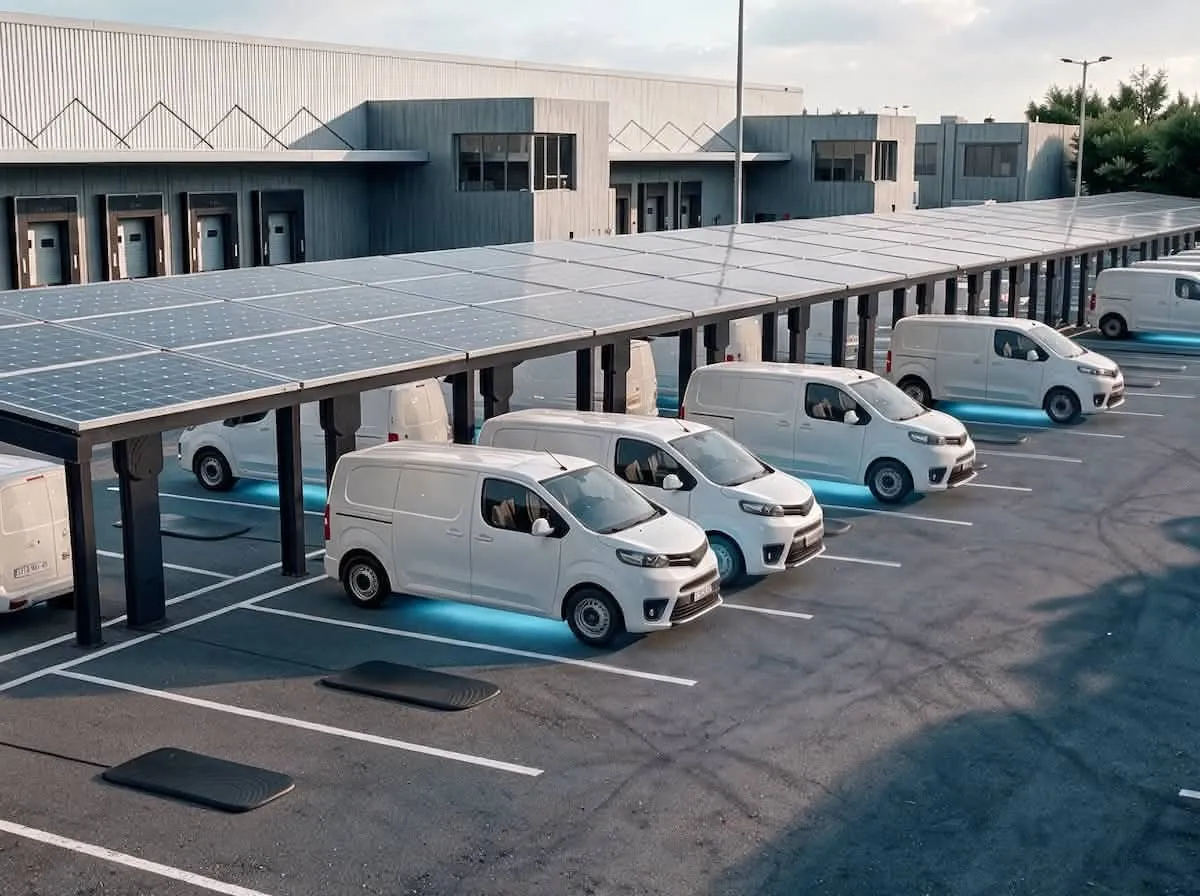
No plug, no cable, no fumbling in the rain. Park over a plate and the car charges itself.
Israeli company Electreon has unveiled Light DOT, a wireless charging system for electric vehicles, at the IAA Transportation show in Hanover. It is aimed squarely at private parking bays and small EV depots rather than highways or public roads, which is a narrower pitch than it first sounds and probably a smarter one.
How it works
The setup has two parts. A charging plate sits on the parking surface, and a control unit mounts on a wall or an outdoor pole. That is it. Electreon says installation needs none of the dedicated cabling, plugs or heavy construction a conventional charger demands.
Once a vehicle parks over the plate, the system identifies it and begins charging on its own. Drivers manage the session through the Electreon Flow app rather than touching anything physical.
Power transfer runs on magnetic induction. A receiving coil fitted to the underside of the vehicle, matched to the specific model, picks up energy from the plate and feeds it into the battery. Maximum output is 11 kW.

Built for weather
Electreon rates Light DOT for operation between minus 30 and 50 degrees Celsius, and says it works through rain and snow.
That matters more than it might seem. Plugging in a cable during a downpour is one of the small daily annoyances that puts people off EVs, and it is exactly the kind of friction a system like this removes rather than reduces.
Light DOT at a glance
Wireless charging via magnetic induction
Charging plate on the parking surface, control unit on a wall or pole
Up to 11 kW of charging power
Automatic vehicle identification and session start
Managed through the Electreon Flow app
Operating range of minus 30 to 50 degrees Celsius
Rated for use in rain and snow
Designed for private parking and small EV fleets, not highways
What Electreon is not saying
Here is where the enthusiasm needs tempering. The company has not announced pricing, a commercial availability date, or which markets it will launch in first. It has also withheld detailed charging performance figures and real-world usage data.
For a product shown at a major trade fair, that is a lot of blanks. It suggests Light DOT is closer to a proof of concept than a shipping product.
The track record
Electreon is not starting from nothing. The company already runs similar wireless charging technology at a bus station in Rosh HaAyin, Israel, and the numbers from there are reasonable: 89.3 percent energy efficiency with the system operational 99 percent of the time.
Uptime of 99 percent is the more telling figure. Efficiency losses of roughly 10 percent against a cable are the known cost of going wireless. Reliability is what decides whether an operator trusts the technology enough to depend on it.
Where this actually fits
Wireless charging is not going to replace fast charging on long trips, and Electreon is not pretending otherwise by keeping Light DOT out of the highway conversation.
Where it makes sense is the vehicle that returns to the same spot every night. A car in a home garage. A delivery van in a depot. A fleet with fixed parking. In those cases the cable is pure friction, repeated daily, and 11 kW overnight is more than enough to fill a battery.
The open question is cost. Wireless charging has been technically viable for years. What has kept it out of driveways is that plugging in a cable is cheap and only mildly irritating. Until Electreon puts a price on Light DOT, there is no way to judge whether it has solved that problem or simply built a more elegant version of it.
For more on EV technology, charging infrastructure and new launches, Autoncell covers it as it happens.