For years the Surface line has been an interesting alternative. Nicely built, well designed, never quite the machine a professional would pick over a MacBook Pro.
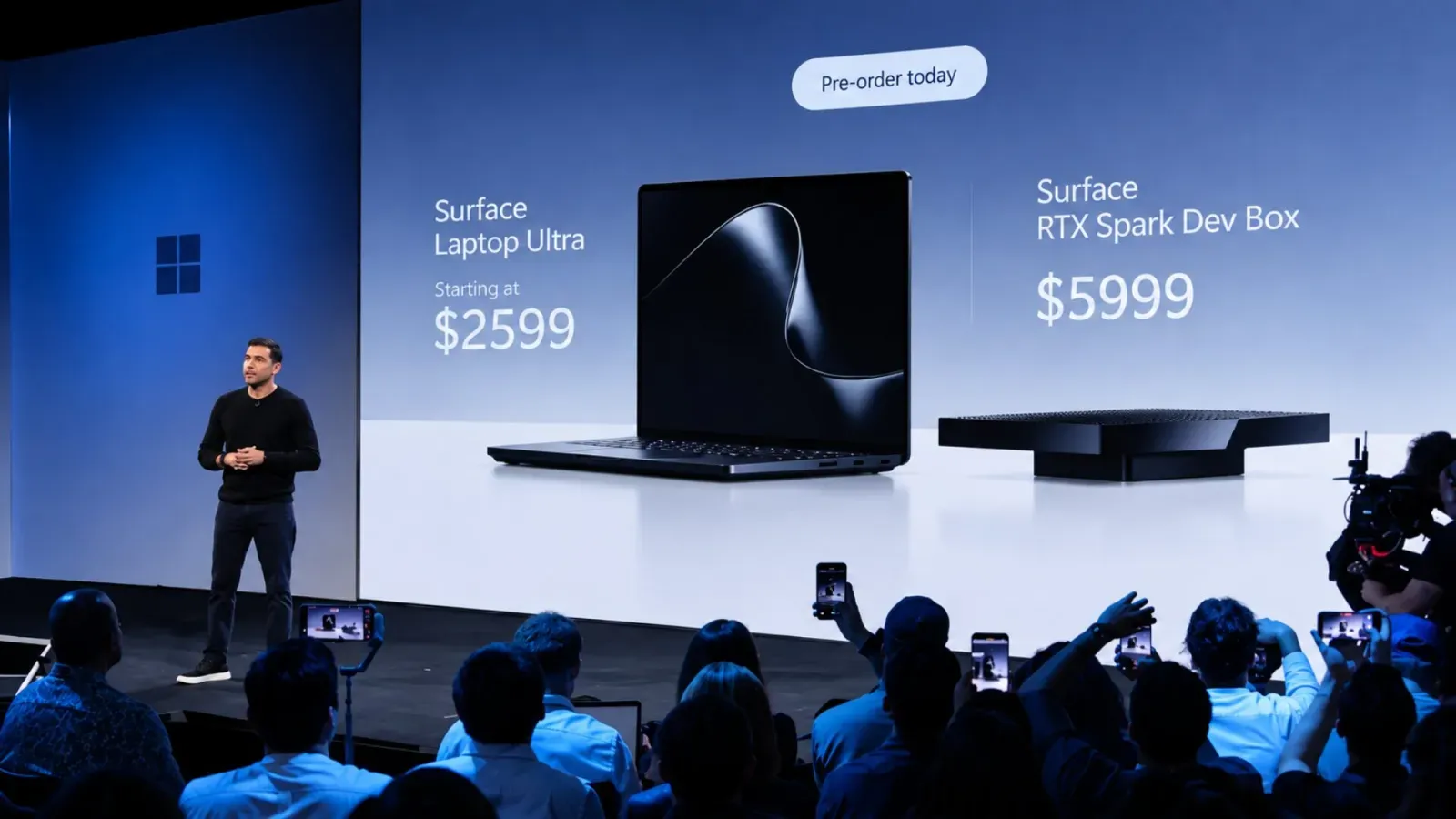
The Surface Laptop Ultra is the first time Microsoft has stopped playing that role. It is the first Surface laptop ever built around a standalone Nvidia chip, it carries up to 128GB of unified memory, and Microsoft claims it generates AI video 6.2 times faster than an M5 Pro MacBook Pro. Jensen Huang came on stage to help announce it.
It starts at $2,599, climbs past $5,900 fully configured, and it ships on 16 October. Here is what is actually inside it, and where the launch claims need a closer look.
What the RTX Spark actually is
The name is doing a lot of work, so worth unpacking.
The RTX Spark Superchip combines an Arm-based Nvidia Grace CPU with a Blackwell RTX GPU on a single package, sharing one pool of LPDDR5X memory. At the top configuration that means a 20-core CPU and a 6,144-core GPU with 128GB of unified memory.
There are two tiers. The S2 runs 18 CPU cores and a 5,120-core GPU with 24GB or 32GB of memory. The S3 steps up to 20 cores and 6,144 GPU cores, available with 32GB, 48GB, 64GB or 128GB.
In graphics terms, the GPU sits roughly at RTX 5070 level. That is serious hardware for a 15-inch laptop, and it is the first time Microsoft has shipped anything close to it in a Surface.
The unified memory part matters more than the core counts. Instead of splitting memory between CPU and GPU, everything draws from one pool, which is precisely what large AI models need. Running a big model locally is usually a memory problem, not a compute problem, and 128GB solves it in a way almost nothing else at this size can.
The performance claims, and the asterisk
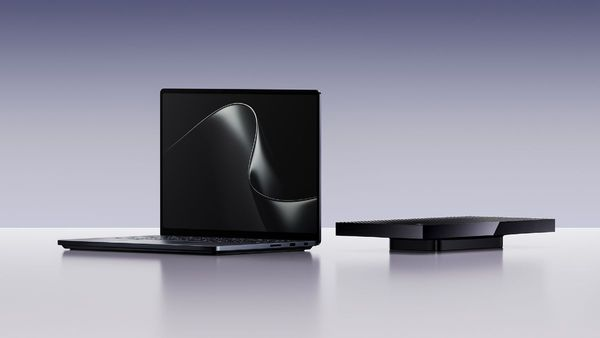
Microsoft put hard numbers up on stage. The Surface Laptop Ultra generates AI images 4.3 times faster than an M5 Pro MacBook Pro, and AI video 6.2 times faster.
Now read the footnote. That testing was conducted by Microsoft in September 2026 using preproduction software on preproduction hardware with 64GB of RAM and 1TB of storage.
So: the manufacturer tested its own unfinished product against a competitor, on workloads it selected. That is not dishonest, it is just how launch benchmarks work everywhere. But nobody should treat these as settled until independent reviewers get retail units.
The live demonstration was more convincing than the slides. Microsoft ran Gears of War: E Day, GitHub Copilot and DaVinci Resolve simultaneously. Gaming, AI assistance and professional video editing at once would flatten most laptops, and that is harder to stage-manage than a bar chart.
Display, ports, and one odd omission
The screen is a 15-inch PixelSense Ultra touchscreen using Mini-LED with 2,000 nits peak brightness. Microsoft also says this has the most ports of any Surface Laptop, which addresses a complaint that has followed the line for years.
Then there is the strange part. The display responds to touch only. There is no Surface Pen support.
On a machine aimed at creative professionals, from a company that effectively built its tablet reputation on pen input, that is a genuinely puzzling decision. Illustrators and designers are exactly the buyers this specification should attract, and Microsoft has handed them a touchscreen they cannot draw on properly.
Microsoft has also not published battery life figures, saying only that the laptop maintains full performance on battery. When a company skips a number at launch, it is usually because the number is not flattering.
Execution Containers and what Windows is becoming
The software announcements may outlast the hardware in significance.
The Surface Laptop Ultra runs a revamped Windows 11 with Execution Containers, which sandbox AI agents so they can act on your machine without free rein over it. Satya Nadella confirmed the feature is coming to all Windows 11 users, not just this laptop.
Nadella's framing was that a model on its own achieves very little. What makes it useful is orchestration, external memory and a harness layer that combines multiple models with context and actions.
That is the real pitch. Hybrid AI lets you route simple tasks to a free local model instead of a paid cloud API, keeps sensitive data on your own machine, and cuts dependence on a constant internet connection. For businesses the cost argument is obvious. For anyone working somewhere with unreliable connectivity, the second point matters just as much.
Alongside the laptop, Microsoft announced the Surface RTX Spark Dev Box, a desktop for developers at $5,999, shipping in November.
Surface Laptop Ultra at a glance
Nvidia RTX Spark Superchip, Grace Arm CPU plus Blackwell RTX GPU
Up to 20 CPU cores and 6,144 GPU cores
Up to 128GB LPDDR5X unified memory
GPU performance roughly at RTX 5070 level
15-inch PixelSense Ultra Mini-LED touchscreen, 2,000 nits peak
Most ports of any Surface Laptop
Windows 11 with Execution Containers for sandboxing AI agents
Claimed 4.3x faster AI image generation than M5 Pro MacBook Pro
Claimed 6.2x faster AI video generation
No Surface Pen support
Specifications
Specification | Detail |
Chip | Nvidia RTX Spark Superchip |
CPU | Arm-based Nvidia Grace, 18 cores (S2) or 20 cores (S3) |
GPU | Blackwell RTX, 5,120 cores (S2) or 6,144 cores (S3) |
Memory | 24GB to 128GB LPDDR5X unified |
Display | 15-inch PixelSense Ultra Mini-LED touchscreen, 2,000 nits peak |
Pen Support | None, touch only |
Operating System | Windows 11 with Execution Containers |
Battery Life | Not disclosed |
Availability | Pre-orders open, ships 16 October 2026 |
Price
Model | Price |
Surface Laptop Ultra, base | $2,599 |
Surface Laptop Ultra, second base configuration | $3,700 |
Surface Laptop Ultra, highest configuration | Up to $5,900 |
Surface RTX Spark Dev Box | $5,999, ships November 2026 |
No Nepal launch, pricing or availability has been announced, and we are not estimating a local figure here. Surface hardware has historically had limited official presence in Nepal, so anyone interested should expect grey-market pricing rather than authorised retail, with the usual warranty complications that brings.
The problem nobody wants to discuss
Here is the caveat that will decide whether this laptop works for you, and Microsoft has been unusually upfront about it.
The RTX Spark is Arm-based. Many popular applications now run natively on Arm and perform well. But Microsoft's own guidance says that if you rely on specialized hardware drivers, plug-ins or older utilities, you should check compatibility before buying.
Anyone who lived through the Surface Pro X years knows how this goes. Arm Windows has improved enormously, but professional workflows tend to depend on exactly the kind of software that breaks: niche plug-ins, legacy drivers, hardware dongles, industry-specific tools that nobody has recompiled.
A machine this expensive, aimed at engineers and creatives, is precisely where that risk bites hardest. Check your actual toolchain before putting money down. The benchmark numbers mean nothing if the plug-in you use every day refuses to load.
The worst possible time to launch a 128GB laptop
The timing is unfortunate, and it is not Microsoft's fault.
The PC industry is in the middle of a severe memory and storage shortage. DRAM and NAND prices have more than doubled, manufacturers have been raising prices across the board, and the component squeeze is not expected to ease before 2028.
As we covered in the global laptop brand rankings, memory had risen to roughly 23 percent of a PC's component cost by 2026, with HP telling investors it had reached 35 percent of its bill of materials.
Now consider what the Surface Laptop Ultra is selling. Its headline feature is 128GB of unified memory. The single most expensive component in the industry right now is the thing this laptop is built around.
That explains the price ladder reaching $5,900, and it suggests these figures will not be getting friendlier any time soon. If you want one, waiting for a discount is probably the wrong strategy.
How it compares to the rest of the Surface line
Worth noting how much of a departure this is.
Microsoft's Surface Pro and Surface Laptop refreshes have followed a predictable pattern for years: new Intel chips, display improvements, incremental gains. Solid, sensible, unexciting.
The Ultra is not that. Different silicon vendors, different CPU architecture, a workstation-class GPU, and a price that doubles the usual Surface Laptop entry point. Microsoft has built a genuinely different class of machine and given it a name that signals as much.
Who should actually buy this
Three groups, and they are narrower than the marketing suggests.
People running AI models locally. If you are working with large language models, image generation or video models and currently paying cloud bills, 128GB of unified memory on your desk changes both the economics and the privacy position. This is the clearest case for the machine.
Developers working on agentic systems. Execution Containers plus local inference is a legitimate development environment, and the Dev Box exists for exactly this crowd.
Creative professionals, with a caveat. The GPU and display are genuinely strong for video and 3D work. But verify your plug-ins run on Arm first, and accept there is no pen.
For everyone else, including most people who just want a very good premium laptop, this is a lot of specialised hardware you will not use, at a price that reflects it.
Conclusion
The Nvidia partnership is the real story, more than any single product.
Microsoft going to Nvidia for an Arm superchip, rather than Intel, AMD or Qualcomm, says it believes local AI performance is what premium laptops will compete on next. Nadella's comments about orchestration and harness layers point the same direction, toward a Windows that assumes AI agents are running on the machine rather than in a browser tab.
Whether this specific laptop succeeds matters less than whether that bet is right. If it is, every premium laptop in two years will be measured on how much AI work it can do without an internet connection.
For buyers in Nepal, the near-term takeaway is simpler and less encouraging. Flagship machines are getting more expensive, the component shortage has years left to run, and the specification that makes this laptop interesting is the one driving its cost.
For more on new launches, prices and the tech market in Nepal, Autoncell covers them as they land.