Thirteen years to build ten million cars. That is the headline number, and it is genuinely impressive.
The more interesting detail is which car BYD chose to mark it with. Lu Tian, general manager of BYD's Dynasty sales division, announced on September 29 that the ten millionth Dynasty vehicle had rolled off the line, and the company picked the Da Han, its new flagship sedan. A model that has not launched yet, in a segment where the Dynasty range is currently selling almost nothing.
That choice is not an accident, and it tells you where BYD thinks it needs to go next.
Thirteen years from the Qin
The Dynasty series started in August 2013 with the BYD Qin. Thirteen years later it spans six model families, Tang, Han, Qin, Song, Yuan and Xia, covering 27 distinct vehicles across various model years.
The pace of the last stretch is worth noting. Cumulative Dynasty sales stood at roughly 8.86 million in January 2026 and crossed 10 million by late September. That is more than a million cars in under nine months, on a series that took over a decade to reach its first eight.
Set against BYD's wider business, the Dynasty range has done the heavy lifting. Of the company's first 15 million new energy vehicles, Dynasty contributed around 9 million, with the Ocean series accounting for about 6 million.
The milestone car nobody is buying yet
Here is the tension in this story.
The Dynasty lineup sold 170,842 vehicles in August, up 13.9 percent year on year. Strong numbers. But look at where they came from. The Yuan family moved 84,550 units, Song 47,350 and Qin 21,826. Those three accounted for roughly 89.8 percent of the month.
The flagships? The Han family sold 2,997 units in August. Tang managed 12,340. Together the two premium families made up about 9 percent of Dynasty's monthly volume.
So BYD celebrated a ten million milestone with a car from the part of its range that is currently selling the worst. That is a statement of intent rather than a reflection of reality, and it fits with the Da Tang SUV, which launched on June 17 and reached 10,000 deliveries by July 23.
The mainstream models pay the bills. The flagships are supposed to change how people see the brand.
The Da Han
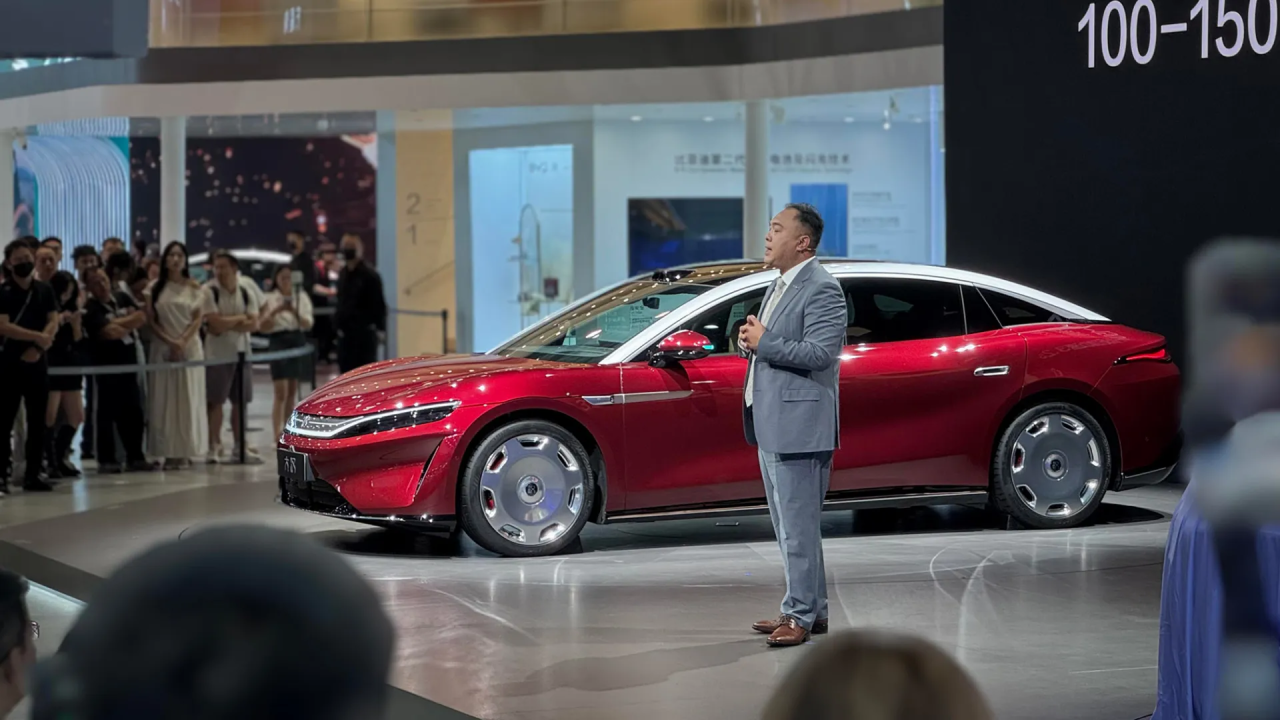
The car itself is substantial. It measures 5,256mm long, 1,999mm wide and 1,510mm tall, sitting on a 3,130mm wheelbase, which puts it squarely in full-size territory.
Chassis hardware includes dual-chamber air suspension and rear-wheel steering, the latter bringing the turning radius under five metres. On a car this long, that is the difference between usable and infuriating in a city.
The entry version runs a single electric motor producing 370 kW, or 496 hp, drawing on a 102.326 kWh battery pack. Claimed range is 1,008 km on China's CLTC cycle, which translates to 827 km on the stricter WLTP standard. The WLTP figure is the one to pay attention to, and it is still an exceptional number.
Driver assistance runs on BYD's DiPilot 300 hardware, offering navigation assistance on both highways and urban roads. A plug-in hybrid version has been filed for regulatory approval, though pre-sales for that have not opened.
The Da Han launches on October 13, with pre-sale pricing for the three battery-electric variants set between RMB 249,900 and 299,900, roughly USD 37,220 to 44,670.
BYD Da Han key specifications
Length 5,256mm, width 1,999mm, height 1,510mm
Wheelbase 3,130mm
Single motor producing 370 kW (496 hp) on the entry version
102.326 kWh battery pack
1,008 km CLTC range, 827 km WLTP
Dual-chamber air suspension
Rear-wheel steering with a sub-five-metre turning radius
DiPilot 300 with highway and urban navigation assistance
Pre-sale pricing from RMB 249,900 to 299,900
Why the premium push matters
BYD has spent years winning on volume and price. The Yuan, Song and Qin families exist to move in enormous numbers at accessible money, and they do exactly that.
The problem with that position is margin. Selling 84,550 Yuans generates revenue, but not the kind of profit per unit that funds long-term development, and it leaves the brand boxed into a perception of cheap and capable rather than desirable.
That is what Da Han and Da Tang are for. Whether Chinese buyers accept a BYD at nearly RMB 300,000 is the actual test, and the August flagship numbers suggest the answer is not settled yet.
The overseas picture
There is a wider shift happening alongside this.
BYD's first-half results showed overseas revenue of RMB 181.268 billion, about USD 27 billion, representing 52.57 percent of total revenue. That is the first time international business has outstripped the domestic market for the company.
The targets have moved accordingly. BYD has lifted its 2026 overseas sales goal from 1.5 million vehicles to between 1.9 and 2 million, with 2027 set above 2.5 million.
For markets like Nepal, where BYD has become one of the more visible EV brands, that matters more than any production milestone. A company deriving over half its revenue from exports has strong reason to keep expanding its dealer networks and model availability outside China.
Conclusion
Ten million cars from a single model family in thirteen years is a serious achievement, and it explains how BYD went from a battery manufacturer to the largest NEV maker in the world.
But the story underneath the milestone is a company trying to move upmarket while its volume sits at the bottom. The Da Han is a genuinely impressive machine, with 827 km of WLTP range, air suspension and rear-wheel steering at a price that would buy a mid-spec European sedan. Whether buyers are ready to pay that for a BYD badge is the question October 13 starts to answer.
For markets outside China, the more relevant number is 52.57 percent. That is the share of BYD's revenue now coming from abroad, and it is the reason this company is going to keep showing up in more places.
For more on EV launches, prices and the auto market in Nepal, Autoncell covers them as they land.