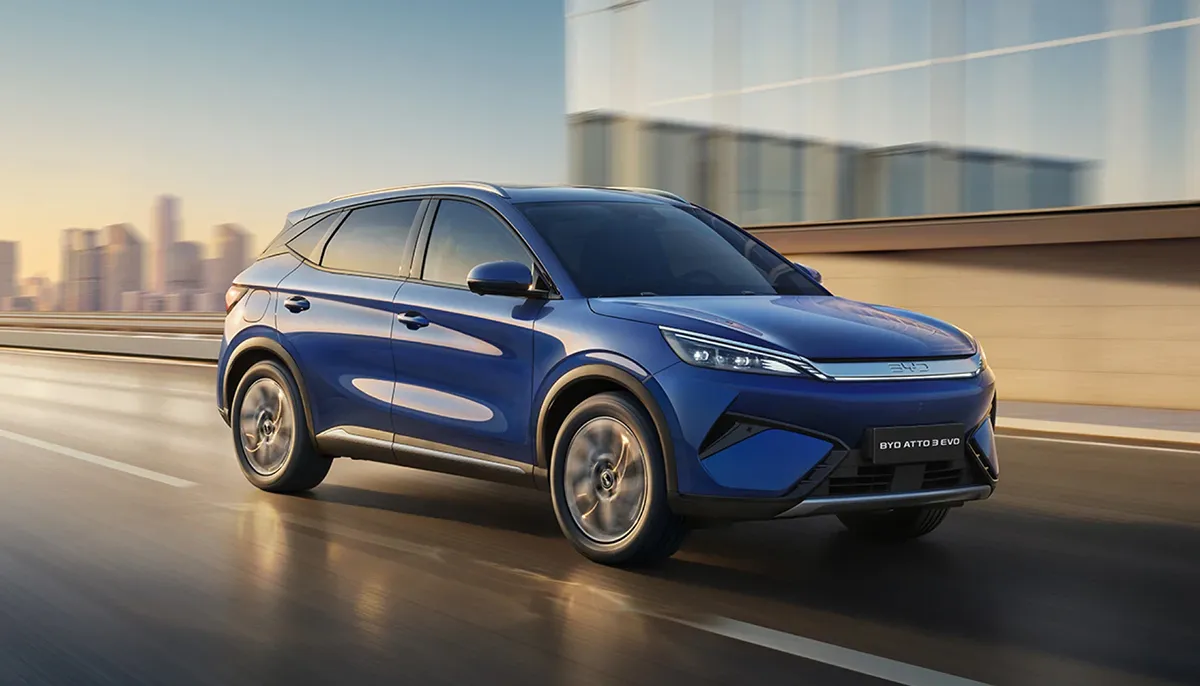
There was a time when the Atto 3 quietly introduced many global buyers to what modern Chinese electric vehicles could achieve. It wasn’t just affordable or well-equipped; it felt mature. With the new BYD Atto 3 Evo, BYD isn’t rewriting the formula, it’s refining it in ways that suggest the company is thinking several moves ahead.
The Evo is not a cosmetic facelift. It is a structural and technological upgrade to the standard BYD Atto 3, bringing a larger battery, an 800-volt architecture, a new suspension setup, and for the first time, a dual-motor all-wheel-drive configuration. In a segment that is becoming fiercely competitive, these aren’t minor updates. They are strategic enhancements designed to future-proof the nameplate.
What makes the Atto 3 Evo particularly interesting is that it signals BYD’s confidence. The brand is no longer just competing on value, it is pushing performance, charging speeds, and chassis sophistication into territory that was once reserved for far more expensive electric SUVs.
Read the full article about The Price of BYD Atto 3 in Nepal
Design
Visually, the Evo retains the familiar proportions of its predecessor. At 4455 mm long, 1875 mm wide, and 1615 mm tall, the dimensions remain unchanged. That continuity is deliberate. The Atto 3’s footprint has always struck a smart balance between urban maneuverability and family practicality.
Rather than reshaping the silhouette, BYD has focused on refining usability. The trunk capacity now stands at 490 litres, expanding to 1360 litres with the rear seats folded. There is also a 101-litre front trunk, an addition that makes daily practicality more flexible, especially for charging cables or smaller luggage.
Interior space has been marginally improved, though not dramatically. The real transformation lies in how the cabin is organized and experienced.
Interior
Step inside the Atto 3 Evo and you immediately notice a shift in layout philosophy. The cabin now feels less playful and more purpose-driven. The gear selector has been relocated to the steering column, freeing up valuable space in the center console. It’s a small change with a big ergonomic impact, drivers get a more open, less cluttered cockpit.
The driver faces an 8.8-inch digital instrument cluster, while a large 15.6-inch central touchscreen dominates the dashboard. The infotainment system integrates mapping and voice control, reinforcing BYD’s ambition to offer a tech-forward driving environment without requiring constant smartphone dependence.
Higher-spec variants go further with a head-up display and heated rear seats, features that elevate the car’s comfort credentials, especially in colder climates. Standard driver-assistance systems are included across all trims, ensuring that safety technology is not reserved for top-end buyers.
The overall impression is of a cabin that has matured. It feels less experimental and more refined, more aligned with global expectations for a compact electric SUV in 2026 and beyond.
Powertrain
Here is where the Evo truly distances itself from the outgoing model.
The rear-wheel-drive “Design” variant features a single motor mounted at the rear axle. It produces 313 PS and 380 Nm of torque, launching the SUV from 0 to 100 km/h in just 5.5 seconds. For a compact electric family vehicle, that’s brisk, more than enough to make overtaking effortless.
But the real headline act is the dual-motor all-wheel-drive “Excellence” trim. With an additional motor up front, total output jumps to 449 PS and 560 Nm. The 0–100 km/h sprint drops to an impressive 3.9 seconds. That puts the Atto 3 Evo into territory that used to belong to performance EVs costing significantly more.
This dual-motor setup transforms the character of the vehicle. It’s no longer just a practical electric SUV; it becomes a genuinely quick crossover capable of surprising traditional performance cars at traffic lights.
Battery and Charging
The Evo is equipped with a 74.8 kWh battery pack, an increase over the previous model. Range figures under WLTP testing stand at 510 km for the rear-wheel-drive version and 470 km for the all-wheel-drive variant.
These numbers are competitive on a global scale. But perhaps more important is the adoption of an 800-volt electrical architecture. Fast charging is supported at up to 220 kW, enabling the battery to reach 80% capacity in roughly 25 minutes at a compatible charger.
This is a significant development. Many mainstream EVs still operate on 400-volt systems. By moving to 800 volts, BYD is aligning the Atto 3 Evo with next-generation charging infrastructure. For long-distance travel, reduced charging time is as critical as total range.
The message is clear: the Evo is built not just for today’s charging networks, but for the high-speed DC corridors of the near future.
Chassis and Ride
Perhaps the most technically interesting update is hidden beneath the body. The rear suspension has been revised from a four-link to a five-link design.
This change may not grab headlines, but it speaks volumes about BYD’s engineering direction. A five-link rear suspension typically improves ride comfort and wheel control, especially over uneven surfaces. It allows for better separation of longitudinal and lateral forces, which translates into more stable cornering and a more composed ride.
In practical terms, drivers can expect improved handling precision and enhanced comfort, two qualities that are often difficult to balance in compact SUVs. This upgrade suggests BYD is investing not just in battery and software technology, but in mechanical refinement as well.
Practical Technology
Beyond performance and charging, the Atto 3 Evo includes vehicle-to-load capability rated at up to 3 kW. This means the SUV can power external devices, camping equipment, tools, or even small appliances.
It is the kind of feature that quietly expands what an EV can do in daily life. In regions with unreliable power supply or for outdoor enthusiasts, this functionality adds tangible value beyond transportation.
Specifications at a Glance
Dimensions: 4455 mm (length) × 1875 mm (width) × 1615 mm (height)
Battery Capacity: 74.8 kWh
WLTP Range:
Up to 510 km (Rear-Wheel Drive)
Up to 470 km (All-Wheel Drive)
Power Output:
313 PS (Single-motor RWD)
449 PS (Dual-motor AWD)
Fast Charging: Up to 220 kW (800-volt architecture)
0–80% charge in approximately 25 minutes
Cargo Capacity:
490 litres (standard)
1360 litres (rear seats folded)
101-litre front trunk (frunk)
What This Means for Markets Like Nepal
In Nepal, the current Atto 3 is offered with 49.92 kWh and 60.48 kWh battery options, delivering WLTP ranges of 345 km and 420 km respectively, with prices ranging from Rs 56.9 lakh to Rs 67.8 lakh.
If the Evo makes its way to Nepal, it would represent a significant step up in both range and performance. A 74.8 kWh battery paired with 800-volt fast charging could redefine expectations in the local EV segment, particularly for buyers who frequently travel between cities.
More importantly, the addition of an all-wheel-drive variant could open up new possibilities in a country where varied terrain often challenges front-wheel-drive electric SUVs.
Conclusion
The Atto 3 Evo is not a radical redesign, and that is precisely its strength. BYD has taken an already successful platform and methodically enhanced the areas that matter most: battery capacity, charging speed, suspension sophistication, interior usability, and performance.
This is how a product matures. Not through flashy gimmicks, but through deliberate engineering improvements.
With the Evo, BYD is signaling that it no longer wants to be seen merely as a value-driven alternative. It is positioning itself as a serious global EV manufacturer capable of delivering speed, range, technology, and refinement in one cohesive package.
The Atto 3 Evo doesn’t just evolve the nameplate, it elevates it.
-original.webp)
-original.webp)
-original.webp)
-original.webp)