For years, the global electric vehicle (EV) story has been one of relentless growth. Month after month, new records were set, fueled by government incentives, tightening emissions regulations, and a growing shift in consumer mindset. But February tells a different story, one that feels less like a temporary pause and more like a reality check.
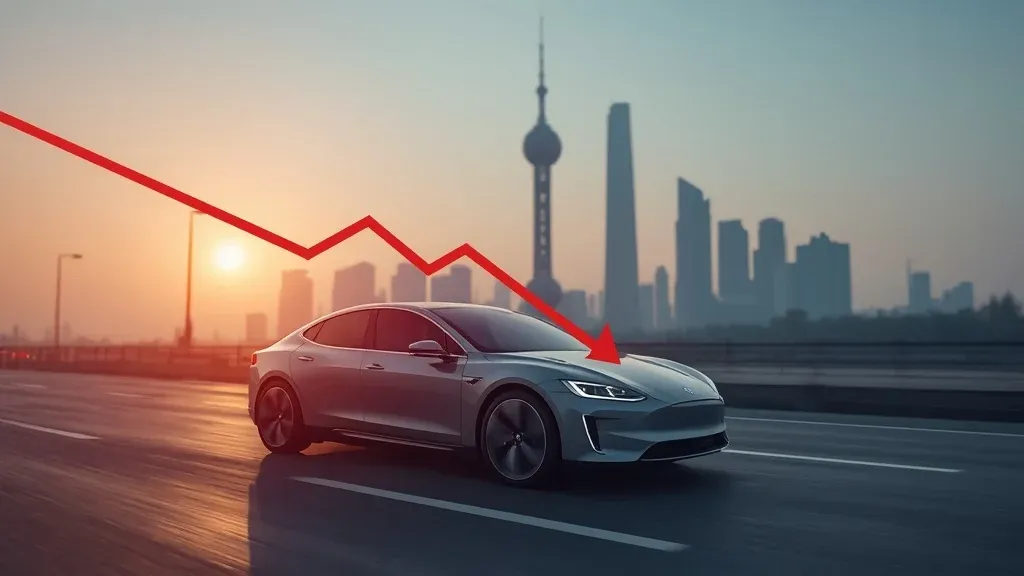
Global EV sales crossed just over one million units in February, but that number comes with a notable caveat: it represents an 11% year-on-year decline. More importantly, this marks the second consecutive month of falling sales, hinting at a broader cooling trend rather than a one-off fluctuation.
What’s happening here isn’t a collapse of the EV revolution. Instead, it’s a complex recalibration, where policy changes, pricing pressures, and shifting consumer priorities are beginning to reshape demand across major markets.
The China Effect: When the World’s Largest Market Slows Down
If the global EV market is a machine, China is its engine. And right now, that engine is sputtering.
In February, EV registrations in China dropped sharply by 32% year-on-year, falling to under half a million units. This is not just a routine dip, it’s the steepest decline the country has seen since the early days of the COVID-19 pandemic.
Several factors are converging here. Government support, which has long been the backbone of China’s EV boom, is being gradually withdrawn. Subsidies for vehicle trade-ins have been scrapped, and a major tax exemption for EV purchases expired at the end of last year. These policy shifts are having an immediate and measurable impact.
But beyond policy, there’s a deeper behavioral change. Chinese consumers, once eager adopters, are becoming increasingly price sensitive. With a crowded domestic market and intense competition among automakers, buyers are no longer rushing in, they’re waiting, comparing, and negotiating.
This shift matters globally. When China slows, the entire EV ecosystem, from battery suppliers to global automakers, feels the pressure.
North America: Policy Reversals and Market Uncertainty
If China’s slowdown is about subsidy withdrawal, North America’s decline is more about policy uncertainty and shifting priorities.
The region saw an even steeper drop than China, with EV sales plunging 35% in February to fewer than 90,000 units. This marks the fifth consecutive month of decline, a worrying trend for a market that was once seen as a key growth frontier.
A major trigger has been the expiration of EV tax credits in the United States last September. These incentives played a critical role in making electric vehicles financially viable for many buyers. Without them, the price gap between EVs and internal combustion vehicles has widened again.
Adding to the uncertainty are proposed policy changes aimed at loosening emissions standards. For automakers, this reduces the urgency to push EV adoption aggressively. For consumers, it creates confusion about the long-term direction of the market.
The financial impact is already visible. Carmakers with heavy exposure to the U.S. market are reportedly absorbing massive writedowns, an indication that expectations around EV growth may have been overly optimistic.
Europe: Growth Continues, But Momentum Is Slowing
In contrast to China and North America, Europe remains a relative bright spot, but even here, the story isn’t entirely straightforward.
EV sales in Europe rose by 21% in February, continuing an upward trajectory. However, this growth comes at a slower pace compared to previous months, suggesting that the market may be approaching a more mature phase.
European governments have also started to ease off aggressive emissions targets, signaling a more balanced approach between environmental goals and economic realities. While this hasn’t yet derailed growth, it has introduced a degree of caution.
The European market today feels less like a sprint and more like a controlled climb. Demand is still strong, but it’s becoming more measured, more dependent on real-world value rather than policy-driven urgency.
While major markets struggle, the “rest of the world” category is emerging as an unexpected growth engine.
EV sales in these regions surged by 78% in February, reaching over 180,000 units. This growth is being driven largely by Chinese automakers expanding aggressively into new territories, including Southeast Asia, Australia, and parts of Europe.
These markets offer something increasingly rare: untapped demand. With fewer legacy systems and growing urbanization, they present ideal conditions for EV adoption, especially when supported by competitively priced vehicles.
What’s particularly interesting is how this expansion is reshaping global competition. Chinese brands, facing intense pressure at home, are turning outward, and succeeding. This could have long-term implications for established automakers, especially in emerging markets.
Pricing Pressure
Across all regions, one theme stands out clearly, price sensitivity.
EVs, despite their long-term cost advantages, still carry a higher upfront price in many markets. When subsidies disappear, that price difference becomes impossible to ignore.
Consumers today are more informed and more cautious. They’re weighing total cost of ownership, resale value, charging infrastructure, and even geopolitical factors. The emotional appeal of going electric is no longer enough on its own.
This shift is forcing automakers to rethink strategies. Price wars, cost optimization, and localized production are becoming central to staying competitive. The era of easy growth, driven purely by incentives, is coming to an end.
Industry Impact
It’s tempting to interpret falling sales as a sign of weakness in the EV market. But that would be an oversimplification.
What we’re witnessing is a transition from policy-driven growth to market-driven sustainability. The industry is being forced to stand on its own fundamentals, product quality, pricing, infrastructure, and consumer trust.
For automakers, this is a challenging phase. Investments made during the boom years are now being tested against real demand. Some companies will adapt quickly; others may struggle.
But in the long run, this correction could be healthy. It filters out unsustainable strategies and pushes the industry toward more resilient growth.
Conclusion
February’s decline in global EV sales is significant, but it doesn’t signal the end of the electric future. Instead, it highlights a shift in how that future will unfold.
The days of rapid, subsidy-fueled expansion are giving way to a more complex landscape, one shaped by economics, policy decisions, and evolving consumer expectations.
China’s slowdown, North America’s uncertainty, Europe’s steady climb, and the rise of new markets together paint a picture of an industry in transition.
The trajectory is still upward, but it’s no longer a straight line.
For anyone watching the EV space, the message is clear: the next phase of growth will be harder earned, more competitive, and far more interesting.
-original.webp)

-original.webp)

-original.webp)