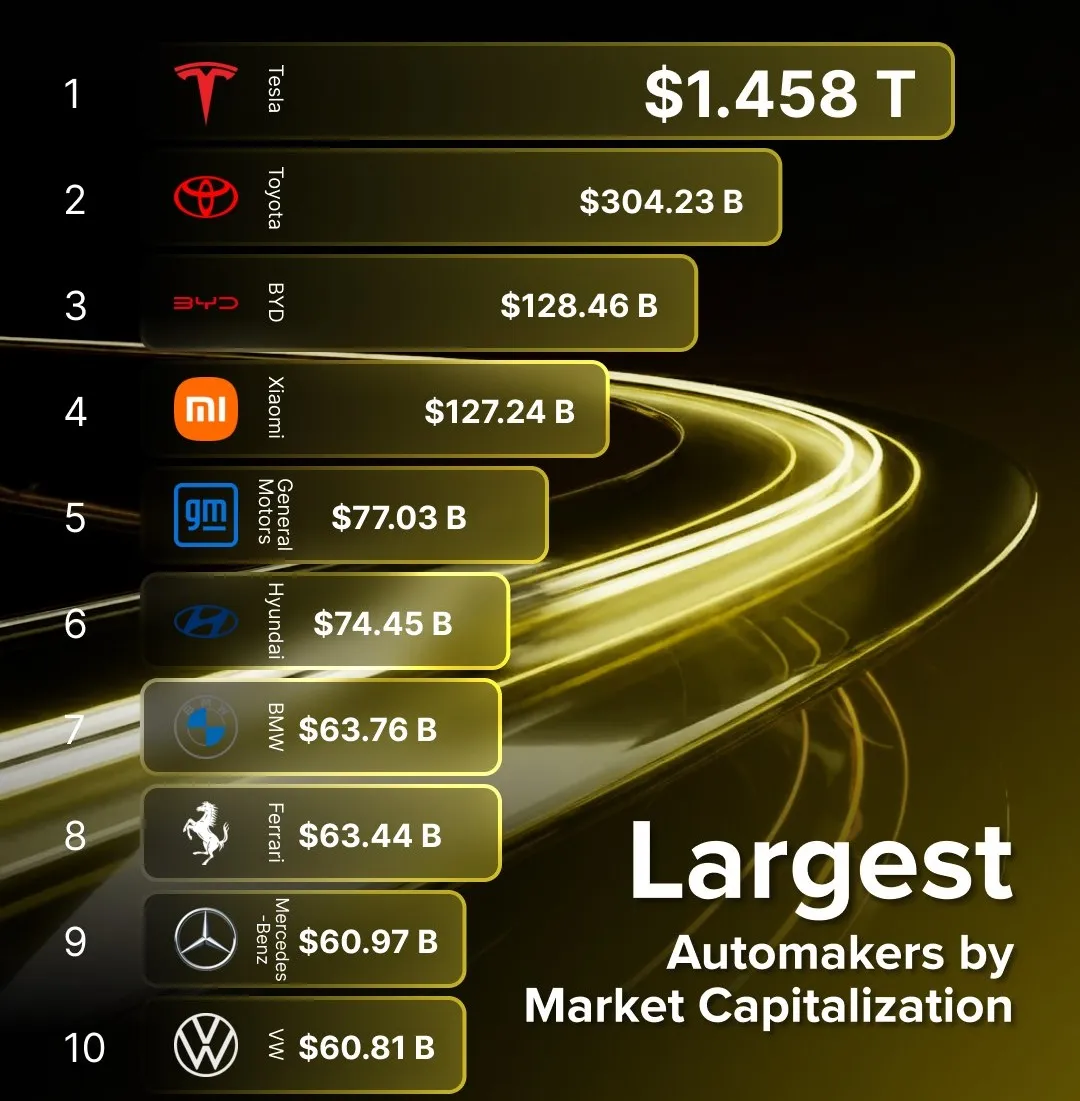
No automaker comes close. As of May 2026, Tesla holds the top spot among the world's most valuable automakers with a market capitalization of approximately $1.548 trillion. That figure is roughly 6.3 times the valuation of Toyota, the company that actually sells the most cars on the planet. The gap between first and second place in this ranking is wider than the entire market cap of most Fortune 500 companies.
Market capitalization is not the same as business size. It reflects what investors are willing to pay today for a company's future earnings potential. And in Tesla's case, the market is paying for far more than cars. It is pricing in autonomous driving, AI-powered robotics, battery energy storage, software platforms, and the robotaxi business that Elon Musk has been building toward. Whether that premium is justified is debatable. That it exists is not.
The Full Global Ranking
Tesla leads at $1.548 trillion, followed by Toyota at $246.51 billion and BYD at $125.11 billion. Hyundai takes fourth at $102.92 billion, while Xiaomi sits fifth at $100.67 billion. General Motors ranks sixth at $67.56 billion, Ferrari seventh at $59.39 billion, Mercedes-Benz eighth at $55.44 billion, Ford ninth at $52.65 billion, and BMW rounds out the top ten at $52.36 billion.
That list alone tells several stories at once.
Rank | Automaker | Country | Market Cap (USD) |
1 | Tesla | USA | $1.548 trillion |
2 | Toyota | Japan | $246.51 billion |
3 | BYD | China | $125.11 billion |
4 | Hyundai | South Korea | $102.92 billion |
5 | Xiaomi | China | $100.67 billion |
6 | General Motors | USA | $67.56 billion |
7 | Ferrari | Italy | $59.39 billion |
8 | Mercedes-Benz | Germany | $55.44 billion |
9 | Ford | USA | $52.65 billion |
10 | BMW | Germany | $52.36 billion |
Toyota: Biggest in Sales, Second in Valuation
Toyota's position at number two is rock solid, but it comes with an asterisk. By actual operational scale, Toyota has no equal. The Japanese automaker sold a record 11.3 million vehicles globally in 2025, including Toyota, Lexus, Daihatsu, and Hino brands, retaining the global sales crown for the sixth straight year. Its consolidated net revenues for FY2025 reached approximately 48.036 trillion yen, equivalent to around $314 billion. Automotive operations alone contributed 43.199 trillion yen of that figure.
No other automaker, including Tesla, operates at that revenue scale. Tesla's 2025 revenue was $94.83 billion, down 3 percent year-on-year, with vehicle deliveries of approximately 1.64 million units across four quarters. Toyota outsells Tesla by nearly seven to one. Yet Tesla is worth six times more. That contrast perfectly illustrates how differently the market prices legacy manufacturing versus technology-first narratives.
BYD: China's EV Giant Goes Global
BYD's third-place ranking at $125.11 billion signals something important about the direction of the global auto industry. The Chinese automaker is no longer simply a dominant domestic player. It has evolved into one of the world's most significant EV and plug-in hybrid manufacturers, with deep vertical integration across batteries, electric powertrains, and vehicle assembly.
Critically, BYD's market cap now exceeds that of General Motors, Ford, Mercedes-Benz, BMW, and Volkswagen individually. Legacy Western and German brands that defined the automobile industry for a century are being outvalued by a Chinese company that barely registered on global radar fifteen years ago.
Hyundai and the Xiaomi Wildcard
Hyundai's fourth-place position at $102.92 billion reflects consistent investor confidence in the Korean automaker's balanced global strategy across internal combustion, hybrid, and electric segments. Hyundai has managed the energy transition more credibly than most of its peers, and the market is rewarding that discipline.
Xiaomi's presence in the top five is the most eyebrow-raising data point in the entire ranking. A consumer electronics and smartphone company sitting alongside Toyota and BYD in an automaker valuation table would have seemed absurd five years ago. Today it signals a structural shift. The wall between technology companies and mobility companies is crumbling, and investors are pricing Xiaomi's EV ambitions and software capabilities as seriously as they price traditional automotive muscle.
Legacy Brands: Still Massive, But Discounted by the Market
General Motors, Ford, Mercedes-Benz, and BMW remain enormous global manufacturers by any real-world measure. But their valuations reflect a market that views traditional automaking as capital-heavy, margin-compressed, and slow to reinvent itself. The valuation multiples applied to these companies are a fraction of what Tesla commands.
Ferrari is the notable outlier. Despite producing far fewer vehicles than any mass-market brand on this list, Ferrari commands $59.39 billion in market value, more than either Ford or BMW. Its luxury positioning, fiercely controlled production volumes, and exceptional profitability earn it a premium that no volume manufacturer can replicate.
India's Place in the Global Valuation Table
Indian automakers are not absent from the broader global ranking. Maruti Suzuki, Mahindra and Mahindra, and Tata Motors all feature among the top 15 largest automakers by market capitalization worldwide. Their inclusion reflects growing investor confidence in India's domestic auto growth story, the expanding middle class driving vehicle demand, and Mahindra and Tata's increasingly credible electric vehicle strategies.
What This Ranking Really Measures
Strip away the numbers and the core message is simple. Market capitalization reflects expectations, not reality. Tesla leads because the market believes its future in autonomous vehicles, AI, robotics, and energy is worth $1.548 trillion today. Toyota leads in the real world because it builds and sells more cars than anyone else on Earth. BYD leads the EV charge from China. Xiaomi represents the technology-to-mobility pipeline. And Ferrari proves that scarcity and prestige can hold their own against scale.
The automakers who figure out how to earn both operational credibility and technological ambition will dominate the next version of this ranking. Right now, only Tesla has managed that combination, even if the real-world numbers still have some catching up to do.
-original.webp)