-original.webp)
Remember when Nepali riders had to watch from the sidelines as the Guerrilla 450 made waves across the border? That chapter just closed. Royal Enfield has officially brought the 2026 Guerrilla 450 to Nepal at Rs 8,99,000, and in a move that genuinely surprised the market, all three variants; Flash, Dash, and Apex, carry the exact same price tag.
No upsell games. No pay-more-for-the-fancy-paint logic. Pick the trim that matches your riding style and pay the same number. That kind of pricing strategy is rare enough that it deserves a moment of recognition before getting into the bike itself.
This isn't a lazy annual refresh either. Royal Enfield has done real engineering work for 2026 , reworked throttle maps, a genuinely sporty new variant, better rubber on specific trims, and meaningful tech updates. The Guerrilla was already a likeable bike. Now it's a properly polished one. Let's get into it.
Also read The Price of Goan Classic 350 in Nepal
Design
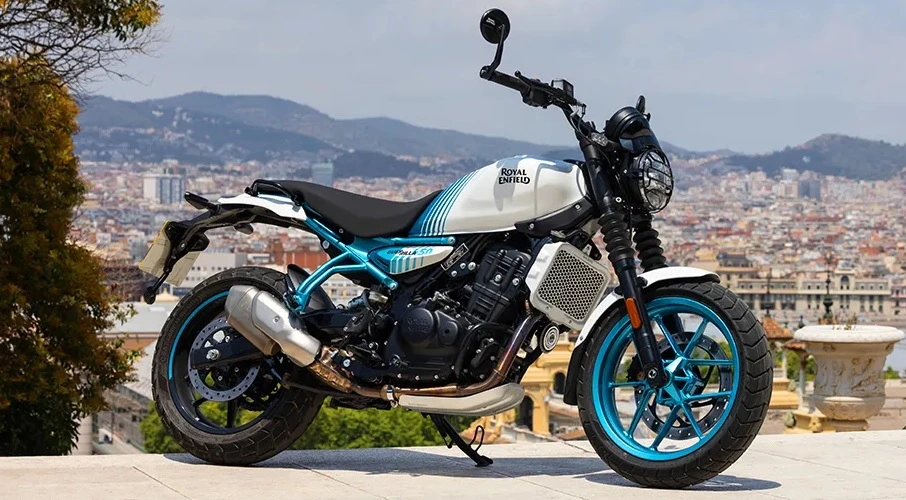
The DNA hasn't changed. Round LED headlamp, muscular teardrop tank, clean tail section , the Guerrilla still looks like the neo-retro roadster that turned heads at its 2024 debut. What's changed is how aggressively the new Apex variant breaks from that relaxed character.
The Apex gets a stubby headlamp visor, a sculpted seat cowl, and a colour-matched front cowl that gives it a flat-track-meets-streetfighter attitude. Three exclusive shades headline the trim , Apex Red, Apex Black, and Apex Green, each finished off with contrasting rim tapes. It's the kind of detail that separates a bike that looks good in photos from one that looks good in parking lots.
The Dash variant picks up a fresh Twilight Blue with matching handguards and a headlight grille, while the Flash carries forward its earlier palette. Underneath, everything rides on a steel twin-spar tubular frame that uses the engine as a stressed member, with 17-inch alloy wheels wrapped in tubeless rubber. At 2,090mm long and 185kg kerb weight, it sits in that sweet spot between flickable city commuter and capable weekend escape machine.
Performance
Let's talk about the elephant in the room. The original Guerrilla 450 had a jerky throttle. Riders complained. Reviewers flagged it. Royal Enfield, to their credit, actually listened.
The 452cc liquid-cooled Sherpa engine itself is unchanged, same DOHC architecture, same single-cylinder layout, roughly 40 PS at 8,000 rpm and 40 Nm of torque at 5,500 rpm, paired with a six-speed gearbox and slip-assist clutch. What's been reworked is the throttle calibration. Street mode now delivers a smoother, more linear response that makes crawling through Kalanki traffic far less twitchy. Sport mode keeps the mid-range punch sharp for when you actually want to lean on the engine. The infamous on-off jerkiness that defined earlier examples? Largely gone.
And then there's mode retention, a small feature with outsized impact. The bike now remembers your last selected ride mode after the ignition is killed. Sounds minor. Isn't. Anyone who has owned a bike that resets every morning knows exactly why this matters.
The tyre split between variants is the other underrated change. The Apex now runs Vredestein Centuro tyres tuned for road grip and sportier cornering, while the Flash and Dash continue with CEAT Gripp XL RE tyres, now with a softer compound for better wet and dry traction. That single difference makes the Apex a meaningfully different bike to ride, not just a cosmetic upgrade.
Specifications
Spec | Detail |
Engine | 452cc, liquid-cooled, single-cylinder, DOHC |
Power | 40 PS @ 8,000 rpm |
Torque | 40 Nm @ 5,500 rpm |
Gearbox | 6-speed with slip-assist clutch |
Front suspension | 43mm telescopic forks, 140mm travel |
Rear suspension | Linkage-type monoshock, 150mm travel |
Front brake | 310mm disc |
Rear brake | 270mm disc |
ABS | Dual-channel |
Wheels | 17-inch alloy, tubeless |
Front tyre | 120/70 R17 |
Rear tyre | 160/60 R17 |
Frame | Steel twin-spar tubular |
Seat height | 780mm |
Kerb weight | 185 kg |
Fuel tank | 11 litres |
Features
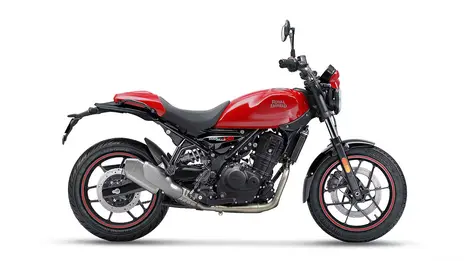
The biggest headline for 2026 is unquestionably the Apex variant. Its handlebar sits 56mm lower than the standard Guerrilla setup, pulling the rider into a more forward-set, engaged posture. Pair that with the road-biased Vredestein rubber and the sportier visual cues, and the Apex transforms from relaxed roadster into focused street machine, without trashing daily comfort the way some sport-tuned bikes do.
The Tripper Dash also gets smarter for 2026. Riders can now lock their smartphone screen while GPS navigation runs, which puts an end to accidental swipes mid-ride. Royal Enfield has also improved overall smartphone pairing and connectivity across all variants, a fix that owners of earlier models will quietly appreciate.
All 2026 variants get the updated Street and Sport ride modes with mode retention. Full LED lighting is standard across the board. The Dash and Flash variants come with the 4-inch round TFT display featuring Google Maps turn-by-turn navigation, music controls, and smartphone integration. USB charging and ride-by-wire round out the tech package. This is, by a comfortable margin, the most loaded motorcycle Royal Enfield builds at this displacement.
Price in Nepal
Here's the official Nepal pricing, the part everyone was waiting for:
Variant | Price in Nepal |
Flash | Rs 8,99,000 |
Dash | Rs 8,99,000 |
Apex | Rs 8,99,000 |
For comparison, India pricing starts at around INR 2.49 lakh for the Apex, with the Dash sitting near INR 2.59 lakh and the Flash topping out around INR 2.72 lakh. The uniform Nepal pricing is an unusual move here, and a smart one. Buyers aren't penalised for wanting the sportier Apex or the better-equipped Flash. They just pick their flavour.
How It Stacks Up Against the Competition
In Nepal, the most direct rival to the Guerrilla 450 is the Triumph Speed 400, another retro-modern roadster aimed at exactly the same buyer. The Triumph brings British badge equity and refined finish quality. The Guerrilla counters with a more modern engine on paper (liquid cooling, DOHC, ride-by-wire), more tech in the cockpit, and a service network that nobody else in this segment can realistically match in Nepal.
Globally, the conversation also includes the KTM 390 Duke, sharper, faster, more track-focused. But the Duke is a different animal altogether: angrier, less forgiving, more demanding. The Guerrilla is the bike you can live with every day, post on Instagram, and still have a riot on when an open road appears. If you want raw performance, the Duke wins. If you want character, community, and a bike that doesn't exhaust you on the commute, the Guerrilla makes its case clearly.
Conclusion
The 2026 Guerrilla 450 isn't a reinvention. It's a refinement, and arguably the kind that proves Royal Enfield is finally engineering for the rider rather than the showroom. The throttle is better. The tyres are better. The tech is smarter. There's now a genuinely sporty variant for buyers who want commitment in their riding posture instead of cruiser cosplay.
At Rs 8,99,000 across all three variants, is it cheap? Not exactly. Is it competitively priced for what you're getting in Nepal's mid-capacity roadster space? That depends entirely on what you value. Spec-sheet shoppers will find plenty to like. Heritage hunters will too. The Triumph Speed 400 still has a strong argument to make, and the decision between the two will ultimately come down to which brand speaks louder to you personally.
But here's the question worth chewing on: now that Royal Enfield has dropped a proper sport-tinged roadster into Nepali showrooms with this much modern hardware on board, where does that leave the rest of the segment? The pressure is officially on, and Nepali riders are the ones who win.