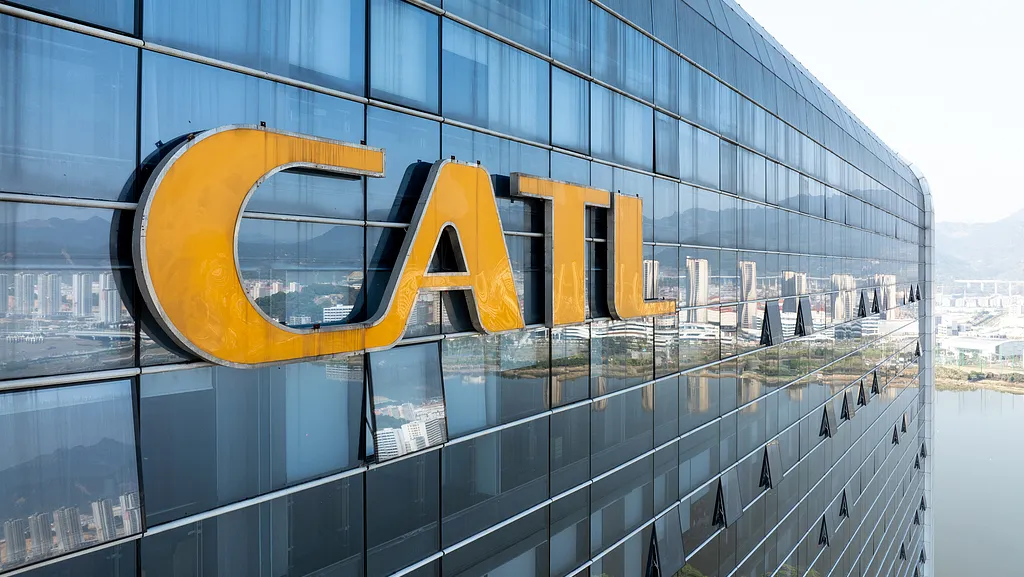
Nearly every second electric vehicle rolling off a Chinese production line last month carried a CATL battery. That statistic alone tells you everything about where the power balance sits in China's EV supply chain.
April 2026 data from Kerui confirms what the industry has long suspected but rarely said plainly, China's power battery market is, functionally, CATL's market with everyone else competing for the scraps. The Ningde-based giant recorded installations of 28,694 MWh during the month, translating to a 47.0% market share and a year-on-year growth of 30.2%. When a single supplier controls nearly half of an entire national industry, that's not a competitive advantage. That's structural dominance.
What separates CATL from its rivals isn't just scale, it's the sheer spread of its customer base. Geely accounted for 9.5% of CATL's April installations, followed closely by Changan at 8.9%, Xiaomi at 8.5%, Li Auto at 8.3%, and Nio at 6.6%. No single automaker controls a disproportionate slice of CATL's revenue. That balance is deliberate, and it's what makes the company so difficult to dislodge. If one automaker stumbles, CATL barely flinches.
BYD's Battery Arm: Comfortable, but Captive
BYD's in-house battery unit, FinDreams, secured second place with 11,133 MWh installed and an 18.3% market share. On paper, that's a strong position. Dig a little deeper and the cracks start showing. FinDreams posted a 3.2% year-on-year decline, a modest dip, yes, but a decline nonetheless in a market that's growing aggressively overall.
The more revealing number is this: 58% of FinDreams' entire April output went directly into BYD's own vehicles. The company is, in large part, a captive supplier feeding its parents. The remaining supply did reach external customers, Xiaomi took 7.5%, Fang Cheng Bao 7.0%, Xpeng 5.3%, and Denza 5.1%, but the external business remains thin relative to the total. FinDreams has brand recognition and deep integration advantages, but its growth ceiling outside the BYD ecosystem is a real and underexplored question.
The Challengers Surging From the Middle
Below the top two, the story shifts from dominance to momentum. CALB, Gotion High-tech, and EVE Energy occupied third, fourth, and fifth respectively, and their growth rates are where things get genuinely interesting.
CALB delivered 5,198 MWh in April, growing 50.1% year-on-year. Its customer spread is notably diverse: SinoTruk led at 16.0%, followed by GAC-Toyota at 12.1%, Xpeng at 9.9%, Leapmotor at 8.7%, and GAC Aion at 7.4%. That mix of commercial vehicles and passenger EVs gives CALB a resilience that pure passenger-market players lack.
Gotion High-tech posted 3,705 MWh with 25.2% year-on-year growth, leaning heavily on Leapmotor (18.3%), SGMW (17.8%), and Chery (17.4%). EVE Energy reached 2,550 MWh with 27.2% growth, anchored by Foton at 20.9% and Xpeng at 19.2%. These are not fringe players finding niche corners, these are companies building real momentum in the middle tier of the market.
The Curious Case of Leapmotor and the Suppliers It Feeds
One of the more striking patterns buried in the April data is Leapmotor's outsized influence on multiple battery suppliers simultaneously. Leapmotor is the single largest customer for not just one, but three separate battery manufacturers, Gotion, Zenergy, and Svolt. That's an unusual level of purchasing leverage for a brand that doesn't always make the front pages.
Zenergy recorded 1,671 MWh with Leapmotor accounting for a remarkable 51.2% of its installations. Svolt, the battery subsidiary of Great Wall Motor, saw Leapmotor take 44.3% of its supply. Here's the irony: Great Wall Motor itself contributed just 37.1% to Svolt's business. A parent company is not the biggest customer of its own battery division. That's a strange dynamic and one that raises legitimate questions about how tightly integrated China's EV supply chains actually are behind the closed doors of corporate relationships.
The Outlier at the Bottom of the Top Ten
Geely's battery unit, Energee, sits tenth on the list with 917 MWh, but its data point is arguably the most extreme in the entire table. A staggering 91.1% of Energee's April installations went to Geely vehicles. No other supplier in the top ten comes close to that level of customer concentration. For context, even FinDreams, which critics often describe as a captive BYD unit , sent 42% of its supply to external customers. Energee, by comparison, is almost entirely self-contained within the Geely ecosystem.
Meanwhile, Xiaomi has quietly emerged as a battery market power broker in its own right. The consumer electronics company turned EV maker is now FinDreams' largest external customer at 7.5%, and sits third among CATL's top clients at 8.5%. For a brand that only entered the car business recently, that kind of battery procurement volume signals that Xiaomi's EV ambitions are scaling faster than most anticipated.
What April Tells Us About the Rest of 2026
A 47% market share held by a single company in a strategically critical industry is the kind of number that draws attention, from rivals, from regulators, and from the automakers who depend on CATL's supply chain. The company's growth is real and its customer diversification is genuinely impressive. But concentration of this scale in any industrial sector always carries a question that eventually demands an answer: what happens when something goes wrong?
For now, CATL's rivals are growing, some of them fast. CALB's 50% year-on-year surge is not a number any market leader can ignore indefinitely. The mid-tier is getting stronger, better-funded, and more strategically positioned. Whether that translates into genuine market share gains against CATL by year-end, or whether the giant simply absorbs the pressure and grows anyway, is the defining question hanging over China's battery industry for the rest of 2026.
-original.webp)