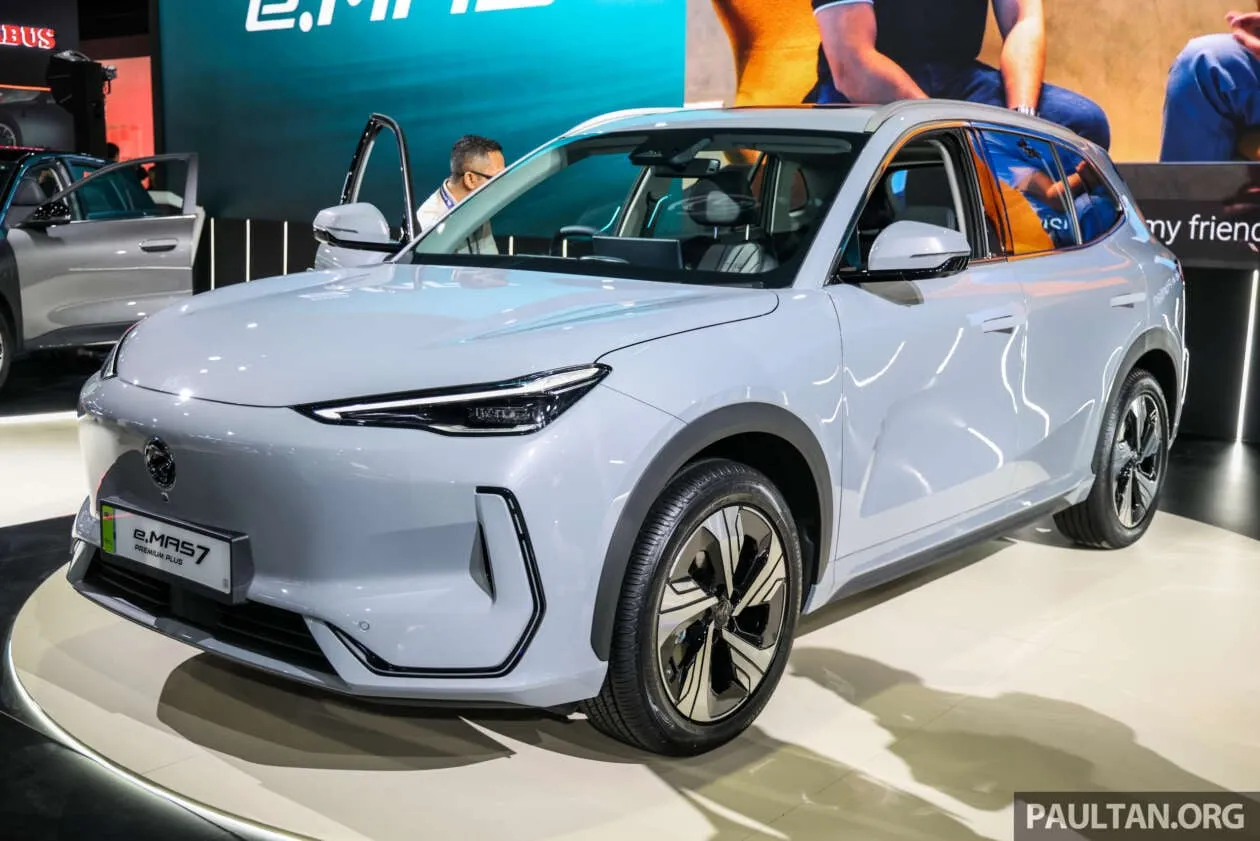
Proton wants you to know it didn't just bolt on a bigger battery and call it a day. At the Kuala Lumpur International Mobility Show this week, the national carmaker's EV arm rolled out the e.MAS 7 Premium Plus, a variant that pushes range past the psychologically important 400km mark while throwing in something most buyers in this segment have never had: a massage seat that actually does something during the commute, not just the showroom demo.
Why should anyone outside Malaysia care? Because this is a window into how aggressively budget-friendly EV brands are now competing on comfort, not just spec-sheet range numbers. The math here matters too, Proton has managed to stretch range by roughly 40km without touching the motor, the charging speed, or the price ladder in any way that feels punishing. That's a tightrope walk a lot of manufacturers fumble.
What's Actually New Here
Strip away the marketing language and the headline change is simple: a bigger battery. The Premium Plus swaps in a 68.39kWh AEGIS Short Blade Battery pack, up from the 60.22kWh unit in the regular Premium trim. That battery delivers up to 450km of WLTP-rated range, according to Pro-Net, the Proton subsidiary that builds and sells the e.MAS lineup.
Forty kilometers doesn't sound dramatic until you remember what range anxiety actually does to EV buyers. It's the single biggest psychological barrier stopping people from switching, and Proton clearly knows it. Pro-Net CEO Zhang Qiang framed the extended range as addressing what he called one of the key considerations for EV adoption , range confidence. That's corporate-speak for "people won't buy what scares them," and he's not wrong.
What's more interesting is what Proton chose not to change. Despite the larger pack, DC fast charging speeds remain capped at 115kW, which still gets the battery from 30% to 80% in roughly 20 minutes, identical to the smaller-battery Premium variant. That's a genuinely good outcome for buyers. A bigger battery usually means a longer wait at the charger; here it doesn't.
Performance: Same Motor, Slightly Heavier Load
Don't expect a faster car. The Premium Plus carries over the same front-mounted electric motor as the rest of the e.MAS 7 range, putting out 218 PS and 320 Nm of torque. Proton hasn't touched the drivetrain, and there was never any indication it would, this update was always about range and comfort, not straight-line speed.
There is a small performance tax, though. The 0–100 km/h sprint takes 7.4 seconds, about 0.3 seconds slower than the standard Premium variant, and that's almost certainly down to the extra weight of the bigger battery pack sitting under the floor. It's a trade most buyers in this segment will happily accept in exchange for not having to think about charging stops on a long drive.
Design and Comfort: Where Proton Actually Tried Something Different
Here's where the Premium Plus separates itself, and frankly, where the real story is. Proton didn't just stretch the range and ship the same cabin. The variant introduces dual front massage seats, a powered front passenger seat with 4-way adjustment and memory function, and an integrated passenger leg rest designed for longer journeys.
A leg rest in a mainstream electric SUV, at this price point, is not something you see often. It's the kind of feature usually reserved for luxury sedans or flagship three-row SUVs costing twice as much. Proton is betting that comfort, not just range numbers on a spec sheet, is what actually closes the sale for family buyers cross-shopping EVs in Malaysia's increasingly crowded market.
The rest of the cabin tech carries over from the existing Premium trim: a 16-speaker Flyme Sound System with headrest-integrated speakers, a windshield head-up display, and a self-dimming rearview mirror. None of that is new, but none of it needed replacing either.
Specifications and Features at a Glance
The driver-assistance suite is unchanged from the Premium variant, and that's not a knock , it was already comprehensive. Buyers get adaptive cruise control, autonomous emergency braking, lane keep assist, active lane change assist, evasive manoeuvre assist, front cross traffic alert, and traffic sign recognition. Proton clearly decided the ADAS package didn't need fixing, so it left it alone and put its engineering effort into the battery and seats instead.
Exterior-wise, nothing visibly distinguishes the Premium Plus from its siblings beyond what's already familiar to e.MAS 7 owners; this is a comfort-and-range update, not a styling refresh.
Pricing: Where It Actually Sits in the Lineup
This is where Nepali readers need to pay close attention, because the numbers reported earlier in some outlets don't match what Proton itself published. According to Proton's official pricing table, the Premium Plus carries a recommended retail price of RM125,800 in Peninsular Malaysia (RM128,800 in East Malaysia), sitting above the Premium at RM119,800 and the entry Prime at RM103,800.
But buyers won't pay sticker price right away. Proton is running a special launch rebate of RM7,000 across the entire e.MAS 7 range, bringing the Premium Plus down to RM118,800 in the Peninsula and RM121,800 in East Malaysia. The Premium drops to RM112,800, and the Prime to a more accessible RM96,000.
Proton sweetened the deal further with what it's calling the Power Pack Plus bundle. That includes a free trade-in processing fee, an additional RM5,000 trade-in top-up for existing Proton owners, a complimentary 7kW home charging wallbox worth RM1,500, a free Vehicle-to-Load converter worth RM500, five years of unlimited internet data worth RM1,800, a six-year unlimited mileage vehicle warranty, an eight-year or 160,000km battery warranty, and a free tonneau cover thrown in on top. Strip out the marketing dressing and that's a genuinely substantial ownership package, the kind of thing that makes the rebate look less like a gimmick and more like Proton trying to lock in loyalty before rivals undercut it.
Conclusion
None of this happens in a vacuum. Proton says more than 23,700 e.MAS vehicles are now on Malaysian roads, and the e.MAS 7 PHEV has become the country's best-selling plug-in hybrid with nearly 3,000 deliveries this year alone. The Premium Plus isn't a desperate move from a struggling brand, it's a confident manufacturer doubling down on a formula that's already working.
The bigger question is whether 450km of WLTP range and a leg rest are enough to keep Proton ahead as competitors inevitably respond with their own range bumps. WLTP numbers rarely survive contact with real-world driving anyway, so the true test will be what owners report once these cars are logging actual kilometers on actual roads, not test cycles.
For now, Proton has handed itself a strong talking point at exactly the moment it needed one. Whether that's enough to keep the e.MAS 7 at the top of Malaysia's EV sales charts through the rest of 2026 is the question every rival automaker in that market is now scrambling to answer.



-original.webp)