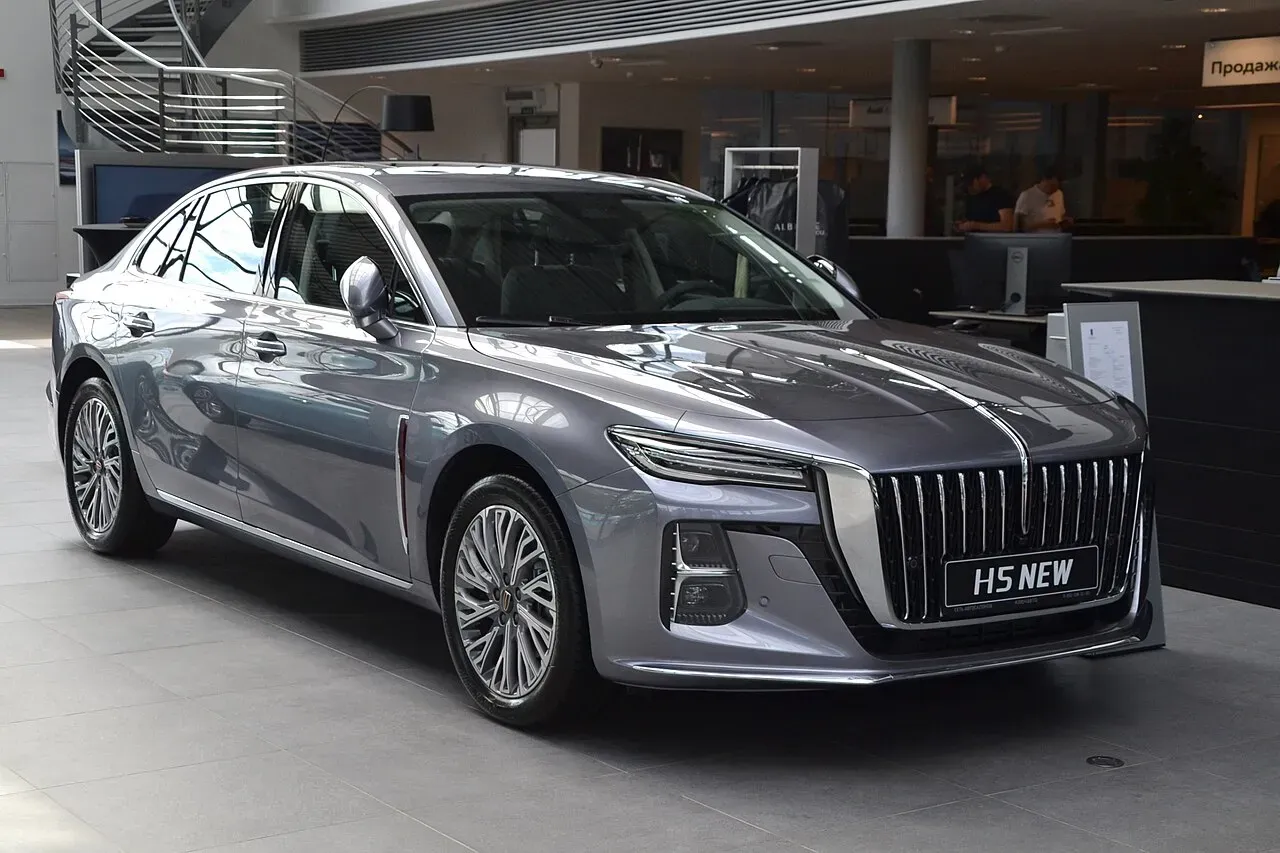
Think about this for a second. The badge on the nose of this car once sat on limousines that carried Chinese presidents to state ceremonies. Chairman Mao rode in a Hongqi. It was rolling propaganda, a symbol of political might you couldn't just walk into a showroom and buy.
Now it's parked at Bhrikuti Mandap with a price tag, hoping a Nepali family picks it over a Mahindra or an MG. That's not just a launch. That's a full-blown identity shift.
The Hongqi E-HS4 made its official Nepal debut at the NAIMA Nepal Mobility Expo 2026, going on sale at Rs 57.99 lakh, a special expo figure shaved from the standard Rs 59.99 lakh. For a marque that spent decades as a rolling emblem of Chinese state power, showing up as a retail product you can finance and drive home is quite the pivot. And honestly? It's a fascinating one to watch.
Advanced Automobiles, the Vishal Group company that also runs Renault here, is the outfit bringing Hongqi to Nepal. The E-HS4 is the entry door to that whole effort, and at under Rs 60 lakh it walks straight into the ring with the swelling pack of premium electric SUVs that Nepal's upper-tier buyers are now genuinely weighing. This is no longer a fringe segment. It's a brawl.
Design
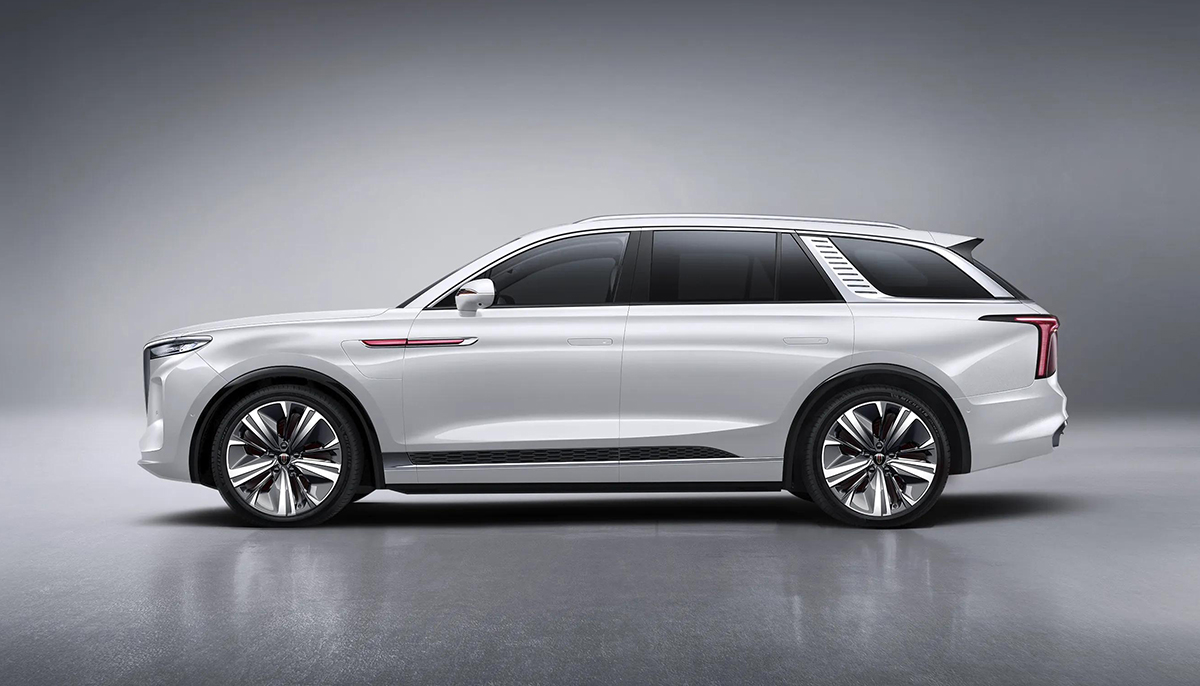
The E-HS4 is not a flashy machine. It wears its proportions with quiet confidence. At 4,520 mm long, 1,873 mm wide and 1,647 mm tall, with a 2,750 mm wheelbase, it occupies the compact luxury SUV segment without trying too hard to fill the space.
The exterior carries a sleek silhouette defined by semi-hidden door handles, LED headlights with automatic activation, integrated daytime running lights and rain-sensing wipers. The panoramic glass roof stretches across the roofline in a single unbroken piece, and the power tailgate includes position memory, which is a small but telling detail about who this car is aimed at.
Ride on 18-inch wheels, and there's an interesting asymmetry in the tyre setup: 225/50 R18 up front and slightly wider 235/50 R18 at the rear, consistent with the rear-wheel-drive layout. It is not a design decision most buyers will notice, but it reflects the kind of deliberate engineering thinking that goes into vehicles built for this segment.
Specifications
Under the skin sits a permanent-magnet synchronous motor putting out 160 kW and 240 Nm of torque, all sent to the rear wheels. Feeding it is a 67.1 kWh battery pack running on a 404.4V platform, IP67-rated against water and dust. Solid, sensible hardware.
The claimed WLTP range is 420 km, with energy consumption pegged at 16.4 kWh per 100 km on the WLTC cycle. And here's the part I appreciate. These aren't fantasy figures. They're grounded, realistic numbers for a car this size and weight. In a market drowning in inflated CLTC and NEDC claims that evaporate the moment you switch on the AC and hit a hill, Hongqi quoting WLTP feels almost honest to a fault. A Nepali buyer can actually trust the 420 km figure to mean something close to reality, and that trust is worth more than a bragging number on a banner.
DC fast charging hauls the battery from 30 to 80 percent in roughly 20 minutes. The E-HS4 also packs V2L, vehicle-to-load, at up to 3.3 kW. Now, in a country that still knows its way around a power cut, being able to run appliances or tools straight off the car battery isn't a gimmick. It's genuinely useful, the kind of feature that earns its keep during the next long outage.
Suspension is MacPherson up front and multi-link independent at the rear, a pairing that chases ride comfort without letting the car feel vague through a corner. Braking comes via ventilated discs at the front and solid discs at the back. Nothing exotic, everything competent.
Features
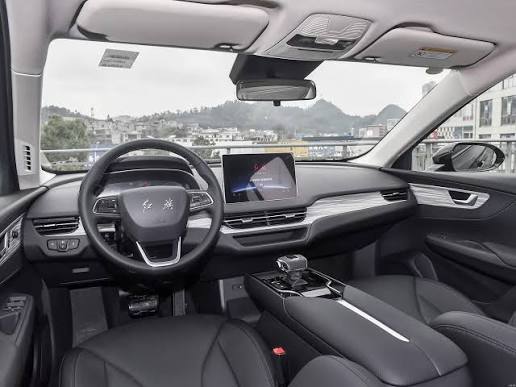
Step inside and the argument sharpens considerably. An 8.8-inch LCD instrument cluster faces the driver, while a 14.6-inch central touchscreen runs the show for everything else. The seats wear bio-material upholstery blending silicone leather and suedette, and the front chairs get six-way power adjustment, four-way lumbar support and ventilation on both sides. On a sweltering Kathmandu afternoon, ventilated seats stop being a luxury flex and start being genuinely civilised.
The ambient lighting runs 64 colours and calls itself dynamic. Sounds like marketing fluff, right? Until you're sitting in the cabin after dark and realize the space feels deliberately designed rather than cost-engineered. Little things shape how a car feels to live with. A 12-speaker system, a 15W wireless charging pad and automatic climate control round out the comfort basics.
Two features here deserve more attention than they usually get. The E-HS4 carries heat-pump technology, which directly protects real-world range when temperatures drop, and Cell-to-Chassis integration, which stiffens the structure and better shields the battery. Neither makes a flashy headline. Both matter enormously if you plan to keep this car for the long haul, which at this price, you probably do.
Boot space runs to 393 litres, opening up to 1,300 litres with the rear seats folded flat. Practical enough for a family that actually uses the thing.
It's worth remembering the E-HS4 isn't fighting alone in this corner of the market. The Wuling Eksion EV launched at the same expo for Rs 55.99 lakh, a seven-seat Chinese SUV pitched at almost the exact same money. Which tells you everything about how crowded this price band is getting, and how hard these brands are now willing to fight for the same buyer.
Safety and Driver Assistance
This is where the E-HS4 stops being merely nice and starts being seriously impressive, all backed by a five-star E-NCAP rating. Airbag coverage spans driver, front passenger, front-row side, side curtain and far-side units. The active safety net includes electronic stability control, ABS, electronic brakeforce distribution, hydraulic brake assist, traction control, active rollover protection and multi-collision braking.
Then comes the driver-assistance package, and this is where the price starts to look almost unfair to the competition. Adaptive cruise control, lane centering, automatic lane change, intelligent speed assist, traffic sign recognition, front vehicle departure warning, forward collision warning and automatic emergency braking, all standard. Lane departure warning, lane keeping assist and emergency lane keeping too.
And it keeps going. Blind-spot detection, lane-change assist, door-open warning, rear collision warning, 360-degree surround view, transparent chassis view and a reversing camera. A driver monitoring camera, life detection radar, drowsiness detection, distraction warning and child presence detection round it out.
That last one, child presence detection, is dead easy to skim past in a bullet list. But it's the feature that quietly prevents the kind of tragedy that makes national news every summer. Including it as standard says something about how seriously Hongqi took this. If you want to see how that kind of safety loadout stacks up against rivals in the bracket, the best electric vehicles in Nepal between 40 and 60 lakhs comparison lays it out clearly.
Price and Availability
The Hongqi E-HS4 is priced at Rs 57.99 lakh as a special NAIMA 2026 introductory figure, with the regular market price set at Rs 59.99 lakh. It is available through Advanced Automobiles, which manages the Hongqi franchise in Nepal alongside its Renault operations.
At this price, the E-HS4 enters territory where buyers are not just counting kilowatts but evaluating brand identity, after-sales confidence and long-term ownership economics. Hongqi's track record in Nepal is, by definition, non-existent right now. Advanced Automobiles will need to build that trust fast, and the product, on paper, gives them a credible platform to do it.
Conclusion
Nepal's premium EV segment has moved quickly. What started as a conversation about range anxiety and charging infrastructure has shifted into one about marque value and cabin quality. Hongqi's arrival asks a pointed question: when a Chinese state brand with presidential lineage prices itself below Rs 60 lakh and shows up with a five-star safety rating and 420 km of range, how long before it stops being a novelty and starts being a genuine benchmark?
The answer probably depends less on the car and more on what happens after the sale.
For more EV coverage and in-depth automotive features from Nepal, visit AutonCell.