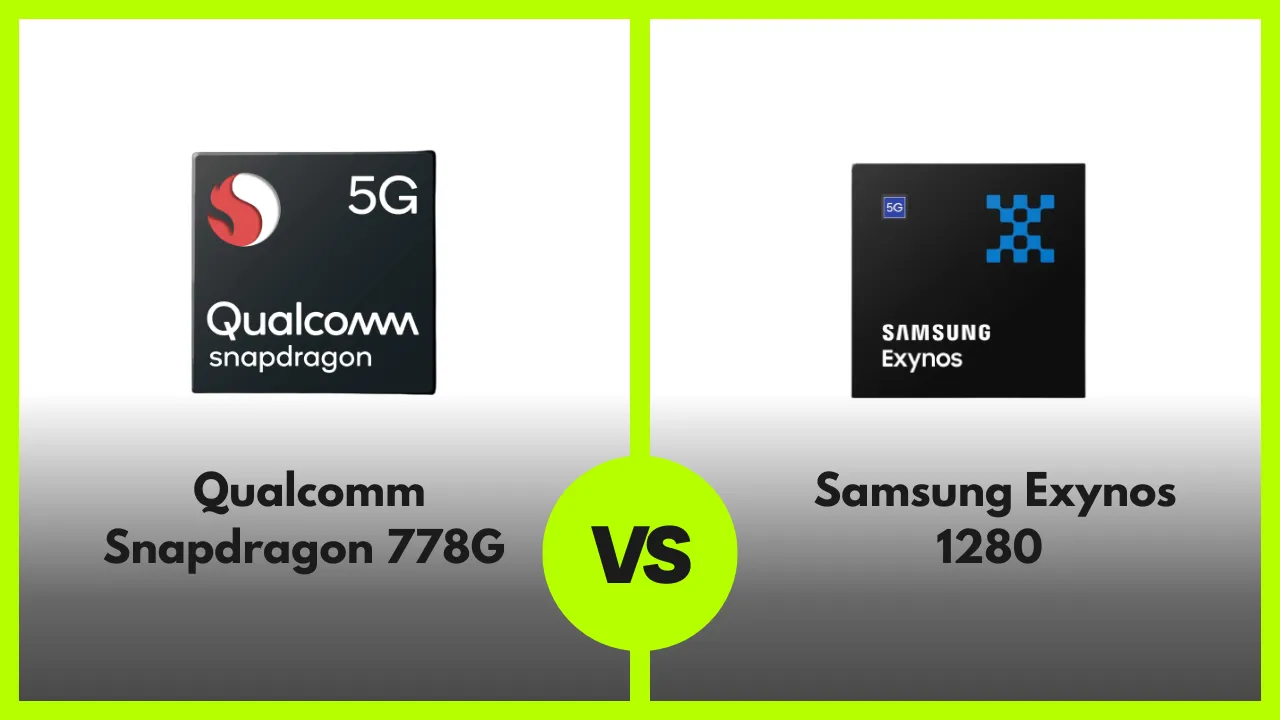
Exynos 1280 and Snapdragon 778G are the two 5G processor that powers mid-range smartphones. Exynos 1280 is a slightly newer processor, as it was launched in March 2022, While the Snapdragon 778G is from May 2021.
Moreover, the Exynos 1280 is a chip from Samsung, and it’s mostly exclusive to Samsung Galaxy phones. On the other hand, Qualcomm’s SD 778G powers midrange smartphones of brands like Xiaomi, Realme, Oppo, Vivo, and even Samsung.
As midrange processors are getting more powerful, consumers are now much more attracted to midrange smartphones. With most of the high-performing midrange phones being powered by processors like Exynos 1280 and Snapdragon 778G, let’s compare these two 5G processors in this article.
Exynos 1280 vs Snapdragon 778G: Specifications Comparision
| Snapdragon 778G | Exynos 1280 | |
| Process | TSMC 6nm | 5nm EUV |
| CPU |
|
|
| Graphics | Qualcomm Adreno 642L | Mali-G68 |
| AI | 6th generation Qualcomm AI Engine with Qualcomm Hexagon 770 Processor | AI Engine with NPU |
| Memory | LPDDR5 | LPDDR4x |
| Storage | UFS v3.1 | UFS v2.2 |
| Modem |
Snapdragon X53 5G Modem-RF System
|
|
| Camera |
Qualcomm Spectra 570L
|
|
| Video |
Video Capture Color Depth: Up to 10-bit Video Capture Color Gamut: Rec. 2020 Video Capture Formats: Hybrid Log Gamma (HLG), HDR10, HDR10+ |
4K 30fps encoding and decoding |
| Display | FHD+ @ 144 Hz | Full HD+@120Hz |
Exynos 1280 vs Snapdragon 778G: Performance
CPU Performance
Starting with the Exynos 1280, the chip is built using a 5nm EUV process. It features two Arm Cortex-A78 performance cores clocked at 2.4 GHz and six Cortex-A55 power-efficient cores clocked at 2.0 GHz.
On the other hand, the Snapdragon 778G uses TSMC’s 6nm process node. It features one Cortex-A78 prime core clocked at 2.4 GHz, three Cortex-A78 Gold cores clocked at 2.2 GHz, and four Cortex-A55 power-efficient cores clocked at 2.0 GHz.
Although the CPU of both these processors look similar on paper, the Snapdragon 778G outperforms the Exynos 1280 in performance. The GeeBench 5 test of the Snapdragon 778G shows the raw single-threaded and multithreaded scores of 779 and 2817, respectively. Compared to Exynos 1280, the 778G has a 5% higher single-core score and a 50% higher multi-core score. Adding on, the AnTuTu 9 benchmark score of the 778G is 531528, which is 29% higher than the 411747 points of Exynos 1280.
Gaming Performance
For graphics, the Exynos 1280 features the Valhall-based Arm Mali-G68 GPU that has been optimized with Fused Multiply-Add (FMA) for better power consumption and battery life. On the contrary, the Snapdragon 778G has Adreno 642L GPU, which on the 3DMark cross-platform benchmark, has an 8% higher performance than Exynos 1280.
Either way, both Exynos 1280 and Snapdragon 778G have a very capable GPU that can easily tackle the most demanding mobile games. Still, the 778G wins the battle of Exynos 1280 vs Snapdragon 778G, as game makers mostly optimize games for Snapdragon processors rather than Exynos.
Additionally, you can find the average FPS of both these midrange processors while playing some popular graphics-demanding games.
| Games | Snapdragon 778G | Exynos 1280 |
| PUBG Mobile | 59FPS (Ultra graphics settings) | 68 FPS (Ultra graphics settings) |
| Call of Duty Mobile | 42FPS (Ultra graphics settings) | 60FPS (High graphics settings) |
| Mobile Legends: Bang Bang | 60 FPS (Ultra graphics settings) | 60 FPS (Ultra graphics settings) |
| Genshin Impact | 53FPS (High graphics settings) | 51FPS (Ultra graphics settings) |
Multitasking Performance
Both these processors are great for multitasking, as you get good memory options with these midrange SoCs. However, when it comes to Exynos 1280 vs Snapdragon 778G, the chip from Qualcomm takes the win here, but it’s marginal.
The Snapdragon 778G has LPDDR5-type RAM compared to LPDDR4X on the Exynos. You further get a higher RAM speed, 3200 MHz, on the 778G, which is much higher than the 2133 MHz memory frequency of the Exynos 1280. Besides, the SD 778G supports up to 16GB of RAM, double what the Exynos 1280 supports.
Nonetheless, the Exynos 1280 is still great for multitasking, and it even has two more memory channels and a slightly higher bandwidth than the Snapdragon 778G.
AI Capabilities
Artificial Intelligence (AI in short) is another section where the Snapdragon 778G overshadows the Exynos 1280. With the SD 778G, you get the 6th generation Qualcomm AI Engine with Qualcomm Hexagon 770 Processor, which brings 2x improvements over its predecessor. Moreover, the AI engine on this Qualcomm chip is capable of running up to 12 trillion operations per second (TOPS).
Samsung’s Exynos 1280 does have an advanced neural network engine, but it’s only capable of running up to 4.3 trillion operations per second. Still, you can expect high-quality AI functions like scene segmentation, real-time motion analysis, multi-object surveillance, and more with the Exynos 1280.
With a better AI engine, the SD 778G takes another advantage in the debate of Exynos 1280 vs Snapdragon 778G.
Connectivity Comparison
Now, we’re on the part where you'll see some minor differences between the Exynos 1280 and Snapdragon 778G. Both these midrange processors are 5G-enabled with support for sub-6GHz and mmWave 5G. And for 4G, you get LTE Cat. 18 support on the Exynos and LTE Cat. 24 on the Snapdragon.
The download speed on both these SoCs can reach up to 1200 Mbps, while the upload speed is slightly higher on the 778G (210 Mbps compared to 200 Mbps). You get Bluetooth 5.2 on both the Exynos 1280 and Snapdragon 778G, but the 778G has better WiFi 6 connectivity than the WiFi 5 of the Exynos.
Multimedia Comparison
Like the connectivity, the multimedia section also has minor differences between the Exynos 1280 vs Snapdragon 778G. Both these SoCs support 4k/30fps video capture and playback. Talking about the display, the max display resolution on the Exynos 1280 is slightly higher at 2960 x 1440 compared to 2520 x 1080 on the Snapdragon 778G.
Lastly, when it comes to smartphones, the cameras are the first feature that spring to mind. And with the Exynos 1280, you can get a single camera with a maximum resolution of 108MP. On the other hand, the Snapdragon 778G goes a step further by supporting a 200MP single camera.
Exynos 1280 vs Snapdragon 778G: Availability
When it comes to the availability of the Exynos 1280 and Snapdragon 778G, you’ll get more SD 778G-powered phones, as the Exynos 1280 is exclusive to Samsung’s Galaxy phones. Either way, smartphones with these chips are available in many regions, including Nepal.
Almost all Android smartphone makers use Qualcomm’s processors, so there are many phones in the market with the Snapdragon 778G chip. Among them, the following are some of the finest phones with SD 778G SoC:
As mentioned above, Exynos 1280 is mostly exclusive to Samsung, so here are some of the Exynos 1280-powered phones that you can buy in the market:
Exynos 1280 vs Snapdragon 778G: Conclusion
Capable of delivering flagship-level performance at an affordable price, midrange phones provide the best value for money. As a result, these phones are getting much more popular, and you can even notice the chip makers putting a lot of effort into making midrange mobile processors. Among those processors, the Exynos 1280 and Snapdragon 778G are some of the best ones, powering some of the popular midrange phones.
When you compare Exynos 1280 vs Snapdragon 778G, the 778G overpower the Exynos 1280 with better overall performance. You get much better CPU, AI, and multitasking performance with Qualcomm’s Snapdragon 778G. Don’t get me wrong, the Exynos 1280 is still a good processor, but compared to the 778G, its performance seems underwhelming.


-original.webp)
-original.webp)