-original.webp)
China's most ambitious electric supercar just crashed one of motorsport's most prestigious parties, and it didn't arrive quietly.
BYD's premium sub-brand Denza pulled the covers off the Denza Z at the Goodwood Festival of Speed in England last week, choosing one of Europe's most respected automotive stages to announce something that should make Porsche, Ferrari, and Lamborghini genuinely uncomfortable. This isn't a concept car, a rendered fantasy, or a vague promise. It's a production-ready supercar with a price tag, a delivery timeline, and performance numbers that sound like someone made a typo.
A Design With a Real Pedigree Behind It
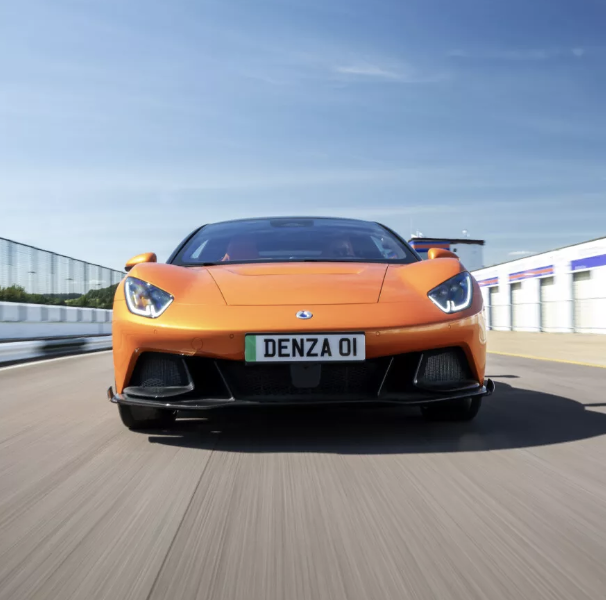
Before anyone accuses Denza of copying the competition, it helps to know who drew the Z. The car's styling is the work of Wolfgang Egger, a designer whose past credits include the Alfa Romeo 8C Competizione, Lamborghini, and Audi. That's not a background you manufacture with marketing. Egger has been at BYD since 2016, and the Z looks like the project he's been building toward.
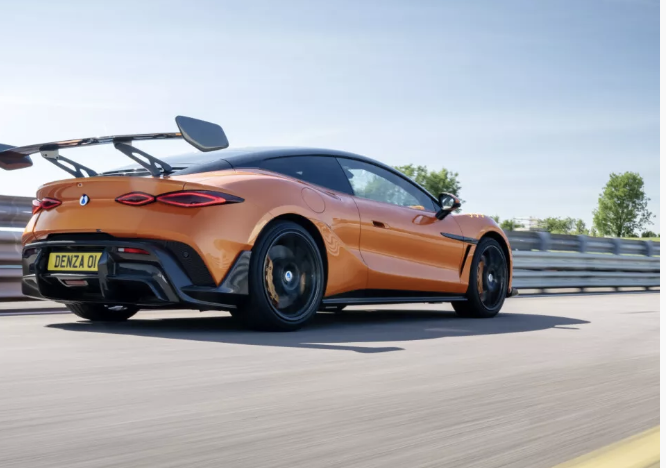
The Coupe measures 4,780 mm in length, 1,975 mm in width, and 1,330 mm in height, while the Spider stands slightly taller at 1,350 mm. The wheelbase comes in at 2,780 mm. The Racing variant goes a step further: it stretches 90 mm longer and 15 mm wider, and adds a carbon fiber front splitter along with a rear wing that adjusts across three positions.
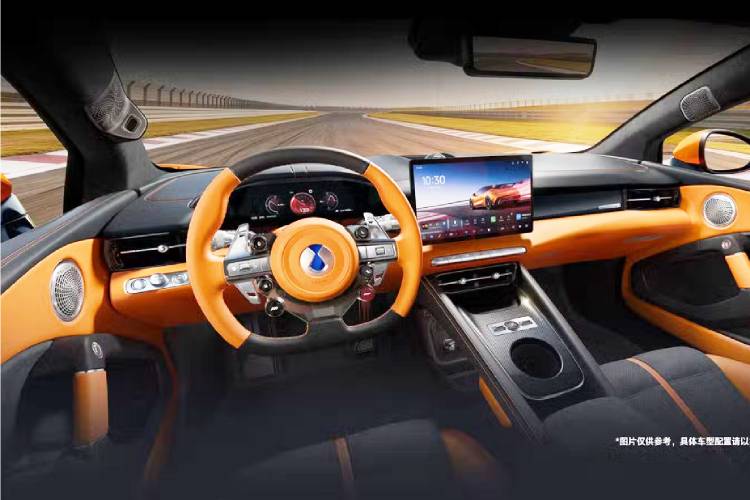
In rich red paint with diamond-like taillights, there's a hint of Bentley to certain angles of the design. That's not a bad comparison to carry. The cabin is built around leather, carbon fibre, suede-effect fabric, and metal trim, with a 12.8-inch infotainment screen running Google built-in and a Devialet sound system. Unusually for a car at this performance level, the Denza Z offers seating for four. A genuine 2+2 supercar with a sub-two-second sprint. That combination barely exists anywhere.
The Z comes in four configurations: Coupe, Spider, Racing, and a Special Edition. The Special Edition is being prepared specifically for record attempts at the Nurburgring Nordschleife circuit.
Performance: The Numbers That Change the Conversation
At the technical core of the Z is the proprietary e3 Sports Car Platform, which integrates a triple-motor powertrain configuration alongside Cell-to-Body architecture. By employing a single motor at the front axle and independent motors for each rear wheel, the system delivers a combined maximum output of 1,180 kW and 1,240 Nm of torque. Convert that and you're looking at approximately 1,582 to 1,604 horsepower depending on the variant, which puts it in rarefied air.
The Track Edition completes the 0 to 100 km/h sprint in 1.96 seconds and achieves a certified top speed of 350 km/h. The standard Coupe is no slouch either, reaching 0 to 100 km/h in 2.25 seconds, 200 km/h in 6.36 seconds, and topping out at 300 km/h.
The Special Edition is expected to push total output close to 2,000 hp, with a sub-1.7-second 0 to 62 mph time. For context, a Bugatti Chiron Super Sport does 0 to 60 mph in 2.3 seconds. Denza is not playing in the same universe anymore.
Denza claims the Z has already commenced lap record attempts at the Nurburgring. The current EV record at the Green Hell stands at 6:59.157, set by the Yangwang U9 Xtreme, which is also a BYD Group product. BYD is, somewhat surreally, competing against itself for EV lap records.
Specifications and Technology That Back the Claims
The chassis tech on the Denza Z is where things get genuinely interesting. The technical architecture completely replaces mechanical steering link hardware with an integrated steer-by-wire FinDreams chassis system developed by BYD's own Fudi chassis division. No mechanical connection between the steering wheel and the front axle. The car reads your inputs electronically and executes them, which on a track means response times and precision that no hydraulic or electric power steering system can replicate.
Chassis technology also includes magnetorheological DiSus-M adaptive dampers and a three-motor torque control system that enables a tight Compass Turn manoeuvre. The rear motors spin independently, which gives the car torque vectoring capabilities that most supercars at this price simply don't offer.
On battery chemistry: energy storage relies on a second-generation flat-pack lithium-iron-phosphate Blade battery. While domestic regulatory catalogue disclosures show a gross capacity scaling up to 102 kWh, initial export specifications list a usable capacity baseline of 76 kWh, with an 800V high-voltage electrical architecture capable of multi-megawatt rapid charging.
Charging That Redefines What's Possible
This might be the single most remarkable thing about the Denza Z, and that's saying something given the performance numbers. The Z supports Flash Charging technology capable of delivering up to 1,500 kW. That allows the battery to go from 10% to 97% in just 9 minutes, even in temperatures as low as minus 30°C.
The standard specification also supports a 10% to 70% top-up in five minutes flat. Think about that for a moment. You could stop for a coffee and be back on the road with a near-full battery before your drink cools down.
BYD is aiming to roll out roughly 300 Flash charging stations across the UK, and 3,000 across Europe, by the end of 2026. The infrastructure promise matters here. Fast charging at these speeds means nothing if the stations don't exist.
Price: The Gap Between China and the West Is a Story in Itself
Here's where it gets politically interesting. UK prices start at £142,900 for the Coupe. The Spider starts from 159,900 Pounds and the Racing from 172,900 Pounds. In US dollar terms, the entry point sits around $184,800 to $190,000 for international markets.
In China, the story is different. Pre-sale pricing in the domestic market starts at around $130,000, roughly $55,000 cheaper than what UK buyers will pay. The reason isn't a mystery. China's vertically integrated manufacturing ecosystem, state-supported supply chains, and lower labour costs mean BYD can build this car for far less at home than it can export it. Import duties, certification costs, local dealer margins, and deliberate premium positioning overseas all stack on top of that base cost.
At 142,900 pounds, the Z Coupe arrives in territory occupied by the Porsche 911 Carrera 4 GTS at 145,900 pounds. At 172,900 pounds, the Racing variant undercuts the 911 Turbo S at £199,500 while claiming significantly more power. On paper, the Denza wins that comparison by a mile. Whether European buyers trust a Chinese brand with no track record in their markets is a different question entirely.
UK deliveries are expected towards the end of 2026.
Conclusion
The Denza Z arriving at Goodwood isn't just a car launch. It's a signal. BYD has spent years quietly building the technology, the supply chain, and the talent base to compete at the absolute top end of the global automotive market. The Denza Z is the result of that build-up.
China's reputation in the supercar world has historically been non-existent. But with Wolfgang Egger's design, BYD's own steer-by-wire and magnetorheological suspension systems, and charging speeds that no European or American manufacturer has come close to matching, the Denza Z has arrived with a very different brief.
The question now isn't whether China can build a supercar. They clearly can. The question is whether the Western automotive establishment can respond fast enough to keep the conversation from moving permanently in China's direction.