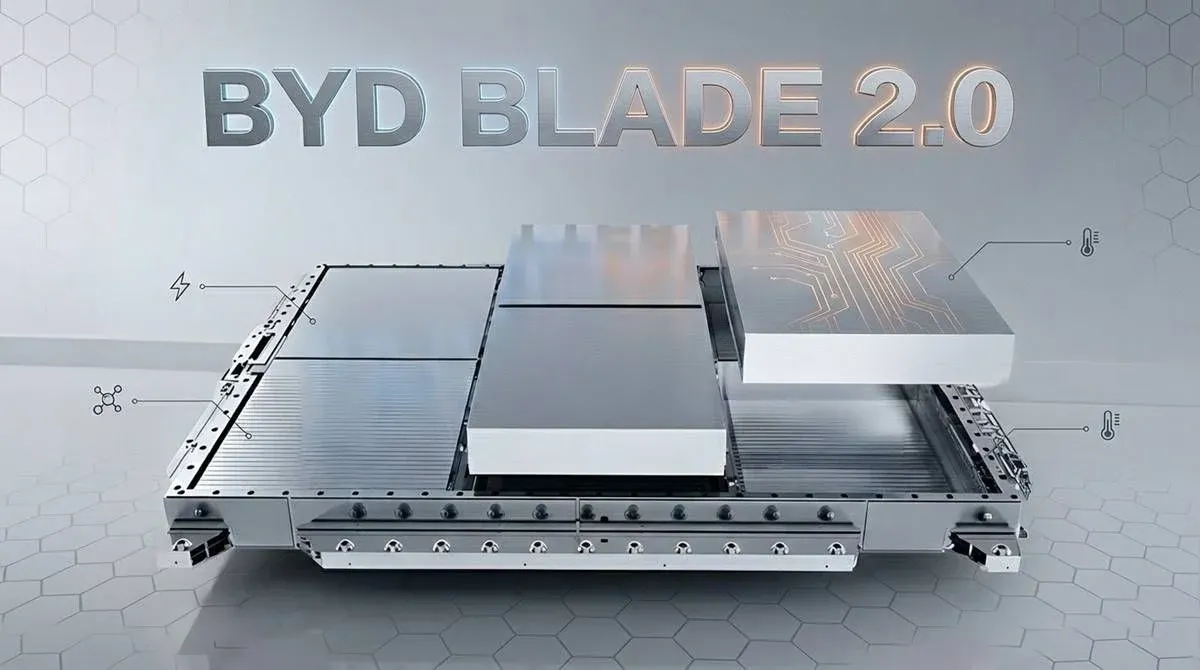
There is a particular kind of excitement that fills a car showroom when something genuinely new walks through the door. Not a refresh, not a spec bump dressed up in marketing language, but something that actually changes the conversation. That is exactly the atmosphere BYD has managed to create across dealerships in China following its March 5 unveiling of the second-generation Blade Battery and Flash Charging 2.0 system.
Showroom floors that had been seeing quieter foot traffic are now dealing with the opposite problem, crowds, queues, and a flood of test drive requests that dealers are scrambling to manage.
This is not organic hype built on vague promises. The buzz spreading through Chinese social media and local news channels is rooted in one stubborn concern that has long haunted electric vehicle ownership in the country's colder northern regions: what happens to your battery when the temperature drops well below freezing?
BYD's answer to that question, it turns out, has people leaving their homes to go see for themselves.
What BYD Actually Announced
The second-generation Blade Battery is not just an incremental update. BYD has pushed both energy density and charging speed forward in ways that, on paper, make several of its rivals look like they are playing catch-up.
The headline numbers are striking. Under standard conditions, the new system can charge from 10 percent to 70 percent in approximately five minutes. Want to push it further? Getting from 10 percent all the way to 97 percent takes around nine minutes. For context, most current fast-charging solutions on the market, including many considered best-in-class, still require significantly longer windows for a comparable charge range.
But the number that is generating the most conversation is not from a warm-weather test. At minus 30 degrees Celsius, the kind of cold that punishes conventional lithium batteries and reduces their effective range dramatically, BYD claims the new Blade Battery 2.0 can still charge from 20 percent to 97 percent in roughly 12 minutes.
That is a figure worth sitting with. Cold-weather degradation has been one of the most persistent and frustrating real-world limitations of electric vehicles globally, and if BYD's claims hold up under independent scrutiny, it would represent a meaningful leap forward not just for the Chinese market but for EV adoption in any region where winters are genuinely harsh.
Why Showrooms Are Suddenly Packed
The timing of this announcement matters. BYD introduced Flash Charging 2.0 at a moment when its domestic sales had been showing signs of softening. The new technology, then, functions as more than an engineering milestone, it is a calculated re-engagement with a consumer base that was beginning to look elsewhere or delay purchase decisions entirely.
It appears to be working. Dealership staff across multiple cities have reported that customers are arriving with unusually specific technical questions, not just "how far does it go" but detailed inquiries about cold-weather battery behavior, real-world charging speeds, and infrastructure availability.
These are the questions of buyers who have done their homework and are now looking for confirmation before committing. The fact that they are showing up in person rather than simply reading spec sheets online suggests a level of genuine interest that test-drive queues are now reflecting.
The EV industry has spent years trying to convince skeptical consumers that charging anxiety and range anxiety are solvable problems. BYD is betting that Flash Charging 2.0 is concrete enough proof to finally close that argument.
The Infrastructure Play Behind the Technology
Fast charging hardware is only as useful as the network that supports it, and BYD clearly understands that. Alongside the battery announcement, the company revealed what it is calling "Flash Charging China", a nationwide infrastructure rollout with an ambitious target of 20,000 high-capacity charging stations across the country by the end of 2026.
The plan involves partnerships with existing charging network operators as well as dedicated installations along major highways, designed specifically to serve vehicles capable of taking full advantage of the new system's peak charging rates.
This is a strategically important move. One of the persistent criticisms of ultra-fast charging announcements has been the infrastructure gap , the chargers capable of delivering these speeds simply do not exist in sufficient numbers for the technology to be meaningful in daily life. BYD is attempting to close that gap proactively, building the ecosystem around the technology rather than leaving it to chance or third-party development.
Industry analysts have noted that this aggressive network expansion could also place pressure on battery swap systems, an alternative EV refueling approach that companies like NIO have built their value proposition around. If high-speed charging can be delivered reliably through existing infrastructure at comparable or lower cost, the case for swapping entire battery packs begins to weaken. Flash charging, if deployed at scale, changes the calculus.
The Bigger Picture
BYD's Flash Charging 2.0 is arriving at a pivotal moment for the global electric vehicle industry. The technology race among Chinese automakers has intensified considerably, and charging speed has emerged as one of the clearest differentiators in a market where price competition alone no longer tells the whole story.
What BYD has done here is combine a compelling technical achievement with a credible infrastructure commitment, and it has done so at a moment when buyer sentiment was ready to be moved.
Conclusion
The showroom crowds are a leading indicator, not a guarantee. Whether Flash Charging 2.0 translates into sustained sales momentum will depend on how closely the real-world experience matches the announcement. Independent tests in genuine cold-weather conditions will be the true measure.
But for now, the fact that consumers are lining up to ask questions, and dealers are running out of time slots for test drives, suggests that BYD has succeeded in doing something that no spec sheet alone can accomplish. It has made people curious enough to come and see.
In an industry where attention is everything, that is not a small thing.