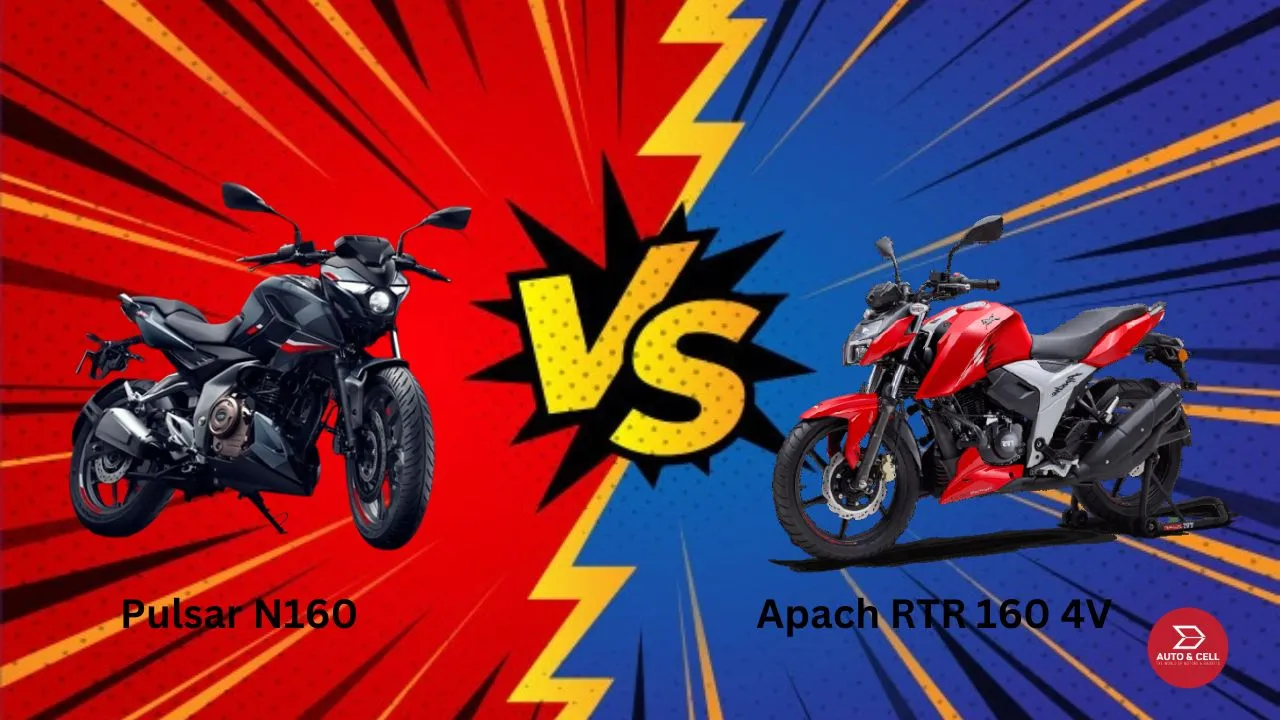
The introduction of the Bajaj Pulsar N160 has once again heated the 160cc motorbike market. Bajaj will face challenges because the market is one of the most competitive in the nation and a favorite among many young people.
Motorcycles in the 160cc class offer the ideal compromise between reliable performance and daily commuting. This sector also offers good fuel economy, which is something that many college-bound young people should consider before purchasing a motorcycle.
Since companies are constantly looking for ways to grow their market share, nearly all of the motorbike producers in India have a distinctive product to offer in the 160cc market. Despite the segment's wide range of options, we will contrast the recently released Bajaj Pulsar N160 with the TVS Apache RTR 160 4V.
We will compare four factors in this comparison: aesthetics, features & comfort, engine, and price.
Pulsar N160 vs. Apache RTR 160 4V Specifications
|
Name |
Pulsar N160 | Apache RTR 160 4V |
|
Dimensions (l x w x h) |
2017mm x 804mm x 1060mm | 2035mm x 790mm x 1050mm |
|
Engine |
Single Cylinder, 4-strokes, SOHC, 2 Valve, Oil- cooled, Twin Spark, FI |
SI, 4-stroke, 4-valve, Oil cooled engine |
|
Emission and Displacement |
BS6 and 164.82cc |
BS6 and BS4 159.7cc |
|
Max power and Torque |
16 PS @ 8750rpm 14.6Nm @ 6750rpm |
Power- 17.55 PS @ 9250rpm (BS6) 16.62 PS @ 8000rpm (BS4) Torque- 14.73Nm @ 7250rpm (BS6) 14.8Nm @ 6500rpm (BS4) |
|
Top Speed and Fuel Capacity |
120kmph and 14 liter | 114kmph and 12 liter |
|
Mileage |
35-40kmpl | 35-40kmpl |
|
Tires |
Front- 100/80-17 (disc) Rear- 130/70-17 (disc) Tubeless tires |
Front- 90/90-17 (disc) Rear- 130/70-R17 (disc and drum optional) Tubeless tires |
|
Suspension setup |
Telescopic Forks and Multi-step adjustable Mono shock with Nitrox |
Telescopic Forks and Mono shock absorber |
|
Seat height and ground clearance |
795mm and 165mm | 800mm and 180mm |
|
Kerb weight and colors |
154kg and Black | 147kg and Blue, Red and Black |
|
Braking system |
Dual Channel ABS |
Single Channel ABS (BS6) Standard (single-channel ABS optional) (BS4) |
|
Price |
Rs. 3.79 Lakhs |
starting from 2.72 lakhs to Rs. 3.83 Lakhs |
Design
What may look good to us may not be likable to others because vehicle design is such a highly personal affair. The Bajaj Pulsar N160 and TVS Apache RTR 160 4V, however, are also made with youngsters in mind.
 Beginning with the most recent design, the Bajaj Pulsar N160 is visually comparable to the Pulsar N250 and has a considerably more appealing overall appearance than the TVS Apache RTR 150 4V. In addition, features like the projector headlamps and the underbelly exhaust give the motorcycle a somewhat sportier and more appealing appearance.
On the other hand, the TVS Apache RTR 160 4V's most recent upgrade has given the motorcycle a somewhat crisper and more modern appearance thanks to the new headlight assembly, DRLs, body graphics, and color possibilities. It falls just a little short of the Pulsar in this aspect, though.
Features and Comfort
In contrast to other sectors, clients for motorcycles in the 160cc range have a wide range of needs and expectations. This is because motorcycles in the 160cc market ought to not only have greater performance than those in the 150cc segment, but also a respectable feature set without costing the earth.
This means the bikes should be loaded with features that cater to long-distance rides as well as offer something to brag about amongst friends circle for the youngsters.
 By providing dual-channel ABS (optional) in this range, Bajaj has this market nailed. Even though it might seem like a small enhancement, this capability occasionally saves lives. in particular when the roads are icy.
Additional features include a rear exhaust, split seats, LED projector headlamps, a gear position indication, a clock, a fuel economy meter, and a readout for the distance till the tank is empty.
In contrast to the single-channel ABS edition, which has a smaller front disc brake measuring 280mm, the dual-channel ABS version of the Bajaj N160 has a larger 300mm front disc brake. Both variations' 230 mm-long rear discs are the same size.
Similar features, including LED headlamps, a digital instrument panel with a gear position indication, and more are also included with the TVS Apache RTR 160 4V. Unfortunately, it is lacking amenities like split seats, underfloor exhaust, dual-channel ABS, and more.
In addition, the TVS' brakes are smaller, with front and rear 200mm and 270mm petal disc brakes, respectively.
Performance
One of the main factors driving individuals to spend more money than they would on a 160cc motorbike is the importance of the powertrain in the 160cc market.
With its 4-Stroke 2-valve engine producing 15.7 bhp of peak power and 14.6 Nm of peak torque, the Bajaj Pulsar N160 has a tiny advantage in this comparison. In addition, it weighs 154kg, which is a little bit more. The gearbox is still a 5-speed device.
The TVS Apache RTR 160 4V, on the other hand, makes a lot more power with 17.39 horsepower and 14.7 Nm of peak torque. Moreover, the motorcycle is lighter, weighing only 147 kg for the rear disc model.
Conclusion
It's nearly a draw. The Bajaj Pulsar N160 provides more features and extras, but the TVS Apache RTR 160 4V competes with it by having a more potent drivetrain. The Bajaj also appears more modern than the other two motorcycles. The decision ultimately comes down to your choices.
>>>You May Also Like-Riders are now allowed to attach mobile holders in their bike inside kathmandu valley<<<
>>>Yamaha MT-15 V2 vs Yamaha FZS-Fi v4- Which is the best?<<<
>>>Bajaj Pulsar 220F re-launching in India after demands surge high<<<
Join us on Facebook for insights on the latest updates on automobiles and gadgets: Autoncell
Also, follow us on our other Social Media Handles:
-original.webp)
-original.webp)