Dell just made the XPS 13 harder to overlook. The 2026 model arrives with Intel's new Panther Lake processors, a price that starts at $599 for students, and a direct shot at Apple's MacBook Neo, all wrapped in the thinnest XPS chassis Dell has ever built.
This isn't a minor spec refresh. The combination of a new chip architecture, a genuinely competitive starting price, and a feature set that outpaces the MacBook Neo on paper makes this one of the more interesting laptop announcements of the year. Here's everything you need to know.
A Design Dell Has Never Pulled Off at This Price
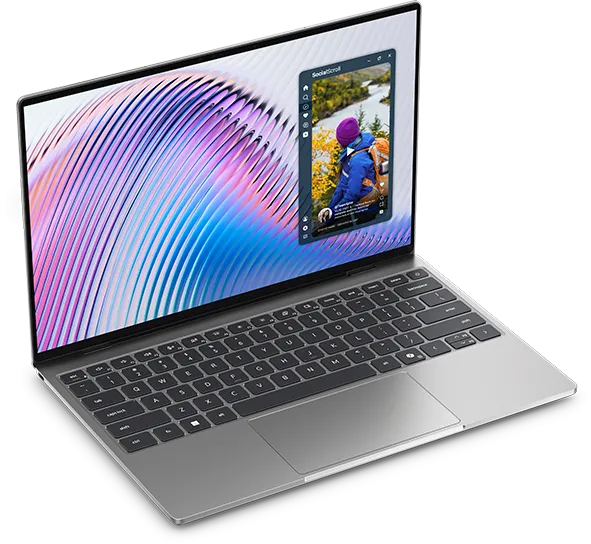
At 12.7mm thick and 1kg in weight, the 2026 XPS 13 is the lightest laptop Dell has ever put the XPS badge on. The chassis is full aluminum, rigid, slim, and built to the same standard Dell applies across the rest of the XPS lineup. Dropping the price didn't mean dropping the build quality, and that's the whole point Dell is trying to make here.
It comes in two finishes: Sky and Storm. The Storm colorway, along with the higher-end processor option, arrives later this summer.
The display is a 13.4-inch 2.5K IPS LCD touchscreen with a 2560×1600 resolution, 100% DCI-P3 color coverage, variable refresh rate between 30Hz and 120Hz, and a peak brightness of 500 nits. For a laptop at this price, that's a strong panel, and the touchscreen alone is something the MacBook Neo doesn't offer.
Intel Panther Lake: The Chip That Changes the Equation
The base model runs on the Intel Core 5 320, six cores, six threads, with a max boost clock of 4.6GHz. The upper-tier configuration steps up to the Core Ultra 7 355, an eight-core, eight-thread chip reaching 4.7GHz. Both belong to Intel's new Panther Lake generation, sold under the Core Series 3 and Core Ultra Series 3 branding.
What makes these chips relevant beyond raw clock speeds is the integrated NPU rated at 49 TOPS on both variants. As AI-assisted features become standard in Windows, live transcription, intelligent search, background processing, dedicated neural hardware keeps those tasks from eating into CPU performance and battery life. Intel has been chasing Apple's Neural Engine for years. At 49 TOPS, they're finally in the conversation.
Graphics run on integrated Intel Graphics, which is the right call for a machine built around portability and productivity. This is not a gaming laptop, and Dell isn't pretending otherwise.
Memory goes up to 32GB of LPDDR5x RAM clocked at 7467 MT/s, paired with a 1TB PCIe Gen 4 NVMe SSD. A dual-fan thermal system keeps the internals cool without adding bulk or noise.
Battery and Connectivity
Dell is claiming up to 17 hours of battery life from a 52Wh cell, charged via USB-C at 65W. If that number holds under real-world conditions, it's a strong result for a battery of that size. The variable refresh rate display doing the heavy lifting on power efficiency helps make that figure plausible.
Every XPS 13 ships with Wi-Fi 7 and Bluetooth 6.0 as standard. Port selection is two USB-C on all models, but the tier you buy determines the speed, Core 5 models get USB 3.2 Gen 2, while the Core Ultra 7 variant upgrades those same ports to Thunderbolt 4. That gap matters if you're running external displays or high-speed storage.
Standard across every configuration: backlit keyboard, glass precision touchpad, Windows Hello, quad speakers, and a touchscreen, none of which come on the MacBook Neo at this price point.
Full Specifications
Feature | Details |
Display | 13.4-inch, 2560×1600 (2.5K), IPS LCD touchscreen, 100% DCI-P3, 30–120Hz VRR, 500 nits |
Processor (Base) | Intel Core 5 320 , 6C/6T, up to 4.6GHz |
Processor (Upper) | Intel Core Ultra 7 355 , 8C/8T, up to 4.7GHz |
NPU | Up to 49 TOPS |
GPU | Intel Integrated Graphics |
RAM | Up to 32GB LPDDR5x at 7467 MT/s |
Storage | Up to 1TB PCIe Gen 4 NVMe SSD |
Battery | 52Wh, 65W USB-C charging, up to 17 hrs claimed |
Ports | 2x USB-C (3.2 Gen 2 on Core 5 / Thunderbolt 4 on Core Ultra 7) |
Wireless | Wi-Fi 7, Bluetooth 6.0 |
Security | TPM 2.0, Windows Hello |
Weight | 1kg / 2.2 lbs |
Thickness | 12.7mm |
Colors | Sky, Storm |
Price and Availability
In the US, the XPS 13 with Intel Core Series 3 (Core 5 320) is arriving soon, priced at $599 for eligible students aged 16 and above, and $699 for everyone else. The Core Ultra Series 3 variant with the Core Ultra 7 355 and the Storm colorway is set to follow later this summer.
As for Nepal, Dell has not announced official pricing or a local launch date yet. Based on typical import timelines and customs duties applied to laptops in this segment, the XPS 13 is expected to land in the Nepali market within two to three months of its US release.
We will update this article with confirmed Nepal pricing as soon as it becomes available.
Conclusion
Dell didn't just build a cheap XPS. It built an argument. The argument is that a $599 laptop doesn't have to mean a worse laptop, and on spec sheet alone, the 2026 XPS 13 backs that up with a touchscreen, faster wireless, more ports, and a larger display than the MacBook Neo it's openly competing against.
The real test is what happens when it lands in people's hands. Does the battery actually last 17 hours? Does the Core 5 320 hold up under sustained workloads? Those answers come with reviews. For now, this is the most interesting the XPS 13 has been in years , and at a price point Dell has never touched before.