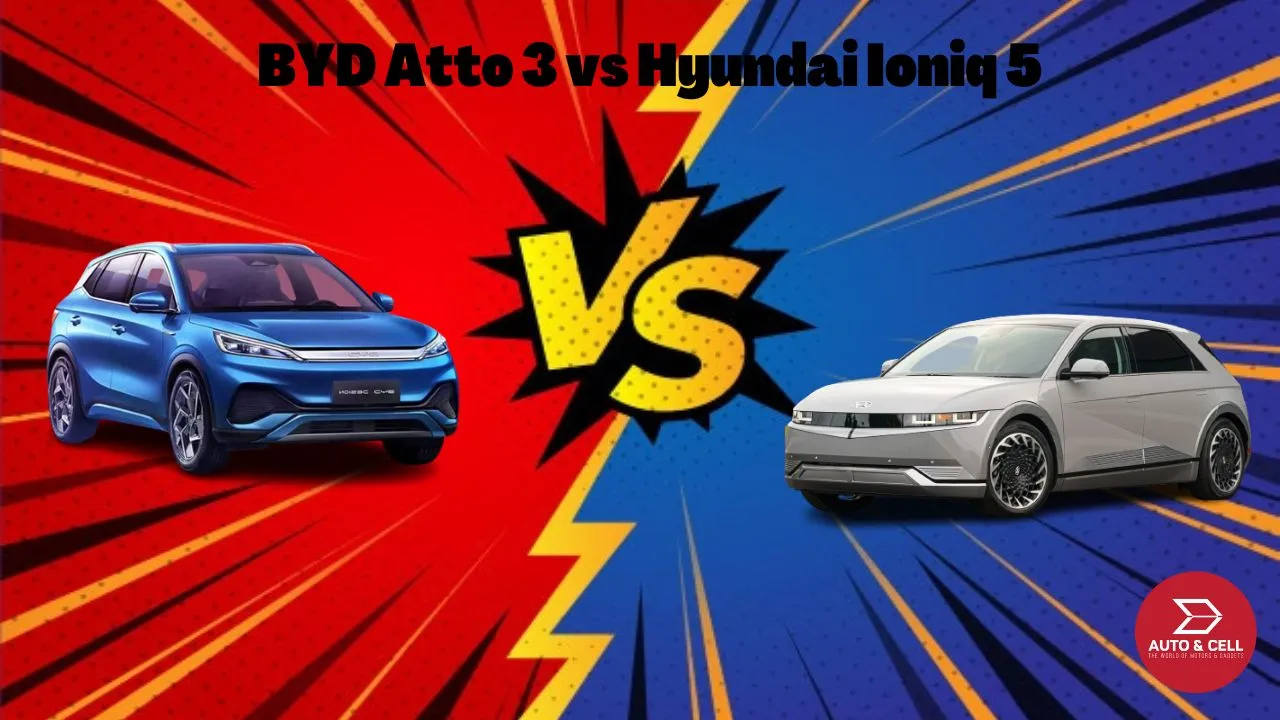
One of the most well-liked EVs in Nepal is the BYD Atto 3 and Hyundai Ioniq 5. Thus, which of these two EVs is the best one on the market right now? We've contrasted the main characteristics of both EVs in the tabled format below so you can see how they stack up against one another. We have contrasted the characteristics of the base variations of both models to get a general sense.
Specifications comparison
|
Contents |
BYD Atto 3 | Hyundai Ioniq 5 |
|
Motor |
150kW Permanent Magnet Sychronous Motor (PMSM) |
Permanent Magnet Synchronous Motor (PMSM) |
|
Dimensions |
4455mm x 1875mm x 1615mm | 4635mm x 1890mm x 1605mm |
|
Wheelbase and Kerb Weight |
2720mm 1750kg |
3000mm 1830-1910kg |
|
Max Power and Torque |
204PS and 310Nm | 125kW (170PS) and 350Nm |
|
Top Speed and Range |
160kmph and 420km | 185kmph and 375km |
|
Battery capacity |
60.48kWh LFP Blade Battery | 58kWh |
|
Charging Time |
0-80% in 50mins (with DC fast charging) |
7hours (with hyundai's AC wall charger) |
|
Tires |
Front- 215/55 R18-Disc Rear- 215/55 R18-Disc Tubeless tires |
Front- 235/55 R19-Disc Rear- 235/55 R19-Disc Tubeless tires |
|
Suspension Setup |
McPherson Strut and Multi-Link | McPherson Strut and Multi-Link |
|
Ground Clearance and Seating |
175mm and 5-seater | 160mm and 5-seater |
|
Safety System |
Airbags, HAC, Regenerative braking | Airbags, ABS, ESC, HAC |
|
Storage capacity |
440liters/1340liters (extended) | 527liters/1587liters (extended) |
|
Transmission and drive type |
Automatic + FWD | Automatic + RWD |
Price Comparison
|
Model Name |
Price |
|
BYD Atto 3 |
Rs. 90Lakhs |
|
Hyundai Ioniq 5 |
Rs. 1.16Crore (Vision Roof) |
Design
Outside it seems high-end and sporty, but inside it is just odd. I enjoy the Atto 3's resolute face and angry-looking front bumper, which give the vehicle a formidable attitude by making it appear broader and lower. Then, it sports a fashionable red LED brake light that joins the elegant-looking taillights on the back.
Additionally, the dashboard, which is constructed of a foam-like substance and resembles wavy sand stretching from door to door in the cabin, can rotate from a landscape to portrait orientation.
I believe BYD may be attempting to replicate the quirky and distinctive inside of a Mini. Although the BYD Atto 3 is significantly less expensive than a Mini, the materials and workmanship don't seem to be of the same high caliber.
The Ioniq continues the tradition set by eco hatches that came before it. You'll notice that this car's profile resembles that of the Toyota Prius; both vehicles were designed in this way to achieve low drag coefficients, which lead to better efficiency and a greater range.
There is no denying the Ioniq's uncool form, even though it is a little more subdued than the current Prius' crazy angles. Even if it warps the low-drag box to Hyundai's design cues, you could argue that it is still awkward. Although the car is slightly improved by the LED headlights, the modest 16-inch wheels and filled-in grille barely give it more street credit.
The Ioniq is more of a proof-of-concept vehicle for early adopters who are more interested in the car's drivetrain and technology than in how the vehicle looks, which is the main focus here.
This is evident in the interior of the Ioniq, which has recently undergone renovation. Impressive digital elements include a floating 10.25-inch screen that now completely dominates the dashboard.
Performance
A 150kW permanent magnet synchronous motor (PMSM) powers the BYD Atto 3. It produces a maximum of 204 PS of power and 310 Nm of torque. It also has three riding modes. It has a 60.48 kWh Blade battery that has a 420 km estimated range. Based on BYD e-Platform 3.0, it will be offered in the Extended Range for the Nepali market.
A permanent-magnet synchronous motor (PMSM) powers the Hyundai Ioniq 5. It has a maximum power output of 170PS and a maximum torque output of 350Nm. A 58kWh Lithium-Ion Polymer battery is included with the Ioniq 5. Additionally, the battery can be fully charged in 7 hours using the onboard 10.5kW charger.
Hyundai claims that its vehicles have an average range of 375 kilometers per charge. The Solar Roof will also provide further aid to increase the total range. It cannot, however, just power the SUV.
The first EV to be constructed on Hyundai's Electric-Global Modular Platform (E-GMP) will be the Ioniq 5. Hyundai Kona and Hyundai Ioniq previously used an entirely new platform. According to Hyundai, this enables quicker charging, a longer driving range, a roomier interior, and better handling.
Conclusion
Not only is the BYD Atto 3 one of the most affordable electric vehicles, but it also has a ton of standard amenities, making it a great value for the money. Service fees are more than we'd anticipate, and the warranty's term falls short of that of competitor MG's seven-year/unlimited-mile coverage.
But many Nepalese will find this to be a functional, little SUV with a distinctive and quirky appearance. Hyundai's Ioniq is still among the top EV choices available right now, just like the Kona EV.
It finds a great balance between giving much more range and better energy efficiency than the less expensive Nissan Leaf or MG ZS EV while offering the comfort of the Hyundai grade and driving experience at a price that is only a little more expensive than a top-spec Prius.
These elements along with the manner in its interactivity provide the engagement that early buyers will be looking for accounting for its reasonably high score.
Therefore, in terms of design and features, I would choose the Hyundai Ioniq 5 above the BYD Atto 3. However, BYD Atto 3 is still one of the greatest EVs on the market when compared to others because of its price and the features that come with it.
>>>You May Also Like-Lucid Air' A Luxury EV with 836km Range<<<
>>>Ford Ranger Raptor Now Available in Nepal<<<
>>>All New Honda WR-V 2023 unveiled<<<