Nepal’s smartphone market, particularly the budget gaming segment, is heating up. And with the arrival of the ZTE Nubia NEO 3 GT, the competition just got more intense. Known globally for offering aggressive specs at affordable prices, ZTE's Nubia NEO series has carved a niche for itself among budget-conscious gamers. This year, for the first time, ZTE brings that reputation to Nepal with the NEO 3 GT.
But while the device flaunts an unapologetically gamer-centric design and some high-end hardware features, a closer look reveals a device that walks a fine line between raw appeal and real-world performance. At a price of NPR 36,999 for the 12/256GB variant, it steps into a ring already dominated by brands like Infinix, especially with the much-hyped GT 30 Pro.
Does the Nubia NEO 3 GT offer true value or is it all just RGB and no real punch? Let’s unpack this device in detail.
Price & Availability
According to reliable sources, the ZTE nubia NEO 3 GT is officially priced in Nepal at NPR 36,999 for the single 12 GB RAM / 256 GB storage variant. The model is available through authorised retail and online stores in Nepal, and the launch announcement mentions that purchasers may also avail 0% EMI payment options where supported.
Design and Build
From the very first glance, the Nubia NEO 3 GT declares its identity loud and clear: this is a phone built for gaming enthusiasts.
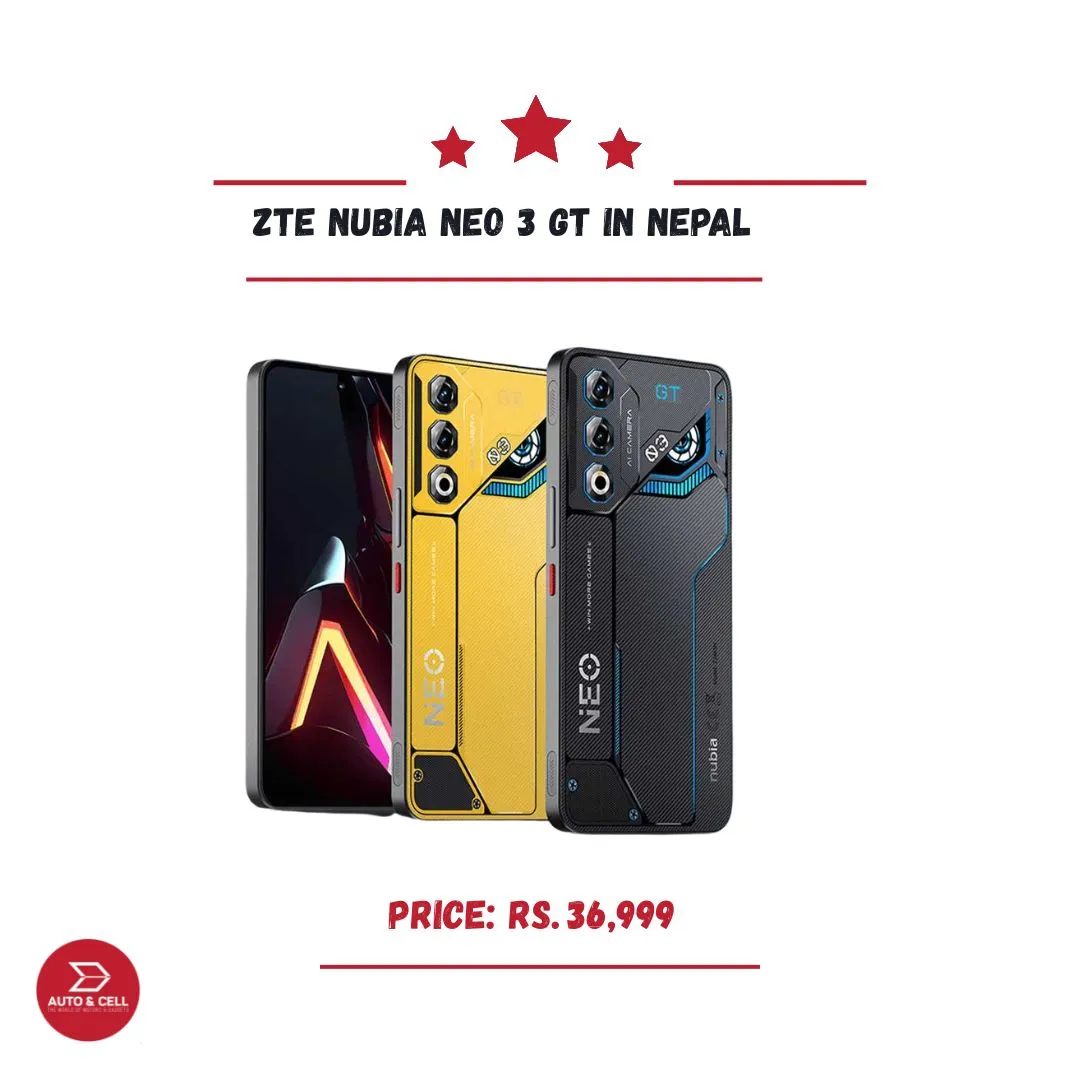
The rear panel features cyber-mecha-inspired aesthetics, complete with RGB lighting and a signature eagle-eye LED design that screams futuristic. It’s bold, unapologetic, and meant to appeal to the Gen-Z gamer or any enthusiast who wants their phone to look as fast as it plays.
There are pressure-sensitive shoulder triggers on the right frame, giving users an edge in FPS or racing games, an element usually reserved for higher-end gaming phones like the ASUS ROG or Black Shark series.
The build itself is relatively slim at 8.2mm thick, considering the size of the battery, and the two color options, Electric Yellow and Interstellar Gray, further drive home the theme of futuristic play.
Display
The 6.8-inch FHD+ OLED panel offers a 120Hz refresh rate, up to 1300 nits of brightness, and a 1200Hz instant touch sampling rate. On paper, this sounds excellent, and for casual gaming and media consumption, the display will perform admirably.
But here's where things get complicated.
Despite being OLED, the actual panel quality feels a bit lacking in contrast and punch compared to rivals in the same price segment. For instance, the Infinix GT 30 offers a similar size and refresh rate, but its color tuning and HDR capabilities are better optimized.
That said, the touch sampling rate is one of the highest in this category, ensuring quick response times, crucial in competitive gaming.
Performance
This is perhaps the most critical and controversial part of the NEO 3 GT, the processor.
ZTE opted for the UNISOC T9100, a 6nm octa-core 5G chip. While this brings modern connectivity, its actual performance is closer to a 4G MediaTek Helio G99, or even less in some benchmarks. For a phone targeting mobile gamers, that’s a letdown.
In comparison, the Infinix GT 30 Pro features a MediaTek Dimensity chip, delivering significantly better CPU and GPU scores. The T9100 simply can’t keep up with modern, graphically demanding games like PUBG Mobile (at higher settings) or Genshin Impact.
However, the 12GB RAM and 256GB UFS storage do help with multitasking and faster app loads. And ZTE did try to compensate with a large 4,083mm² vapor chamber cooling system, which keeps the device thermally efficient during longer sessions.
But thermal control can only go so far when raw performance is underwhelming.
Software Experience
On the bright side, the phone ships with Android 15, a surprising move given that most competitors at this price point are still stuck with Android 13 or 14. The software experience is relatively clean, with minimal bloatware, and ZTE has made some gaming-centric UI customizations, including performance tuning and game space optimizations.
This gives it a slightly smoother feel in day-to-day operations, and the ability to isolate gaming performance from background processes is a thoughtful touch.
Cameras
In true gaming phone tradition, the camera department takes a back seat.
-
Rear: 50MP main + 2MP depth sensor
-
Front: 16MP selfie camera
These are standard at best and fall behind rivals like Xiaomi or Realme in image processing. ZTE hasn’t specified aperture sizes or sensor details, which further suggests that photography was never the priority here.
Casual users might find the daylight shots acceptable, but low-light performance and dynamic range are not strong suits of this camera setup. Still, for the gamer crowd, this may not be a dealbreaker.
Battery and Charging
One area where the Nubia NEO 3 GT shines above the competition is battery and charging performance.
With a massive 6,000mAh battery, the phone is capable of enduring intense gaming sessions without reaching for the charger every few hours. But more impressive is the 80W fast charging, a feature rarely found even in phones twice the price.
To put that in perspective: most phones in this bracket max out at 33W or 45W.
What’s more, bypass charging support means that during gaming, the battery is not constantly being charged and heated, preserving its long-term health. This is an underrated but very gamer-focused feature that more brands should adopt.
Full Specifications of ZTE Nubia NEO 3 GT
|
Feature |
Details |
|
Display |
6.8-inch OLED, FHD+ (1080 x 2392), 120Hz refresh, 1300 nits peak brightness |
|
Processor |
UNISOC T9100 (6nm, Octa-core) |
|
RAM & Storage |
12GB RAM + 256GB internal storage |
|
Cameras |
50MP (Main) + 2MP (Depth), 16MP front |
|
Battery |
6,000mAh with 80W wired charging, bypass charging supported |
|
OS |
Android 15 |
|
Build |
RGB lighting, gaming triggers, pressure-sensitive shoulder zones |
|
Dimensions |
163.3 x 77.2 x 8.2 mm |
|
Colors |
Electric Yellow, Interstellar Gray |
|
Price in Nepal |
Rs. 36,999 (12GB/256GB variant) |
Conclusion
The ZTE Nubia NEO 3 GT is a device that excels in design and battery tech but stumbles where it matters most, performance.
For casual gamers or users who prioritize aesthetics, long battery life, and super-fast charging, it could still be an appealing option. The pressure triggers and RGB design add a layer of uniqueness that many competitors don’t offer.
However, for serious mobile gamers, the underwhelming UNISOC processor simply can’t justify the price tag. When brands like Infinix are offering better chipsets, smoother displays, and overall stronger performance at the same price point, the NEO 3 GT feels like a missed opportunity from ZTE.
Still, its arrival is notable, it signals that ZTE is ready to compete in Nepal’s evolving smartphone ecosystem. But for its next launch, they’ll need to back the flash with more firepower.