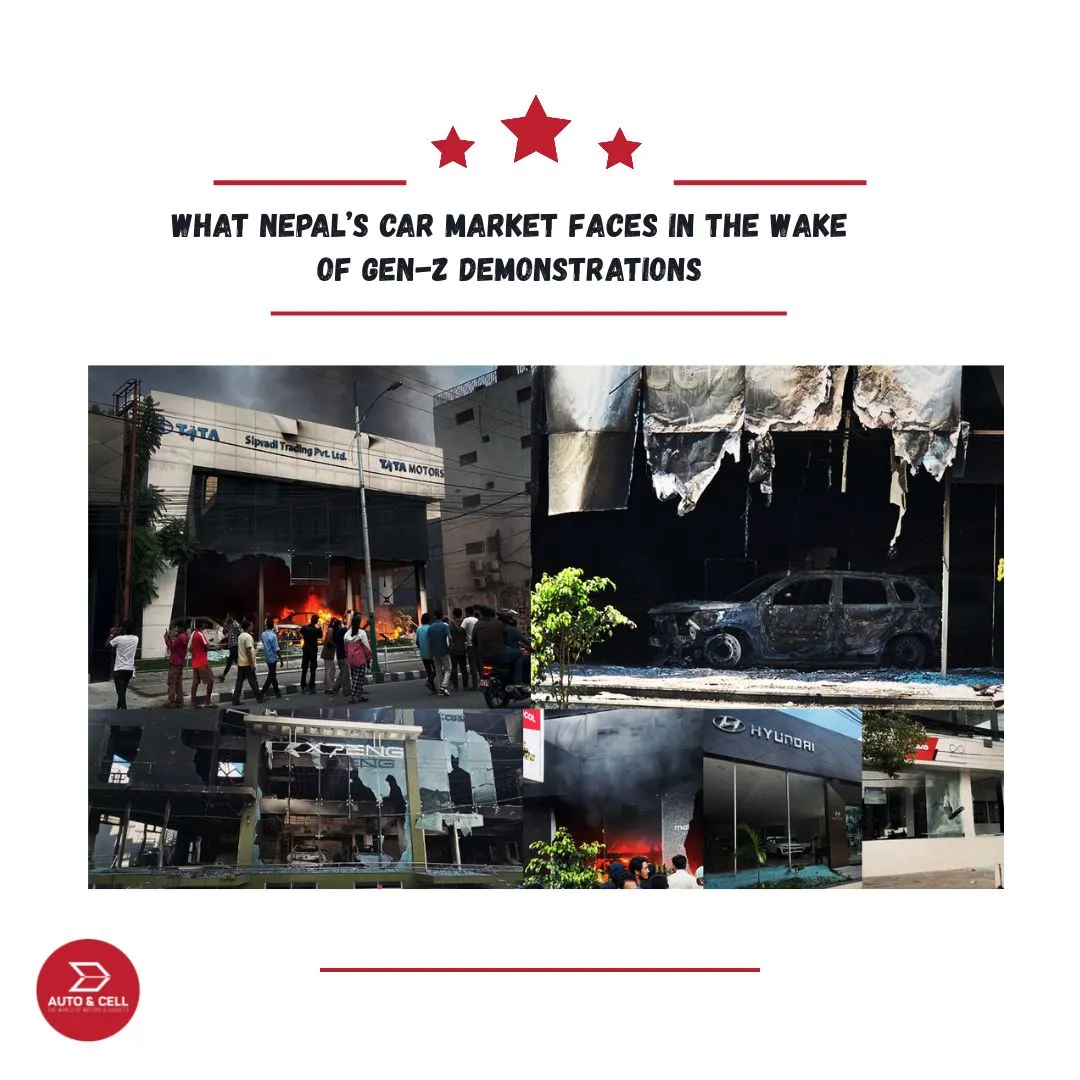
Nepal is no stranger to political upheavals, but the recent Gen-Z–led demonstrations have left more than just a psychological scar. What began as a youth-driven cry for justice has evolved into a defining moment for the nation’s infrastructure, economy, and business sectors. Amid the images of historical landmarks set ablaze and governmental buildings defaced, one sector has taken a direct hit, Nepal’s automotive industry.
From charred showrooms in the Kathmandu Valley to vandalized service centers across Lalitpur and Pokhara, the devastation has been swift and symbolic. And yet, the images being shared on social media aren’t just snapshots of broken glass and burnt hoods. They represent something more fragile: trust, stability, and a sector already in a delicate period of transformation.
This article looks at what the aftermath of these protests means for Nepal’s auto market, its players, and the consumers who now face uncertainty in a sector once associated with aspiration and progress.
The Visual Toll: More Than Just Metal and Glass
If you’ve scrolled through your feed recently, you’ve probably seen them, the torched cars, the gutted showrooms, the blank stares of employees standing in rubble. For many Nepalis, these businesses weren’t just sales points. They were community centers of employment, aspiration, and mobility.
Automotive showrooms serve several roles: they are employment hubs, after-sales service points, financial centers (with loan processing and EMI facilities), and local economic multipliers. Their destruction has temporarily stalled an entire ecosystem: from sales executives and technicians to financing agents and delivery partners.
For instance, when a showroom in Jawalakhel is burnt down, it doesn’t just delay car purchases, it also means dozens of families dependent on commission, maintenance services, and insurance facilitation are now financially paralyzed.
Symbolism and Sentiment: Why the Auto Sector Became a Target
Why were cars and showrooms, of all things, targeted? The answer lies in the complex intersection of public anger, economic inequality, and symbolism.
To many, flashy car dealerships and luxury vehicles symbolize wealth, privilege, and the status quo. In times of civil unrest, these visible indicators of prosperity become easy, emotional targets, not because of what they are, but because of what they represent. The destruction, though regrettable, is rooted in deep systemic frustrations that go far beyond any one showroom or brand.
Moreover, with social media amplifying every burned tire and shattered glass panel, the emotional impact has become nationalized. The automotive industry, usually a neutral bystander in political tensions, has suddenly been pulled into the center of a societal reckoning.
A Sector Already in Transition
It’s important to remember that even before these protests, Nepal’s automotive industry was in flux. A major transformation has been underway, largely driven by:
-
EV adoption: Sparked by rising fuel prices, environmental concerns, and supportive government policies.
-
Increased imports: Mid-range and luxury vehicles from China and India were seeing strong demand post-pandemic.
-
Rising urbanization: Demand for compact SUVs, crossovers, and two-wheelers was growing, particularly among young professionals.
Events like the NAIMA Nepal Mobility Expo and NADA Auto Show 2025 had started regaining consumer confidence. Brands were launching electric crossovers, setting up digital showrooms, and even exploring AI-assisted test drives. There was momentum.
But the protests, and their sheer intensity, have hit the pause button on that progress. Consumer sentiment has shifted from excitement to uncertainty.
Confidence Crisis: Will People Still Buy Cars?
The biggest challenge now isn’t just rebuilding infrastructure, it’s rebuilding consumer confidence.
Car buying is a high-involvement, long-term decision. Customers look for stability, service assurance, financing support, and future resale value. After witnessing dealerships reduced to ashes and offices looted, it’s only natural for potential buyers to hesitate.
This hesitation may be even stronger among middle-class first-time buyers, the very demographic that was driving the recent surge in auto demand.
Will they trust that the new car they buy today will have service support tomorrow? Will banks be as willing to process auto loans for a sector still reeling from shock? These are critical questions.
The Role of Government: Policy Watch Begins
With an interim government now in place, all eyes are on how quickly, and how strategically, it can respond.
Key expectations include:
-
Emergency relief or subsidies for auto retailers and affected employees
-
Clear communication on insurance claim processes for damaged assets
-
A restoration fund or partnership with banks to ease working capital burdens
-
Security protocols to prevent such targeted destruction in future crises
-
Continued push for EV infrastructure, so the long-term sustainability goals aren’t derailed
Even a symbolic visit by a senior minister to a destroyed showroom could help project reassurance. But policy clarity, especially around recovery, loans, and infrastructure, is what will truly anchor the sector.
For Industry Players: A Time for Resilience and Reinvention
If you’re a stakeholder in Nepal’s auto market, now is the time to pivot and prepare.
Some early steps businesses might consider:
-
Pop-up showrooms: Setting up smaller, mobile, or shared retail spaces to continue operations while rebuilding
-
Digital experience upgrades: Doubling down on online consultations, test drive scheduling, and AR/VR vehicle demos
-
Customer reassurance campaigns: Proactive communication around servicing, guarantees, and safety
-
Community partnerships: Collaborating with local youth or civic organizations to rebuild trust, not just walls
The businesses that show empathy, clarity, and innovation during this recovery phase will likely win long-term loyalty.
For Consumers: Questions of Timing and Trust
For Nepali consumers, especially Gen Z and young professionals, the unrest has created a mental shift. Cars, once a symbol of independence and aspiration, now feel like high-risk investments, both financially and emotionally.
Yet the need for mobility hasn't disappeared. If anything, the protests have underscored how important it is to have personal transport during times of public disruption. The challenge is emotional reassurance.
Consumers will be watching for three things:
- Visible signs of stability in showrooms and service centers
- Policy clarity on road infrastructure, tax rebates, and EV incentives
- Brand trustworthiness, which companies stood with their customers during the crisis?
Brands that step up their communication, clarify their post-sale support, and show commitment to community rebuilding may find themselves gaining market share, even in a volatile environment.
Looking Ahead: A Turning Point, Not a Full Stop
While the damage is real and the emotions are raw, this is not the end of the road for Nepal’s automotive sector. If anything, it is a powerful inflection point.
Historically, Nepal’s auto industry has faced disruptions, from tax overhauls and border blockades to policy shifts around electric vehicles. And each time, it has adapted. The resilience is built-in. What’s needed now is a collective effort, from government to garages, from brands to buyers.
The burnt showrooms will be rebuilt. But what really matters is whether trust, innovation, and forward-thinking strategy can rise from the ashes.
Because mobility in Nepal isn’t just about moving from one place to another. It’s about moving forward, together.
-original.webp)
-original.webp)
-original.webp)