Nissan is coming back to the compact SUV ring, and it’s not pulling any punches. With the unveiling of the all-new Tekton, Nissan has officially signaled its intent to disrupt one of the most fiercely contested segments in the Indian automotive market. Slated for launch between April and June 2026, the Tekton is more than just a new product; it’s a redefinition of Nissan’s design philosophy and a strategic reboot of its India roadmap.
For a brand that once enjoyed strong recall in India with models like the Terrano and the Magnite, Tekton represents a bolder, more globalized approach, one that merges international design cues with local market ambitions. And if the initial design reveal is anything to go by, Nissan is preparing to square off with heavyweights like the Hyundai Creta, Kia Seltos, Honda Elevate, and the upcoming new-gen Renault Duster.
Let’s take a deep dive into what makes the Nissan Tekton a potential game-changer in this hyper-competitive landscape.
A New Platform, A New Chapter
Underpinning the Tekton is the CMF-B platform, the same architecture that will also spawn the next-generation Renault Duster. This shared DNA is no coincidence, it’s a calculated move under the Renault-Nissan Alliance to streamline development costs while allowing each brand to retain its distinct identity.
But don’t mistake shared bones for shared personalities. While the Tekton shares its dimensions and base with the Duster, Nissan has gone out of its way to ensure the SUV stands apart in styling, execution, and brand essence. The Tekton is designed to be more urbane, more tech-forward, and more aligned with global Nissan products like the Patrol.
Exterior Design
Ken Lee, Nissan’s Senior Design Director, describes the Tekton as a vehicle that carries the "design DNA of the Patrol", and that reference is not thrown around lightly.
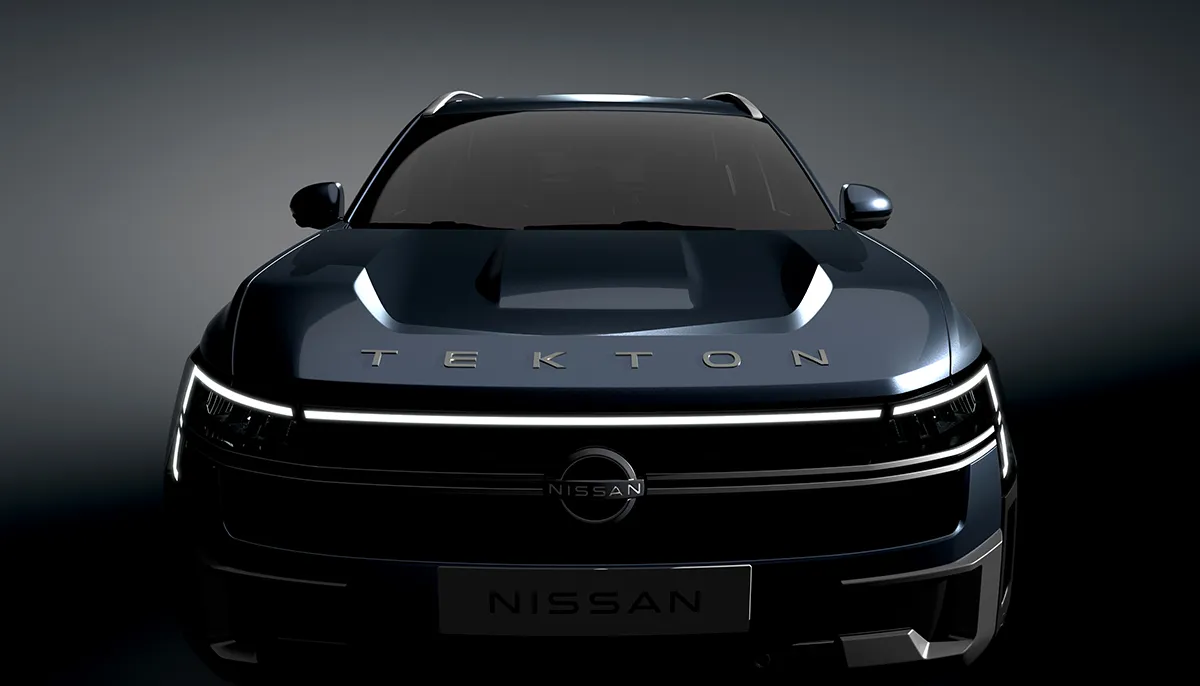
At the front, the wide, commanding grille with integrated C-shaped LED headlamps gives the Tekton an unmistakably bold face. The connected LED DRLs feel modern, while the upright sculpted bonnet adds visual mass and off-road credibility. Nissan has cleverly added TEKTON badging on the nose, reinforcing identity and presence.
The bumpers are dual-tone, black and silver, and accented with a chunky skid plate that hints at light trail-readiness. Moving to the side profile, the SUV maintains a tall, upright silhouette, with roof rails, muscular wheel arches, and dual-tone alloys. The rear door handles are seamlessly integrated into the C-pillar, lending the side a cleaner, coupe-like profile.
At the rear, connected inverted C-shaped taillamps, a large roof spoiler, and hefty body cladding combine to give the Tekton a planted, assertive look. It’s robust, without being overly aggressive, much like the intended buyer demographic: modern, aspirational, and subtly adventurous.
Interior
While Nissan hasn’t fully revealed the cabin, the interior teaser gives us plenty to speculate, and be optimistic about.
We see a layered dashboard layout, which immediately elevates the Tekton above the utilitarian feel of older Nissan cabins. The upper dash features soft-touch materials, while the center console adopts a glossy black finish. But the real attention-grabber is the copper accent strip that runs across the dashboard, hinting at a premium aesthetic that could challenge even the more upscale interiors in this segment.
Expect Nissan to go heavy on technology and connectivity, likely including a large touchscreen infotainment system, digital instrument cluster, connected car tech, and a premium sound system. Given the 2026 timeline, ADAS Level 1 features (such as lane departure warning, autonomous emergency braking, and blind spot monitoring) might also be on the cards, especially for export models.
Performance & Powertrain
Nissan has not yet disclosed the Tekton’s engine lineup, but educated guesses are easy to make. Given the CMF-B platform and the global trends, we can expect:
-
A 1.3L turbo-petrol engine (used in models like the Nissan Kicks and Renault Duster) producing between 130–156 PS, mated to a CVT or 6-speed manual.
-
Possibility of a 1.0L turbo-petrol entry variant to keep costs competitive.
-
An eventual strong-hybrid variant, considering Nissan's global direction towards electrification and the CMF-B’s adaptability for hybrid powertrains.
-
No diesel variant is expected, which aligns with both Nissan’s clean fuel direction and the segment's gradual diesel phase-out.
With performance likely tuned for both city comfort and highway cruising, expect the Tekton to strike a balance between refinement and punch, much like its intended competitors.
Made in India, for the World
The Tekton will be manufactured at the Renault-Nissan Alliance plant in Chennai, a facility that has been instrumental in both domestic and export strategies for the partnership. Nissan has confirmed that Tekton will be a globally aligned product, meaning it will cater not just to Indian buyers, but also be exported to developing markets in Africa, the Middle East, and possibly Latin America.
This global play brings scale, and with it, the ability to offer higher features at competitive prices, a win-win for Indian buyers. It also means Nissan will have no room for cost-cutting or corner-cutting, as global homologation standards will likely be in play.
Strategic Positioning: Nissan’s Comeback Vehicle
Let’s not ignore the bigger picture. Nissan’s presence in India has dwindled in recent years, with limited models and even fewer segment winners. The Magnite helped revive interest, but it’s the Tekton that could finally give the brand a serious shot in the mid-size SUV space, a space that is now the volume king of the Indian passenger vehicle market.
By positioning Tekton as a premium-yet-value-loaded offering, Nissan can bridge the gap between the urban crossover and traditional SUV buyer. It will need to offer aggressive pricing, feature-loaded trims, and strong aftersales support. If it manages that, the Tekton could replicate or even exceed the success of the Magnite, and that’s saying something.
Conclusion
Absolutely. The Nissan Tekton isn’t just another SUV launch, it’s a serious contender backed by global design language, mature platform engineering, and a clear intent to scale. With Hyundai, Kia, Maruti Suzuki, Honda, and soon even Toyota crowding this segment, competition is cutthroat, but so is consumer demand.
What gives the Tekton an edge is its authentic SUV styling, globally benchmarked interiors, and a freshness that other established players can’t easily replicate. If Nissan gets the pricing and variant strategy right, it won’t just shake up the segment, it could help rebuild Nissan’s brand equity in India.
Come 2026, all eyes will be on Tekton. And from the looks of it, Nissan is ready for its second act.
-original.webp)
-original.webp)
-original.webp)
-original.webp)
-original.webp)