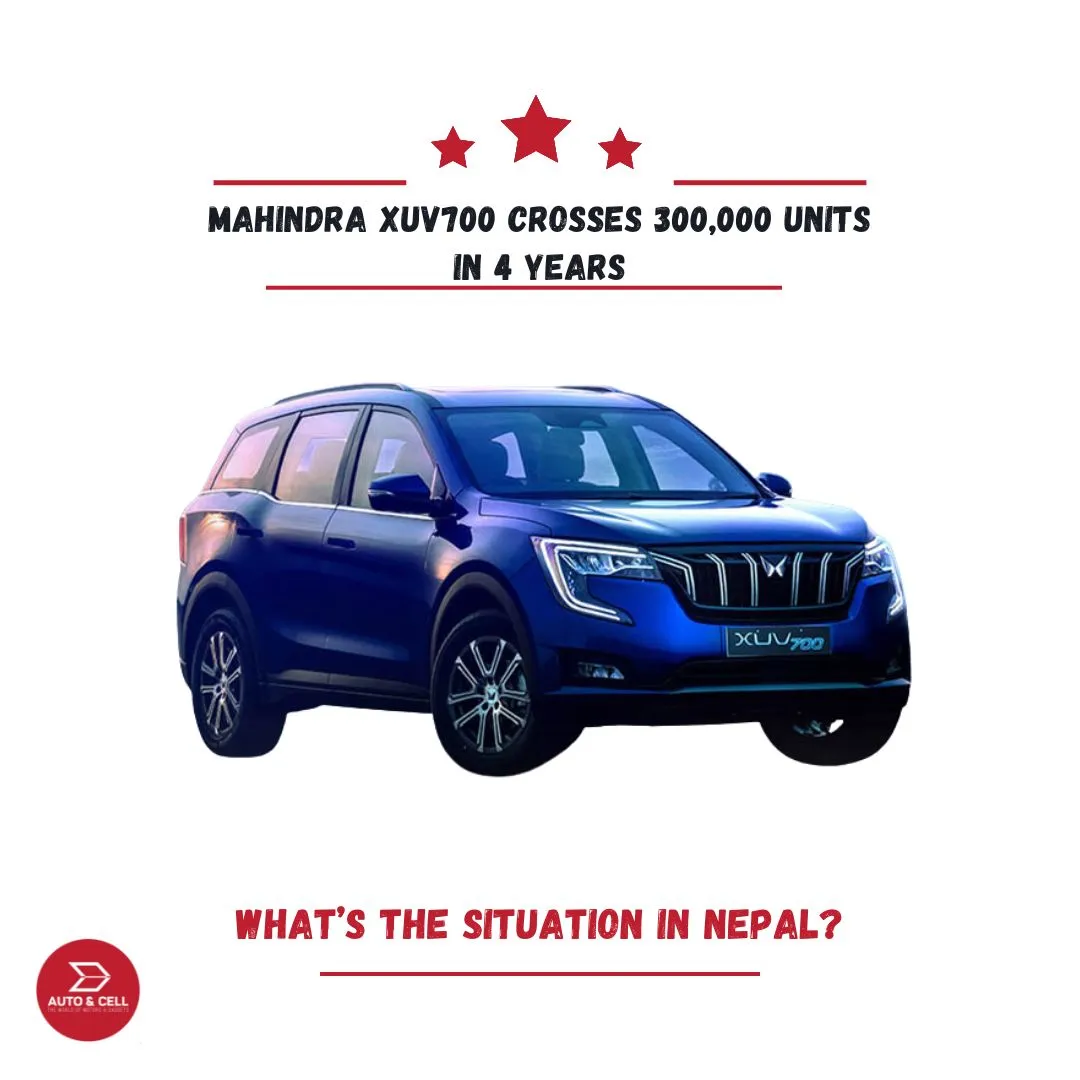
Four years ago, Mahindra took a bold leap into the premium SUV space with the XUV700, positioning it as the brand's flagship offering in India’s hyper-competitive mid-size SUV segment. As of mid-2025, it has officially crossed a significant production milestone: over 300,000 units sold across India. That figure isn't just a number, it’s a reflection of how effectively the XUV700 has managed to capture attention in a crowded market filled with global giants like Hyundai, Tata, MG, and even Toyota.
But while the story in India is one of continuous momentum, the situation in Nepal paints a contrasting picture. Launched in Nepal in early 2023, the XUV700 had early buzz and strong showroom footfall. Yet today, it finds itself struggling for traction, challenged by evolving consumer expectations and a sharply rising interest in electric vehicles. So why the disconnect between the two markets? Let’s break it down.
Design and Variants
The XUV700 was designed to be Mahindra’s most forward-looking SUV ever, replacing the popular XUV500 with a more assertive, modern look. Its design elements, sharp LED DRLs, flush door handles, muscular wheel arches, and a commanding grille, communicate both tech-savviness and road presence.
In India, the XUV700 is offered in six distinct variants: MX, AX3, AX5, AX5 Select, AX7, and AX7 L. Customers can choose between 5-seater and 7-seater configurations, giving the model a wide appeal, from young professionals to growing families. Mahindra has also kept things fresh with the launch of special editions like the Blaze and Ebony, targeting younger, style-conscious buyers with custom paint schemes and cabin tweaks.
Inside, the XUV700 is loaded with creature comforts like a dual 10.25-inch display setup, premium upholstery, panoramic sunroof, and ADAS (Advanced Driver Assistance Systems), features that were once unthinkable in a Mahindra vehicle, and certainly rare in its price range.
Engine and Performance
What sets the XUV700 apart from many of its competitors is its commitment to performance. The SUV is offered with two powerhouse engine options:
-
2.0L Turbocharged Petrol (mStallion)
-
2.2L Turbocharged Diesel (mHawk)
These engines are mated to either a 6-speed manual or a 6-speed automatic transmission, and selected diesel variants even come with all-wheel-drive (AWD), a rare feature in this segment.
In India, this translates into a dynamic drive experience. The petrol variant is refined and fast, offering quick acceleration, while the diesel is ideal for highway cruising and offers better torque under load. The XUV700 also boasts features like drive modes (Zip, Zap, Zoom), enabling the car to adapt to different driving styles and terrains.
But in Nepal, performance is no longer the trump card it once was. With rising fuel prices and tighter urban environments, Nepali customers are shifting their focus to fuel efficiency and compactness, areas where the XUV700 doesn’t shine as brightly.
Pricing: Competitive in India, Premium in Nepal
In India, Mahindra has been aggressive with its pricing. The XUV700 starts at INR 14.49 lakh (ex-showroom), offering a strong value proposition when compared to rivals like the Tata Safari, Hyundai Alcazar, and MG Hector Plus.
In Nepal, however, the starting price is a hefty NPR 74 lakhs, going all the way up to NPR 1.10 crore for the top-end variant. This positions it well above some similarly specced rivals and even puts it in the same bracket as emerging EV models, particularly from BYD, GWM, and even Hyundai’s electric lineup.
That price difference, combined with lower fuel efficiency and the lack of tax breaks (which EVs enjoy in Nepal), has made it difficult for the XUV700 to appeal to budget-conscious or future-focused buyers.
Sales in Nepal
The XUV700 officially arrived in the Nepali market in Magh 2079 (early 2023), with Agni Group as its authorized distributor. Initial bookings were promising. Mahindra’s strong brand recall in Nepal, combined with the buzz around the ADAS-equipped flagship, meant that early adopters showed genuine interest.
However, as the EV wave started to rise sharply in Nepal, the XUV700 began to lose momentum. In a market now flooded with high-value EVs like the BYD Atto 3, MG ZS EV, and GWM Sealion 7, buyers have increasingly turned toward electric alternatives that offer lower operating costs, tax incentives, and a more modern narrative.
It’s not that the XUV700 lacks appeal, it’s just that the market moved faster than Mahindra expected. And unlike India, where ICE vehicles still dominate and infrastructure supports long-distance drives, Nepal's dense cities and short commutes are better suited to electric powertrains.
Comparative Challenges: ICE vs EV in Nepal’s Current Climate
When placed side by side with an EV like the GWM Sealion 7, which is priced similarly, the XUV700 suddenly feels a bit out of place. While the Mahindra boasts 200+ horsepower and a rugged chassis, the Sealion counters with:
-
Zero emissions
-
Tax incentives
-
Advanced infotainment
-
High safety ratings
-
Minimal running costs
For many Nepali families and corporate buyers, the decision is no longer about horsepower or off-road capability, it’s about value over time. And this is where internal combustion engine (ICE) vehicles like the XUV700 struggle to compete unless priced more strategically or paired with hybrid options.
Can the XUV700 Still Compete in Nepal?
There’s no denying the engineering brilliance and feature-rich proposition of the XUV700. It remains one of the most advanced Indian SUVs ever built, and its 300,000-unit milestone in India is proof that Mahindra has cracked the formula domestically.
However, in Nepal, the brand needs a course correction.
From a product strategy perspective, Mahindra could:
-
Introduce mild-hybrid or full-hybrid variants to balance performance and efficiency
-
Localize assembly or components to reduce import costs.
-
Work with the Nepali government to offer targeted financing or servicing packages.
More importantly, Mahindra must acknowledge the EV shift head-on. While the XUV700 excels in features and power, it does not currently align with Nepal’s new-age automotive preferences. The future success of Mahindra in Nepal may rest not in ICE domination but in electrifying its fleet, including the long-rumored XUV.e8, the EV version of the XUV700, which could be the perfect answer to Nepal’s evolving mobility needs.
Conclusion
The Mahindra XUV700 is a triumph in India, breaking records and redefining expectations from a homegrown SUV. But in Nepal, its journey is far more nuanced. It started strong but now finds itself at a crossroads, a familiar position for many ICE vehicles around the world as EVs gain ground.
That said, Mahindra is known for agility. If the company adapts quickly, whether through localized strategies or faster EV rollouts, it still has the brand strength and customer trust to remain relevant in Nepal.
For now, though, 300,000 units may be the story in India, but in Nepal, the next chapter is still being written.
-original.webp)
-original.webp)

-original.webp)