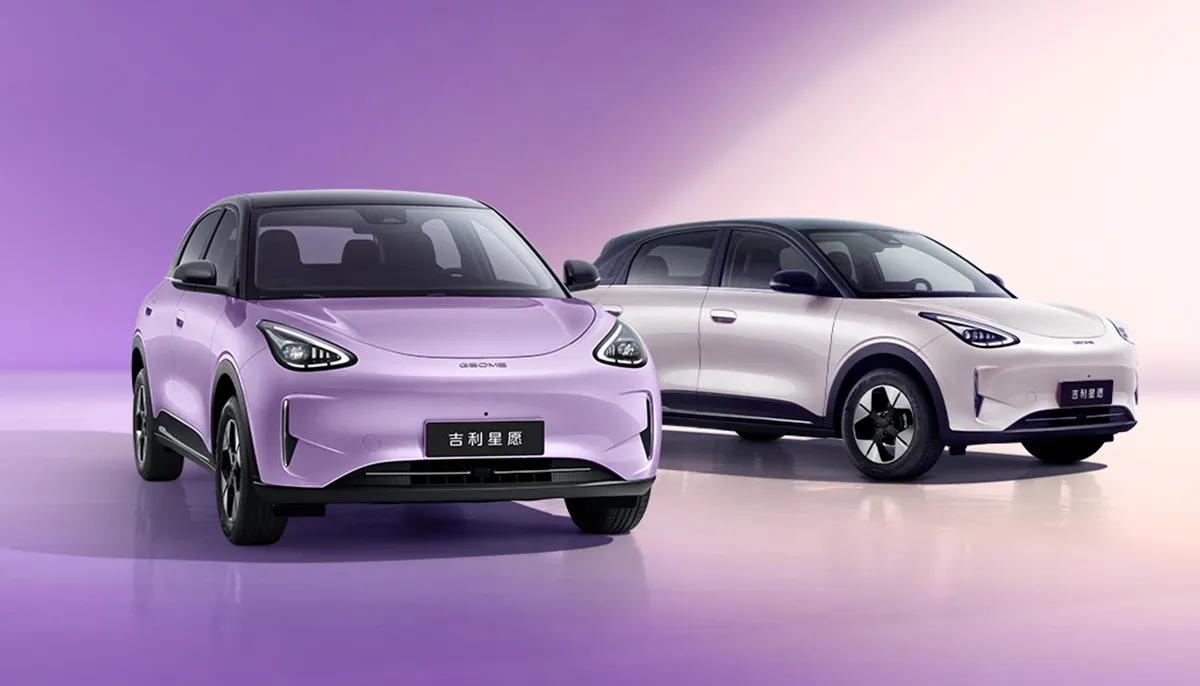
Geely, one of China's most prolific automotive giants, has once again made headlines with the launch of its 2026 Geometry Xingyuan electric vehicle. At first glance, it might seem like just another compact EV added to an already crowded Chinese market, but a closer look reveals a product that is deeply strategic in both design and intent.
The Xingyuan isn’t just meant for China. It’s the backbone of Geely’s increasingly global EV ambitions, with strong signals pointing towards its rebadging as the upcoming Proton eMas 5 in Malaysia. That makes this release more than just a local affair, it’s a blueprint for affordable, export-ready electric mobility in emerging markets.
Design
The Geometry Xingyuan may not scream flamboyance, but its design quietly commands respect. The aerodynamic front fascia, featuring a closed-off grille and L-shaped daytime running lights, leans into EV trends without overdoing the futuristic aesthetics. It’s a clean, compact profile that looks at home in urban environments while still hinting at technical sophistication.
One of the more thoughtful touches is the semi-hidden door handles, subtly improving aerodynamics while giving the vehicle a sleeker silhouette. The 16-inch alloy wheels, flush surfaces, and tight body lines are all about maximizing visual appeal within compact proportions.
With a length of 4,135 mm, width of 1,805 mm, height of 1,570 mm, and a 2,650 mm wheelbase, the Xingyuan is clearly optimized for urban maneuverability. But it doesn’t sacrifice practicality. You get a 375-litre rear trunk, a 70-litre front trunk, and foldable rear seats that expand total cargo space to a generous 1,320 litres, more than adequate for grocery runs, road trips, or luggage-heavy airport commutes.
Interior
Step inside, and the Geometry Xingyuan greets you with a surprisingly refined cabin for its segment. An 8.8-inch digital instrument cluster keeps the driver informed with minimal distraction, while either a 10.1-inch or a 14.6-inch floating central touchscreen anchors the infotainment experience depending on the variant.
But this isn’t just about screens for the sake of it. The interface runs Flyme Auto, a platform that integrates smartphone-like usability into the vehicle. Dual-zone voice control allows for hands-free interaction, while Flyme Link ensures tight synchronization with mobile devices. For parking and navigation, the 540° panoramic camera system is a standout, particularly rare in compact EVs at this price point.
Geely’s attention to digital UX here suggests a deeper understanding of what the modern urban driver values: not just tech, but intuitive tech.
Performance and Powertrains
Under the hood, or rather, under the floor, are two rear-wheel-drive, single-motor options tailored for different needs. The base 310 km range version is powered by a 58 kW motor delivering 130 Nm of torque, paired with a 30.12 kWh lithium iron phosphate (LFP) battery. This setup is clearly optimized for budget-conscious daily commuters.
For those with longer travel needs, the 410 km variant bumps up the motor to 85 kW and 150 Nm of torque, with a larger 40.16 kWh LFP battery. While it doesn’t promise earth-shattering acceleration, the performance figures are sufficient for its segment, and importantly, both variants are tuned for smooth, predictable city driving.
Battery temperature management is handled by liquid-cooling, a premium feature that ensures consistent performance across various weather conditions, something especially crucial for markets like Malaysia or Nepal, where ambient temperatures vary widely.
Charging also gets a solid mark. A 30–80% DC fast charge takes just 21 minutes, and a quick 10-minute top-up provides about 120 km of range. That’s a meaningful leap for users with busy lifestyles, and it aligns well with urban EV usage patterns.
Specifications at a Glance
|
Feature |
310 km Variant |
410 km Variant |
|
Motor Output |
58 kW |
85 kW |
|
Torque |
130 Nm |
150 Nm |
|
Battery Capacity |
30.12 kWh (LFP) |
40.16 kWh (LFP) |
|
Estimated Range (CLTC) |
310 km |
410 km |
|
Charging (DC Fast, 30–80%) |
~21 minutes |
~21 minutes |
|
Trunk Space (Rear + Front) |
375L + 70L |
375L + 70L |
|
Infotainment |
Flyme Auto w/ 10.1" or 14.6" screen |
Same |
|
Wheelbase |
2,650 mm |
Same |
Global Relevance
This isn’t just a story about China. The Xingyuan’s modularity is what makes it particularly compelling. Proton, Malaysia’s national automaker and a Geely subsidiary, is preparing to release the Proton eMas 5, a right-hand-drive version of this very model.
That means what we’re seeing in China today could soon be traversing streets in Kuala Lumpur, Kathmandu, or Jakarta. For developing nations where EV adoption is in its early stages, the eMas 5 represents something critical: a practical, affordable, and modern electric hatchback without premium frills but also without compromise.
Given Malaysia’s roadmap for EV infrastructure and incentives, the Proton eMas 5 could become a major player in Southeast Asia. And as demand grows for compact EVs in countries like Nepal, where narrow roads, fuel prices, and environmental awareness are all driving change, the chances of this vehicle entering the local market are high.
Conclusion
Geely’s 2026 Geometry Xingyuan may not make headlines in the West, but it could end up being one of the most influential compact EVs globally. It offers a glimpse into what scalable, adaptable, and export-ready electric vehicles can look like, not just for China, but for a broader global audience hungry for clean, efficient, and affordable urban mobility.
By focusing on real-world practicality, space, charging ease, intuitive tech, and wrapping it in an accessible price bracket, Geely has effectively created a benchmark. The Xingyuan (and its Proton eMas 5 sibling) is not just a car. It’s a signal of intent: that the future of EVs isn’t confined to luxury sedans or premium SUVs, but rooted in smart, everyday solutions built for the people.
And if Geely plays its cards right, we might just see this little hatchback quietly revolutionizing the streets of Asia and beyond.