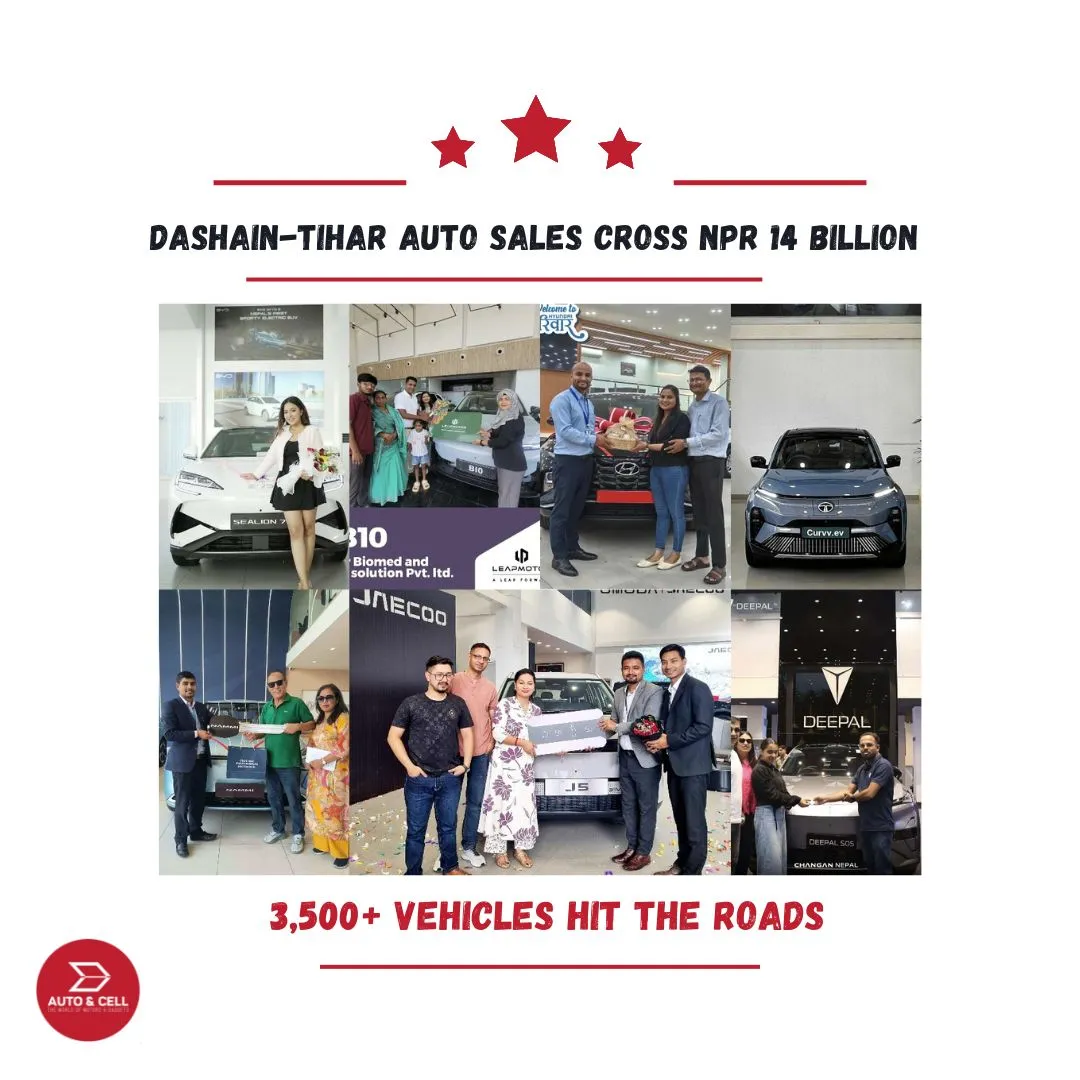
It’s that time again when the festive lights of Dashain and Tihar shine brightest, and they’re doing more than just brightening homes, they’re driving engines. Nepal’s auto market has accelerated, with dealerships and companies reporting over NPR 14 billion in sales and 3,500+ vehicle deliveries during the festive season.
In this article, we’ll unpack how the numbers came about, which brands were in the fast lane, what challenges they overcame, and what it all means for auto buyers in Nepal.
The Big Picture: What the Numbers Tell Us
According to the data released by dealers and the customs department, auto traders delivered more than 3,500 vehicles across Nepal during Dashain–Tihar, valued at over NPR 14 billion.In an industry where the festive season often accounts for around 40 % of annual deliveries, that high mark is significant.
Why does this matter? For one, the purchasing decision during the festivals carries social and psychological weight in Nepal: new vehicle purchases often align with family celebrations, status recognition, and practical upgrades. Dealers know this, and they gear their operations accordingly, with launch events, booking offers, and delivery schedules. This year, despite external headwinds, the market held up well. Dealers reported that many bookings made during the major auto shows (such as the NADA Auto Show) in mid‑year were delivered in this festive window. That said, the figures also reflect the tension between demand and supply: logistics delays, import bottlenecks and external disruptions loomed large even as sales hit record territory.
Supply‑Chain Strain and Market Realities
On closer inspection, the challenges behind the festive sales surge are telling. Dealers report that this year was far from smooth. Two major factors disrupted the flow: the flooding and landslide events, and a prolonged protest movement by the Gen-Z Movement (as reported). The first disrupted roads; the second forced delays in shipments and showroom operations.
To be specific: the main China‑Nepal trading border at Rasuwā closed after landslides and bridge damage, hampering the arrival of imported vehicles. For an import‑reliant market like Nepal, where many models arrive via China or through Chinese manufacturing, this meant that some bookings got shifted to after Dashain–Tihar.Yet, the industry still managed to deliver. That mix of deferred bookings and festive‑enabled purchases shows the resilience of local dealerships and the underlying strength of consumer demand, even when external logistics are under pressure.
Who Drove the Numbers: Brand‑by‑Brand Breakdown
If you peek under the hood of that NPR 14 billion figure, a few brands stand out prominently.
BYD
This Chinese electric‑vehicle brand, via its Nepal dealership Cimex Inc., led the pack with about 1,100 units delivered during this period.
Their model mix included:
-
Better‑selling mid‑sized EV hatch/hatchback models like the ATTO 2 with ~475 units.
-
The smaller ATTO 1 with around 420 units.
-
Their luxury segment model, the SEALYAN‑7, also saw about 200 units delivered.
What this tells us: the EV segment is accelerating fast, and BYD is effectively riding the wave in Nepal. Their large portion of the festive share suggests consumers are increasingly ready for EV ownership.
Tata
Tata, via official dealer Sipradi Trading Ltd., delivered 577 units across multiple models during Dashain–Tihar.
The breakdown included:
-
Express T: 190 units
-
Punch EV: 177 units
-
Tiago EV: 120 units
-
K‑3 Nexon EV: 50 units
-
Fuel/ICE (Internal Combustion Engine) models: 20 units
This mix demonstrates again that EVs are taking a sizable share even among established ICE‑players.
Hyundai
Hyundai, through dealer Laxmi Intercontinental, delivered around 600 units (roughly) of models such as the Creta EV, Venue, and the facelifted Creta petrol. This is noteworthy since Hyundai’s range still includes strong ICE demand, showing that the transition to EVs is not uniform yet, hybrid/ICE remains strong.
Other notable players
-
Deepal: ~200 unit deliveries in the festive window.
-
Dongfeng: ~150 units delivered in Nepal via their importer.
-
Leapmotor: ~ 160 units delivered in Nepal.
-
Omoda: Approximately 350 units delivered.
-
MG: ~ 200 units delivered in Nepal
-
Other brands such as CG Motors (commercial + passenger) delivered around 112 units.
The diversity of brands and sizable numbers across EVs and ICE suggest that consumer demand is broadening rather than narrowing; customers aren’t just buying on brand name, they’re buying on value, technology, and utility.
What This Means for Consumers and Industry
For consumers
If you are a prospective car buyer in Nepal, this surge has meaningful implications:
-
Better negotiation leverage: dealers offering festive season deals implies that you may find some residual incentives or perks even after the festive window.
-
Broader model availability: with 3,500+ deliveries, the odds that your preferred model is available increase. That said, supply issues do persist (as we’ll discuss), so early booking remains wise.
-
Transition‑readiness to EVs: Given EVs are making large headway (BYD, Tata, etc), you now have more real‑world options, service networks, and consumer confidence. If you’ve been sitting on the fence about EV vs ICE, the marketplace is tilting.
For industry
-
Festive season remains vital: The fact that about 40% of annual deliverables happen during the festival window means that manufacturers and dealerships must align production, logistics, and marketing for a condensed burst. The 2025 figure shows they are managing that, but just barely.
-
Supply chain vulnerability exposed: The disruption at the China border and protests show how import‑heavy markets like Nepal can be exposed to external shocks. Manufacturers and logistics providers will be looking to diversify or build resilience.
-
EV acceleration: The dominance of EV deliveries among top sellers signals that manufacturers should invest more heavily in EV infrastructure, service networks, and consumer education in Nepal. Dealers that succeed will likely be those who can offer end‑to‑end EV readiness, not just the vehicle.
Challenges Ahead
Even in a good year, the industry faces risks. The 2025 festive window was flagged by dealers for delays in importation and delivery due to landslides and border closures. Additionally, some bookings made during the auto‑shows had to be deferred. While the market demand remains strong, future growth may hinge on whether the supply side can keep pace, and whether government policy, infrastructure, and financing can support the EV transition.
Equally important: customer after‑sales, financing, service networks, especially for EVs, which can’t be taken for granted. The “delivery” number is only the beginning; long‑term satisfaction depends on what happens after the keys are handed over.
What to Watch Going Forward
Here are some key indicators that will shape the next wave of Nepal’s auto market:
-
The balance between EV and ICE model sales: if EVs continue to represent a growing share, we may be seeing a structural shift.
-
Dealer service and charging infrastructure growth: especially in semi‑urban and rural areas.
-
Policy shifts from the government: import duties, incentives for EVs, road infrastructure, all these will interplay with market growth.
-
Supply chain resilience: how manufacturers and importers manage external risks (landslides, border issues, protests) will affect delivery timelines and consumer confidence.
-
Financing and ownership costs: as vehicles grow more advanced (EVs, connected features), consumers will look to financing models that match their budgets and expectations.
Conclusion
The festive season of Dashain–Tihar 2025 in Nepal has proven to be more than just a time of tradition and celebration, it’s become a major economic indicator for the auto industry. With over NPR 14 billion in sales and more than 3,500 vehicle deliveries, the market is signaling robust consumer demand, increasing acceptance of EVs, and the vital importance of logistics and timing in Nepal’s unique terrain.
If you’re in the market for a vehicle, or thinking ahead for your next move, this is a moment worth noting. The brands that have seized this period did more than sell cars; they delivered sentiment, utility, and confidence. For buyers and dealers both, the key will be maintaining that momentum through the year, ensuring that what happens after the delivery is as strong as the numbers that got us here.
In a landscape where roads can close, borders can be delayed, and supply chains can strain, the fact that the festive market held firm speaks volumes about Nepal’s auto industry maturity, and about the choices available to its drivers.