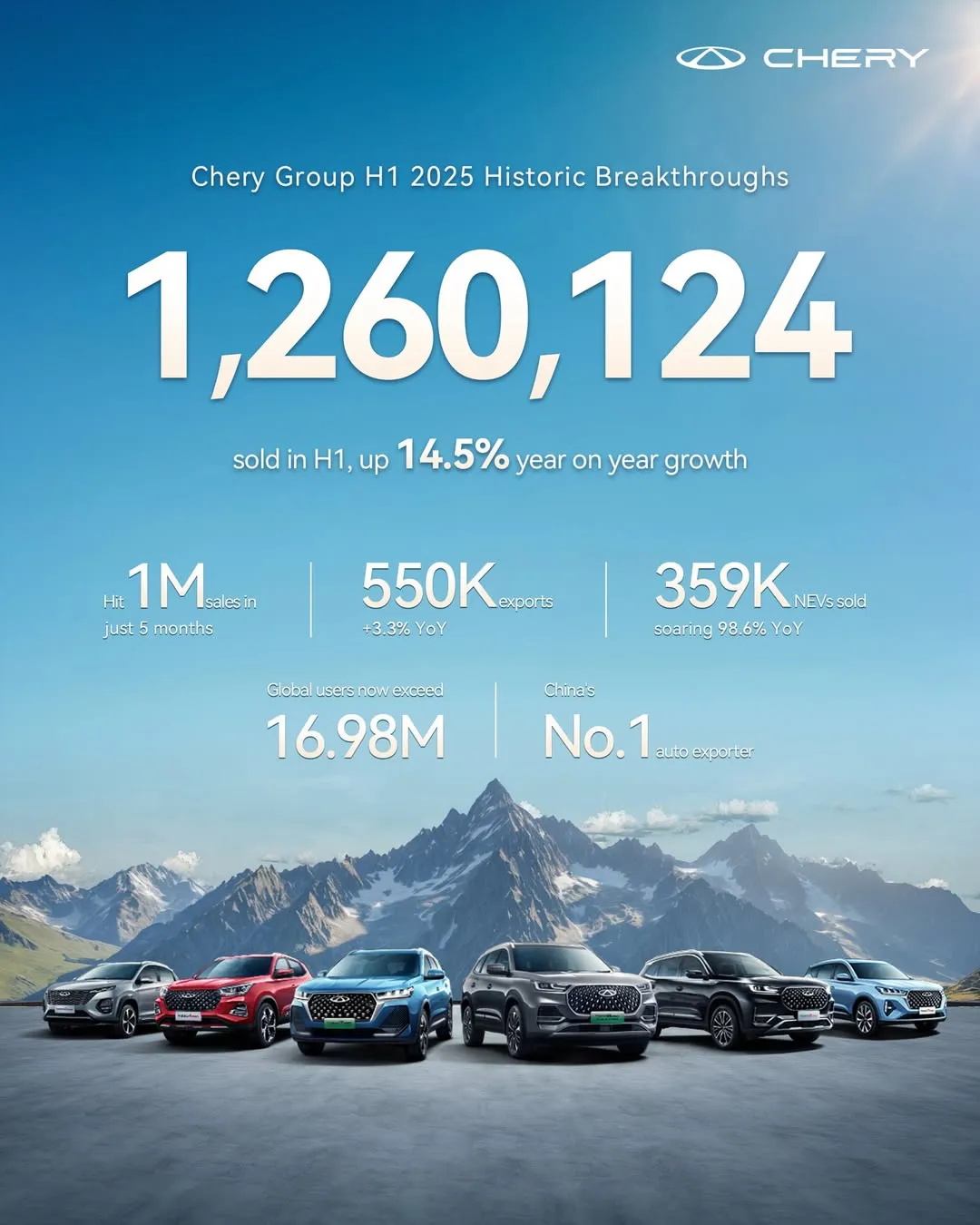
Chery isn’t just breaking records, it’s rewriting the rulebook for how a Chinese automaker can conquer global markets. For years, legacy brands in Europe and Japan have dominated the automotive narrative. But 2025 marks a pivotal shift: a homegrown Chinese brand, once considered a domestic player with limited international influence, has now exported over 1 million vehicles in just ten months. That's not a headline. That’s a paradigm shift.
From a market once perceived as export-dependent and value-driven, Chery has matured into a brand defined by precision strategy, technological confidence, and market localization. And this isn’t a fluke. The numbers back it. The direction is deliberate. This milestone is a snapshot of a much larger playbook, one that rivals should now be seriously dissecting.
Let’s dig into the bigger story behind this 1 million vehicle triumph.
The Export Milestone
Between January and October 2025, Chery Group exported 1.06 million vehicles, representing a 12.9% year-on-year increase, according to CNEV Post. This isn't just growth, it’s sustained momentum.
In October 2025 alone, Chery shipped 126,434 units abroad. That marked the sixth straight month of exporting over 100,000 vehicles. This level of consistency underscores a robust global supply chain, strong logistics partnerships, and most importantly, sustained foreign demand.
For context, many legacy automakers, especially those navigating the EV transition, are still struggling with year-on-year dips or flatlining overseas sales. Chery, by contrast, has turned the corner and is now leading the charge from the front.
Europe: The Surprising Success Story
Europe, often considered the most conservative and regulation-heavy auto market, is where Chery has arguably pulled off its most impressive feat.
From January to October 2025, Chery sold 171,147 vehicles across the EU and UK, marking a staggering 240% increase from last year. For an Asian brand , especially one with Chinese origins, this is unprecedented. The success boils down to several factors:
-
Multi-brand strategy: Chery isn’t relying on a single badge. It distributes a portfolio of brands including Omoda, Jaecoo, and the core Chery marque.
-
Targeted market entry: Rather than spreading thin, Chery has focused on high-potential markets like Spain, Italy, and the UK, customizing product lines and pricing to fit local expectations.
-
European-friendly design and tech: Whether it’s the futuristic design of the Omoda 5 or the tech-forward Jaecoo lineup, these models are speaking a design language that European consumers respond to.
In short, Chery isn't just present in Europe, it's performing in Europe. That’s a qualitative leap few Chinese brands have managed.
Nepal: The Ascent of Omoda and Jaecoo
Closer to South Asia, Chery’s efforts in Nepal are also beginning to bear fruit. With the Omoda and Jaecoo brands already gaining traction for their bold aesthetics and electric variants, the brand is tapping into Nepal’s nascent but rapidly growing EV ecosystem.
What sets Chery apart in the Nepali context is the timing and relevance of its offerings. While local consumers are gradually warming up to EVs due to rising fuel costs and government incentives, Chery is positioning itself at the sweet spot, delivering premium-looking EVs that don’t carry a luxury badge price tag.
And with the anticipated launch of iCaur, another electric sub-brand aimed at broadening Chery’s EV footprint, the brand seems poised to expand its relevance even deeper into urban Nepali households and commercial fleets alike.
The Power of a Multi-Brand Global Strategy
At the heart of Chery’s international success lies a shrewd multi-brand strategy that goes beyond traditional branding logic. Each sub-brand, from Chery (core), to Omoda (tech-savvy), to Jaecoo (urban premium), and now iCaur (EV-centric), serves a different psychographic and market profile.
Rather than force a singular identity, Chery is building a family of identities, allowing it to scale globally while maintaining local relevance.
This approach is in stark contrast to Western automakers, many of whom still struggle to adapt a monolithic brand image across diverse geographies. Chery’s decentralization, if one could call it that, is in fact a form of localization done right.
What This Means for the Global Auto Industry
Chery’s success isn’t just a win for one company, it’s a signal to the global automotive sector that Chinese brands are no longer playing catch-up. They are competing on design, safety, software, sustainability, and scale, and they’re doing it convincingly.
This 1 million export milestone isn’t just about numbers; it’s about credibility. For the skeptics, Chery’s rise is a wake-up call. For emerging markets, it’s a sign of what’s possible when innovation meets strategic clarity. And for industry watchers, it’s a case study in how globalization can be led from the East.
Conclusion
What Chery is doing in 2025 is no accident. It’s the result of years of market observation, brand refinement, and supply chain mastery. As Western automakers navigate internal restructures and regulatory bottlenecks, Chery is proving that agility, ambition, and alignment can trump legacy.
This 1.06 million vehicle milestone is not a peak, it’s a pivot point. Chery isn't just going global. It’s going glocal, adapting, scaling, and setting new benchmarks for what a modern automotive brand can look like in a multipolar world.
And if this pace continues, 2026 might just be the year when Chery doesn’t just lead Chinese exports, it leads global influence in the auto industry.
-original.webp)
-original.webp)
-original.webp)