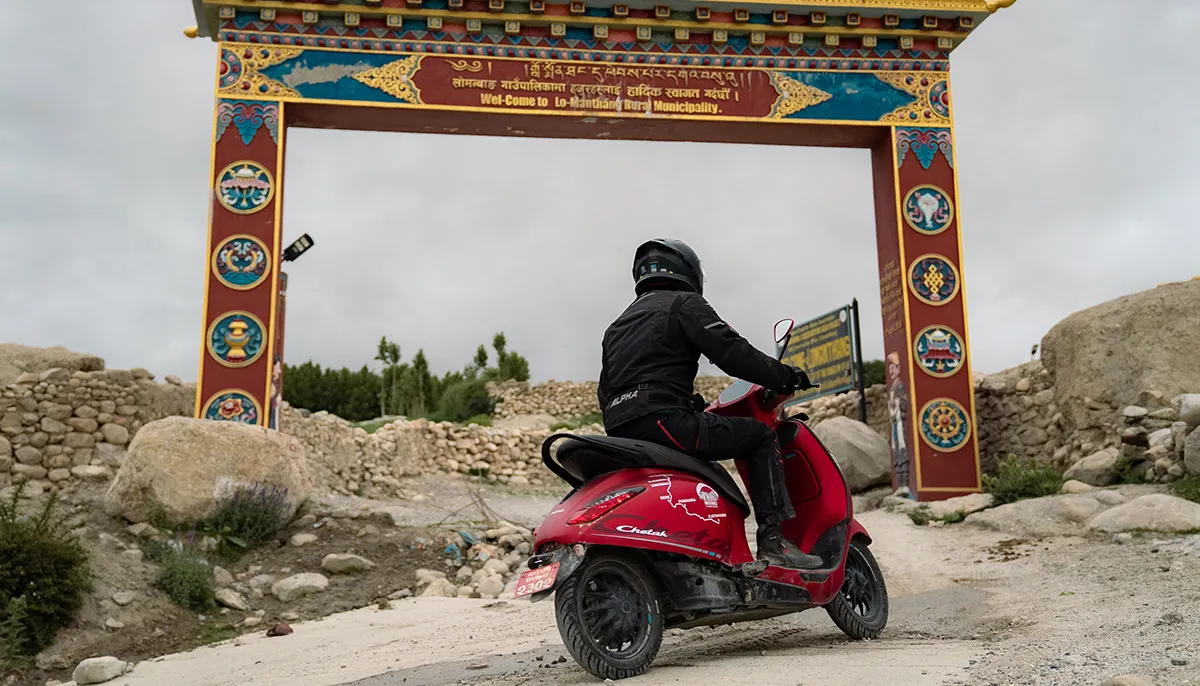
It’s not every day that an electric scooter becomes the talk of the Himalayas. But that’s exactly what happened when Dhiren Man Shrestha, a passionate EV enthusiast, rode his Bajaj Chetak 3501 from the streets of Kathmandu to the unforgiving trails of Upper Mustang, reaching all the way to Lo Manthang and the Korala Border near Tibet.
At 4,660 meters above sea level, the Korala Border isn’t just another scenic destination, it’s one of the highest drivable passes in Nepal, a location known for thin air, rocky ascents, and terrain that humbles even the hardiest combustion-powered bikes. This makes Dhiren’s journey not just inspiring but groundbreaking. It challenges the long-standing belief that EVs are only fit for urban commuting, not for rugged, multi-day explorations in high-altitude Himalayan zones.
This isn’t just a story about reaching a destination, it’s a bold statement about where the future of mobility is headed in Nepal.
Design
The Bajaj Chetak EV has always exuded a sense of neo-retro charm, with design cues that pay homage to its iconic petrol-powered predecessors while embracing the future with electric confidence. But good looks alone don’t get you to Lo Manthang.
One of the defining aspects of this journey was the sheer reliability of the Chetak’s build. The 3501 variant comes with an IP67-rated all-metal body, meaning it’s designed to withstand not just dust and debris, but also exposure to water, a critical asset when navigating through sudden rain, river crossings, and the harsh elements of Upper Mustang.
Unlike the lighter plastic-bodied competitors that might falter under rugged stress, the Chetak held its own. The solid chassis, thoughtful ergonomics, and vibration-absorbing panels ensured that even on the bumpiest tracks, rider fatigue was minimal and control remained steady.
Performance
Power delivery is where electric scooters often face skepticism, especially in regions where uphill climbs, sudden drops in temperature, and oxygen-thin air test any vehicle’s limits. But according to Dhiren’s firsthand experience, the Chetak EV delivered smooth, linear power throughout the trip.
What makes this even more impressive is the fact that electric motors tend to be highly sensitive to load, gradient, and ambient temperature. Yet, the Chetak maintained consistent torque, offering enough grunt to climb winding, steep passes, often with no power drop despite the high altitude.
This kind of performance is a result of Bajaj’s refined motor control systems and intelligent power management. While exact motor specs for the 3501 are often kept under wraps by the manufacturer, its real-world responsiveness makes it clear: this is no sluggish scooter.
Range and Charging
Perhaps the biggest worry for any EV adventurer in Nepal is range anxiety, and with good reason. Charging infrastructure in rural regions is nearly non-existent, and battery efficiency tends to drop in cold climates.
But the Chetak 3501, with its certified range of 153 km, proved up to the task. While total distance between major stops in Upper Mustang can stretch beyond this, Dhiren carefully planned his route with stopovers where power could be sourced, showing that with the right strategy, even highland routes can be EV-compatible.
More importantly, the scooter’s fast-charging capability, from 0 to 80% in just 3 hours, meant downtime was minimal. It offered flexibility, especially in regions where staying overnight is a norm due to difficult terrain.
This isn’t to say you can casually head to Korala on any electric scooter. But with the Chetak, it’s been proven: smart planning + smart tech = Himalayan success.
Features
The Bajaj Chetak 3501 isn’t just about the motor and the metal. It’s also equipped with a suite of smart features that make it genuinely user-friendly, especially for long, uncertain routes.
Geo-fencing ensures the rider gets alerts if the vehicle moves out of a predefined area, ideal for hotel stays in unfamiliar places.
Accident alerts and anti-theft protection bring peace of mind, especially when leaving the scooter parked in remote guesthouses or campsites.
Keyless access and 35 liters of under-seat storage add convenience, no need to fumble with keys or extra bags.
App integration and smart diagnostics allow riders to monitor battery health and performance stats in real-time.
These features are more than just city gimmicks, they’re practical tools that can make or break a journey in wild landscapes.
Price in Nepal
The Bajaj Chetak 3501 is currently available in Nepal for Rs. 3,24,900, a price that sits competitively in the mid-premium electric scooter segment. Given the features, range, and now, proven high-altitude capability, it offers genuine value for adventurous souls looking to cut down their carbon footprint without cutting out the thrill.
For urban users, it offers unmatched elegance and efficiency. For explorers, it now offers hope, a credible alternative to petrol-fueled motorcycles for trips that matter.
What This Means for Nepal’s EV Movement
Dhiren’s ride to Lo Manthang isn’t just a personal achievement, it’s a signal to the entire Nepali auto community. The EV conversation is no longer just about city commutes and fuel savings. It’s about possibility, performance, and pushing boundaries.
Bajaj’s Chetak 3501 has opened the door to a new kind of adventure riding, one that’s cleaner, quieter, and more sustainable. And in a country like Nepal, where the future of transportation lies delicately between tradition and innovation, this journey sets the tone for what’s to come.
Electric scooters aren’t just for the flat streets of Kathmandu anymore. They’re for the mountains. They’re for dreamers. They’re for the future.
-original.webp)


-original.webp)
-original.webp)