A Facelift That Actually Feels Like One
There is something quietly confident about the way Hyundai has gone about the Exter. When the car first launched, it arrived not with a whisper but with a very deliberate statement: that a sub-four-metre SUV could look bold, feel spacious, and still start under six lakh rupees. The market listened. More than two lakh customers across India bought into that promise. And now, Hyundai is back with the 2026 Exter facelift, not to fix what was broken, but to sharpen what was already working.
Priced from INR 5,79,900 (ex-showroom), the updated Exter brings over 25 changes across design, cabin experience, technology, and safety, a number that sounds like a marketing figure until you actually go through the list. This is not a sticker-refresh. Hyundai has genuinely rethought several aspects of the car, and the result is a more complete package that takes direct aim at what buyers in this segment are increasingly demanding: premium touches without the premium price tag.
Design
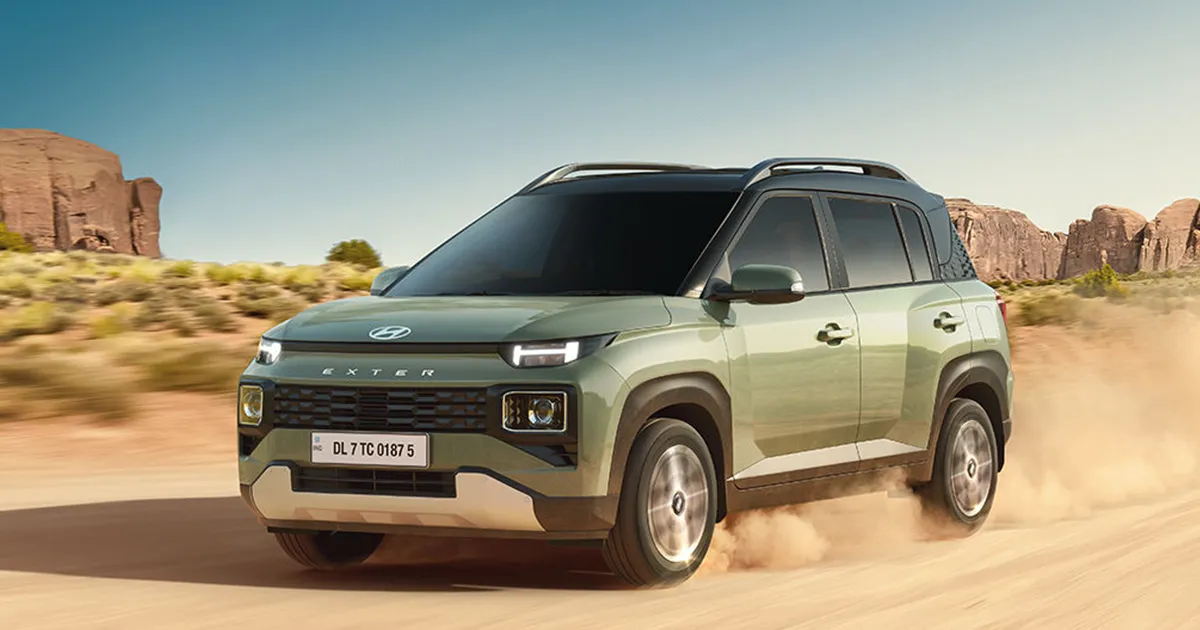
The Exter always had a distinctive face,upright, muscular, with that cubic silhouette that made it stand out in parking lots full of rounded city hatchbacks. The 2026 facelift preserves all of that while giving the car a crisper, more self-assured look. Up front, there is a redesigned centre garnish, a revised grille, and updated bumpers that give the fascia a more structured appearance. The changes are subtle enough that existing Exter fans will nod in approval, but noticeable enough that anyone on the street will realise this is the newer model.
Move around to the rear and things get sportier. A new wing-type spoiler, a revised tailgate design, and a freshened C-pillar garnish collectively give the Exter a more dynamic rear profile than before. Hyundai has also added new diamond-cut alloy wheels, which lend the car a more premium stance when viewed from the side.
On dimensions, the Exter continues to measure 3,830 mm in length, 1,723 mm in width, and 1,643 mm in height (with roof rails), riding on a 2,450 mm wheelbase. Hyundai maintains that the Exter is the tallest SUV in its segment and offers the longest wheelbase, a claim that carries real-world weight when you sit in the rear seats and realise there is genuine headroom and legroom, not just the illusion of it.
Colour choices have also expanded. The 2026 Exter comes in seven monotone options and one dual-tone combination. Two new shades, Golden Bronze and Titanium Black Matte, join existing colours including Titan Grey, Atlas White, Starry Night, Titanium Black, and Ranger Khaki. The dual-tone version pairs Ranger Khaki with a black roof for buyers who want something a little more striking. It is a thoughtful palette for a segment that has traditionally been conservative about colour.
Interior
The inside of a car is where most buyers spend the majority of their time, and Hyundai appears to have understood that deeply with this update. The 2026 Exter gets a new dual-tone Navy and Grey interior theme that feels considerably more upmarket than what came before. Combined with a 3D carbon-pattern dashboard finish and a sporty D-cut steering wheel, the cabin has shed some of its entry-level associations without the price moving dramatically.
One of the more interesting additions is the segment-first metal pedals , a detail you would typically find in a hot hatch or a performance-oriented vehicle, not a micro-SUV priced under six lakh. It is a small thing, but it speaks to how Hyundai is thinking about the Exter's buyer: young, aspirational, someone who cares about the tactile feel of a car and not just its spec sheet.
Practical comfort upgrades are equally worthwhile. A folding driver armrest is now on offer, new seat upholstery improves the look and feel of the cabin, and driver seat height adjustment is now standard across all variants, not just the higher trims. Adjustable rear headrests across all variants is another welcome standardisation. The boot capacity remains a generous 391 litres, which continues to be a strong suit for a car of this footprint.
Technology
The technology story on the 2026 Exter is where Hyundai has been most aggressive, and understandably so,connectivity is now a baseline expectation, not a differentiator. The facelift ships with wireless Android Auto and Apple CarPlay, eliminating the cable clutter that made the previous model feel slightly dated by comparison. Rear passengers also gain a Type-C USB charging port, which in 2026 is honestly the bare minimum for a car aimed at young families.
More interesting is the segment-first dashcam, a built-in camera that records while you drive. In an era of rising road incidents and insurance disputes, this is a genuinely useful addition rather than a gimmick. It is the kind of feature that buyers might not actively seek out when shopping, but will deeply appreciate the moment they actually need it.
Hyundai's Bluelink connected car platform offers over 60 features on the Exter, and the system now supports more than 300 embedded voice commands that function without an internet connection. This offline voice capability matters enormously in a country like India, where cellular connectivity can be inconsistent in smaller cities and on highways. OTA (over-the-air) updates for maps and infotainment ensure the car stays current without a trip to the dealership. Rounding out the technology package is a digital instrument cluster and an electric sunroof , the latter being a non-negotiable expectation for buyers in this segment.
Performance and Powertrain
Under the hood, Hyundai has kept what works. The 2026 Exter continues with the 1.2-litre Kappa petrol engine, available with both a manual gearbox and an AMT (automated manual transmission) option. The engine is a 4-cylinder unit, and Hyundai is quick to point out that the Exter is the only SUV in its class to offer a refined four-cylinder petrol motor. Most competitors in this space use 3-cylinder engines, which tend to be less smooth at idle and during city driving. The Kappa's character suits the Exter's urban mission well: composed, predictable, and easy to drive in traffic.
The CNG variant continues to cater to the cost-conscious buyer who needs to manage running expenses in the long term. A notable upgrade for the CNG version is the introduction of an underbody-mounted spare wheel. This frees up boot space significantly, the CNG Exter now offers approximately 225 litres of usable luggage capacity despite housing dual CNG cylinders. It is a clever engineering solution that removes one of the more persistent practical complaints about CNG variants across all segments.
Safety Features
If there is one area where the 2026 Exter facelift truly raises the bar, it is safety. The car now offers more than 45 advanced safety features, with 30 of these standards across every single variant, including the base model. In a segment that has historically treated safety as an upgrade rather than a right, this is a bold and commendable move.
The headline figure here is six airbags as standard. Not available on select trims, standard, across all variants. Alongside this, Electronic Stability Control (ESC) and Hill Start Assist (HAC) are also fitted as standard. ESC is one of those technologies that works quietly in the background and you only appreciate it when you genuinely need it , in a sudden swerve, on a slippery surface, or during an evasive manoeuvre. Mandating it on the base Exter reflects Hyundai's seriousness about occupant protection in a price band where buyers typically have to compromise on safety to afford the car at all.
This is arguably the most important story in the entire Exter facelift package. India's road safety record is a subject of ongoing national concern, and the gradual push by carmakers to democratise safety features, rather than reserve them for buyers who can afford top-spec trims, is exactly the kind of industry progress that the market needs more of.
Variants and Pricing: Something for Every Budget
Hyundai has structured the 2026 Exter lineup to cover a wide range of buyer profiles. The petrol manual variants begin at INR 5,79,900 for the entry-level HX 2 trim and extend all the way to INR 8,35,900 for the HX 8. For those who prefer the convenience of an automatic transmission in city traffic, AMT variants are priced between INR 6,90,900 and INR 9,41,900 for the top-specification HX 10 trim. CNG buyers can start at INR 6,99,900 for the HX 2 and go up to INR 9,40,900 for the HX 8. All prices are ex-showroom.
Bookings are open both at Hyundai dealerships and through online platforms, making the process straightforward for buyers who prefer to start their purchase journey digitally. The pricing strategy places the Exter in a competitive position against rivals in the micro-SUV and compact hatchback crossover space, and given the feature additions in this facelift, the value proposition looks even stronger than it did at launch.
What About Nepal? Here Is What We Know
For buyers in Nepal, the good news is that the Exter is not a stranger to the market. The pre-facelift model is already on sale through Laxmi Intercontinental, Hyundai's authorised distributor in Nepal, available in three variants, EX, S, and SX ,priced at NPR 36,96,000, NPR 42,96,000, and NPR 46,96,000 respectively. The car has found a reasonable audience among urban buyers looking for a compact SUV with genuine road presence.
India Launch Timeline
The 2026 facelift was officially launched in India on March 20, 2026. As of now, there has been no official announcement from Hyundai Nepal or Laxmi Intercontinental regarding when the updated model will arrive. That is not unusual, Nepal typically receives updated models after India, with the gap ranging anywhere between three to nine months depending on import clearances, homologation requirements, and the distributor's stock readiness.
Expected Nepal Launch Window
Given that the India launch has only just happened, a realistic window for the 2026 Exter facelift to reach Nepali showrooms would be late 2026 at the earliest. Buyers who are actively considering the Exter would do well to watch Laxmi Intercontinental's official channels for any booking announcements, or visit their nearest Hyundai dealership for the latest updates. If the original model's reception in Nepal is anything to go by, the facelift, with its stronger safety package and upgraded cabin, should generate genuine interest when it does arrive.
The Bigger Picture: What the 2026 Exter Tells Us About Hyundai
Tarun Garg, Managing Director and CEO of Hyundai Motor India, framed the updated Exter around what the company is calling a 'Drive to Shine' philosophy, refreshed styling, a more premium cabin, smarter connectivity, and an enhanced safety package working together to serve young, ambitious buyers. It is a positioning statement, yes, but also a fairly accurate description of what the car actually delivers.
The 2026 Exter facelift is not a revolution. It does not need to be. What it represents is a company that listened carefully to two lakh existing customers, understood what they wanted more of, and delivered those improvements in a measured, purposeful update. The standard safety package is the standout story, the cabin upgrades make daily use more pleasant, and the technology additions ensure the Exter does not fall behind in an increasingly connected automotive world.
If you are in the market for a sub-four-metre SUV and find yourself weighing options under ten lakh rupees, the 2026 Hyundai Exter has just made that decision considerably harder for its rivals. That is probably the most honest verdict one can offer.